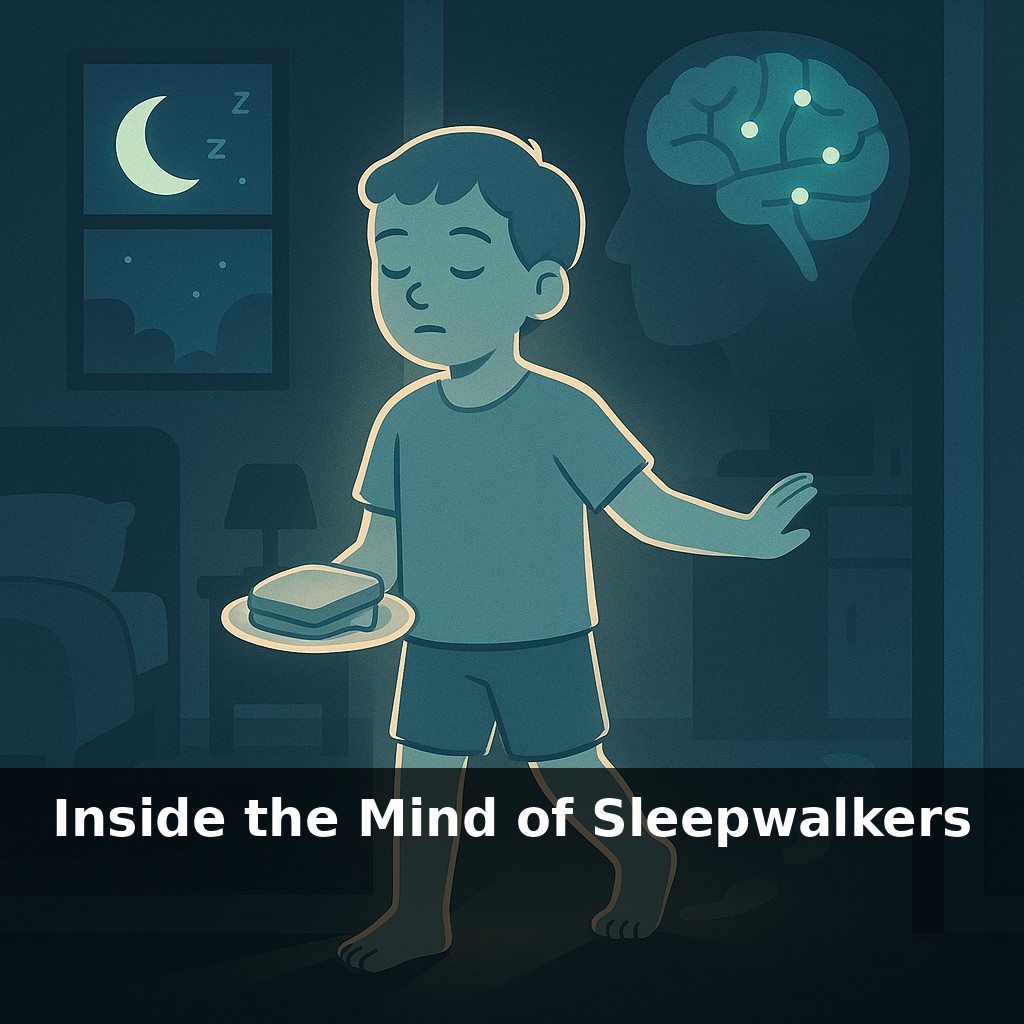
A child calmly making a sandwich with closed eyes. An adult found driving, but later remembers nothing. These aren’t movie scenes—they’re real sleepwalking reports. How does a brain that’s “asleep” manage such complex actions while the person’s awareness stays locked out?
Night-time security cameras have captured people quietly rearranging furniture, slowly eating a meal, even stepping outside to “check the mail”—all while technically asleep. To neighbors, it can look quirky or even funny; to families, it’s often unnerving. Is this a harmless glitch in the night, or a sign that something deeper is off in the brain’s sleep system?
What makes this phenomenon even more intriguing is its selectivity: one sibling might wander the hallway every week, while another in the same bedroom never does. Some people only sleepwalk during periods of intense stress, jet lag, or after a few drinks; others seem triggered by the slightest disruption to their usual bedtime rhythm. And then there’s the legal gray zone: when a sleepwalker’s actions cause harm, how responsible are they for what happened while their conscious mind was offline?
In sleep labs, researchers wire volunteers with sensors the way a sound engineer outfits a concert stage—tracking tiny shifts in brain waves, eye movements, and muscle tone through the night. Amid the usual rhythms, sleepwalkers show curious spikes of activity where quiet should be, as if parts of the brain briefly “log back in” while others stay signed out. Large twin and family studies add another layer: certain lineages seem to carry a much lower threshold for these glitches, and when stress, fever, or jet lag pile on, episodes can cluster like aftershocks following a larger quake.
Under the sensors’ quiet hum, what stands out in sleepwalkers isn’t just “partial wakefulness,” but *where* that wakefulness appears. Motor regions and circuits for routine behaviors light up first, which is why the actions people perform are so stereotyped: walking the same hallway, fiddling with door locks, opening the fridge, straightening objects, rummaging in drawers. These are the brain’s well‑rehearsed “default scripts,” the ones that normally run with almost no conscious effort.
What’s striking is how rarely something *new* happens. People don’t typically learn a fresh skill, compose an email, or solve a novel problem mid‑episode. Tasks that demand planning, moral weighing, or flexible decision‑making usually stay offline. That gap helps explain why sleepwalking episodes can look eerie: the body is capable, the behavior is purposeful, but the actions are oddly narrow—like someone scrolling through a very short menu of options.
Development adds another twist. In children, deep sleep is especially intense and fragmented, which seems to make these brief “cross‑overs” more likely. As the brain’s regulatory systems mature through adolescence, the boundaries between sleep stages sharpen; for most, episodes fade without any particular intervention. Adults who continue to sleepwalk often have a different pattern: episodes recur when something repeatedly jostles those boundaries—long shifts, new medications, chronic insomnia, or an underlying sleep disorder such as sleep apnea.
Risk isn’t evenly distributed. Some families pass down a remarkable sensitivity: grandparents, parents, and children who all report childhood wandering, night terrors, or confusional arousals. Others only discover a hidden vulnerability when a powerful trigger arrives—a traumatic event, rotating shift work, or sedative drugs that deepen certain stages of sleep while destabilizing others. In that sense, sleepwalking can function a bit like a stress‑test in finance: most systems look stable until you push them hard enough, and only then do the weakest links reveal themselves.
For clinicians, the pattern of behaviors during episodes becomes crucial. Quiet wandering in a child who occasionally sits up and mumbles calls for reassurance and safety measures. Recurrent, high‑risk behavior in an adult—trying to exit a second‑story window, attempting to drive, or becoming physically aggressive—signals a different level of concern and often prompts a detailed search for co‑factors: untreated sleep disorders, neurological conditions, or substance use that might be amplifying an existing genetic or developmental tendency.
Consider a teen who only “wanders” during exam season, but never on weekends. Another adult has episodes only on nights they take a certain painkiller—and notices things calm down when the dose is shifted earlier. These patterns matter: they hint at which levers in daily life quietly nudge the brain toward an episode and which ones pull it back.
Real‑world cases show just how specific this can be. Some people report episodes only after long‑haul flights crossing multiple time zones; others almost exclusively during the first nights in unfamiliar hotel rooms. Parents sometimes notice a child’s episodes cluster after late‑night sports practices followed by very early wake‑ups, but vanish over holidays when mornings are slower and more flexible.
One useful way to think about this is how software behaves under “stress testing”: most bugs appear only when you overload the system in a very particular way. For sleepwalkers, the “bug report” often lies in those repeating circumstances that precede an episode.
Courts and clinics are slowly catching up. Instead of relying on blurry memories and character testimony, they’re turning to hard data: synchronized video, motion sensors, even home EEG headbands. Think of it as a “black box recorder” for a night in bed, capturing what actually happened when no one was supposed to be awake. As these tools improve, they won’t just reconstruct sleep‑crimes—they may help prevent the riskiest nights before they begin.
The next frontier is figuring out *why* some nights stay quiet while others unravel. Researchers are probing hormones, gut signals, even body temperature swings that might tip the balance. Your challenge this week: note bedtime, last meal, and room temperature nightly—then see if your “data trail” hints at patterns your memory misses.