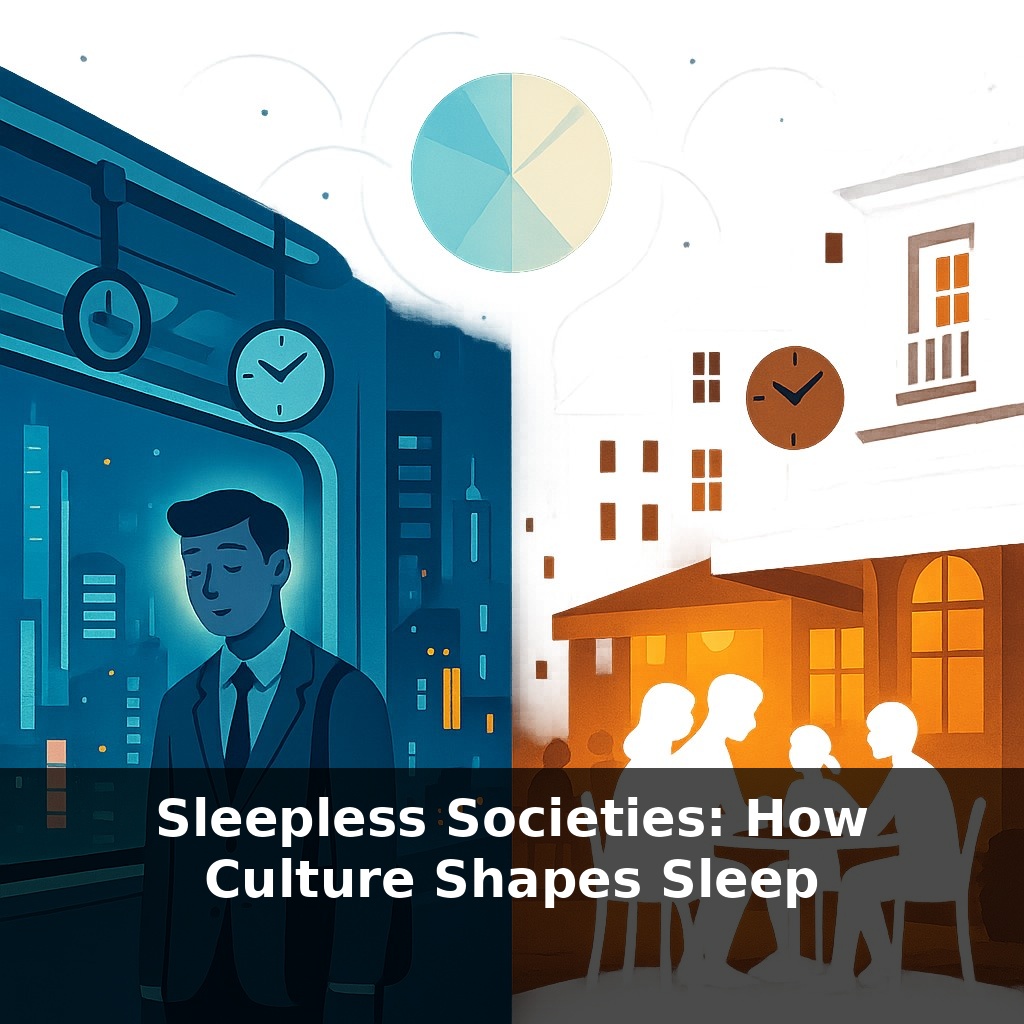
Some people in Tokyo are napping upright on crowded trains, while families in Madrid are just sitting down to dinner near midnight. Same species, same basic sleep needs—yet our clocks, rituals, and cities pull our nights in radically different directions. Why?
In this episode, we’re stepping back from bedrooms and alarm clocks and looking at the larger stage: the society your sleep is performing on. The hours you think of as “normal” are less a personal choice and more a social script you were handed long before you set your first alarm. Office start times, school schedules, prayer calls, late‑night sports broadcasts, even food delivery hours quietly tug at your bedtime like invisible strings. Some cultures stretch the night to fit long dinners and socializing; others slice sleep into smaller chunks around shift work and commutes. Over time, these shared habits become so familiar that cutting your sleep short can feel responsible, even admirable. We’ll explore how that script got written—and how much freedom you really have to edit your role.
Zoom out one more step and the pattern gets clearer: entire nations run on different “sleep settings.” In Japan, dozing in public can signal dedication, not laziness. In parts of Southern Europe, late dinners push bedtimes, while in many Muslim‑majority countries, nightly routines flex around Ramadan. Technology layers on its own demands—24‑hour customer support, global video calls, streaming releases dropping at midnight. Policies, not just preferences, steer this too: school start times, shift‑work rules, transit hours. Together, they can either quietly protect your rest or steadily erode it, night after night.
Across countries, the “script” for a typical night can differ by hours, even when people wake at similar times. Large time‑zone offsets play a role. Spain shares the same clock as Central Europe but sits farther west, so the sun sets later; workdays, meals, and TV all drift deep into the evening. By the time prime‑time shows end near midnight, many Spaniards have already traded almost an hour of potential sleep compared with the EU average. That lost hour isn’t just personal preference—it’s baked into broadcast schedules, restaurant hours, and social life.
In Japan, the pressure runs in the opposite direction: toward compression. Long commutes, dense urban living, and demanding work norms squeeze nights from all sides. The OECD’s finding that Japanese adults average just over six hours of sleep fits a larger pattern: in the Science Advances actigraphy study, both Japan and Singapore ranked at the very bottom for nightly duration. When office culture rewards staying late and socializing after work, going home “early” to sleep can feel antisocial or disloyal.
Contrast that with the Netherlands, which topped that same study at a bit over eight hours. It’s not that Dutch brains need more sleep; policies and expectations simply leave more room for it. Shorter average commutes, strong norms around work–life boundaries, and earlier evening routines make it easier to protect a full night. In practice, those extra minutes accumulate into a very different experience of daytime alertness and mood.
Economies that never fully shut down intensify this squeeze. Round‑the‑clock logistics, global markets, and 24/7 customer support scatter work across the clock. Someone, somewhere, is always on the night shift or staying up for a meeting in another time zone. The WHO’s estimate of 300 million lost workdays each year from sleep‑related productivity decline reflects not just tired individuals but entire systems that treat sleep as a leftover, not a requirement.
Your own nights sit at the intersection of these forces. Local school bells, store hours, worship times, sports schedules, and delivery cutoffs quietly sort people into patterns: some clusters get socially supported eight‑hour nights; others learn to “make do” with much less, even when their biology protests.
In Silicon Valley, product teams obsess over “user journeys”: the exact path someone takes through an app, step by step. If you mapped your night the same way, you’d see how culture populates each screen. A U.S. sports fan may stay up for a west‑coast game that ends at midnight. A Korean drama fan in Europe waits for new episodes timed to Asian audiences. A call‑center worker in Nairobi adjusts to clients in London and New York. None of these choices look extreme in isolation—taken together, they become a silent architecture of fatigue.
Notice how even “optional” events create hard edges. A weekly 7 a.m. meeting pins the morning; a popular bar’s happy hour pins the evening. Over time, work, social life, and entertainment close in like calendar invites you never consciously accepted. Just as a recipe dictates how the same ingredients produce different dishes, the same 24 hours can be “cooked” into radically different sleep outcomes, depending on whose timetable you’re orbiting and which invitations you feel free to decline.
If societies start treating sleep like clean water—something infrastructures must protect—you may see quieter nights written into building codes, staggered school starts, or transit designed around healthier rest. Remote teams could rotate meeting times like sharing chores, rather than defaulting to one “sacrificial” time zone. Your phone might flag “social jet lag risk” before you accept a late event, nudging communities to redesign norms so rest is a shared asset, not a private struggle.
Treat this less like a solo battle and more like a group project: small, visible choices can shift expectations—ending gatherings earlier, backing colleagues who decline late calls, praising well‑rested performance. Your challenge this week: notice one “normal” late‑night custom you follow, and quietly test a different script once. Watch who follows your lead.