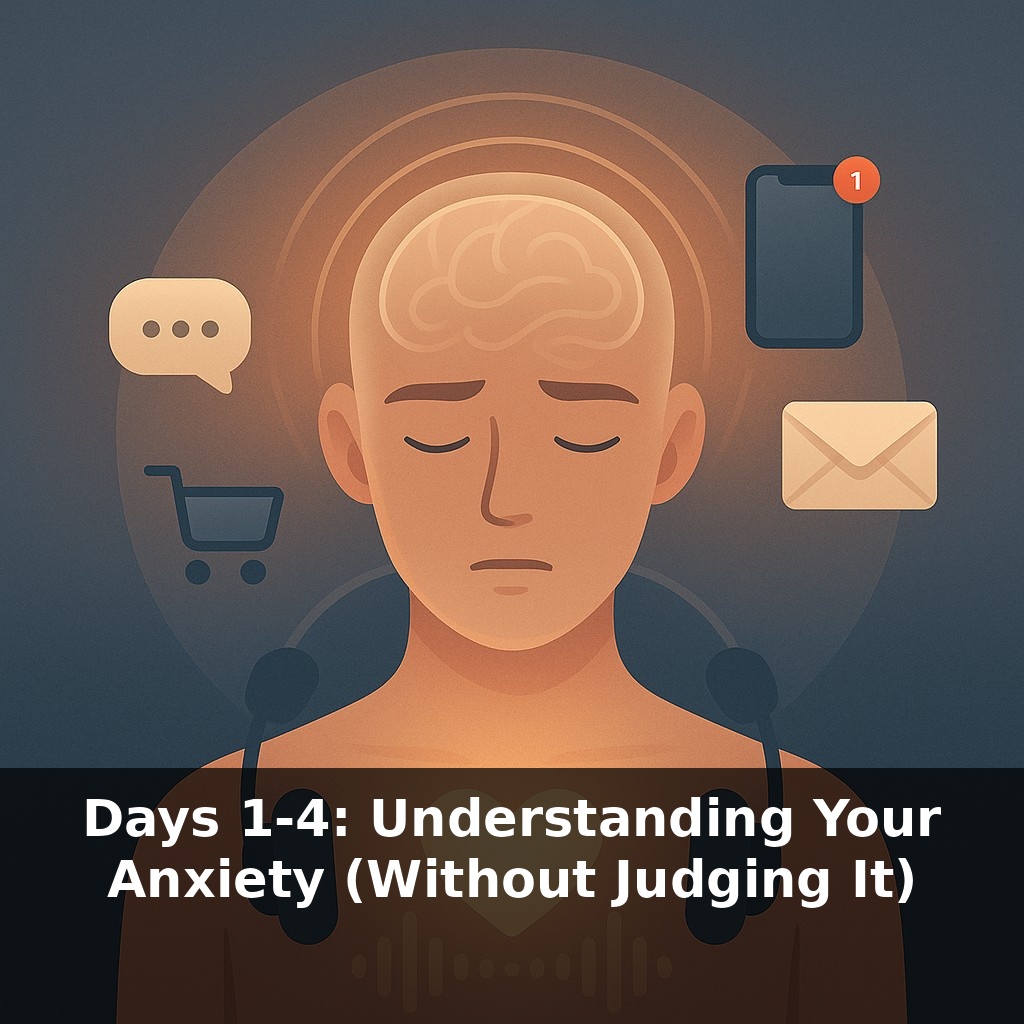
Days 1-4: Understanding Your Anxiety (Without Judging It)
📝 Transcript
Right now, as you listen, your brain is quietly scanning for danger—just like it does when you’re sound asleep. The paradox is this: the same system that kept your ancestors alive might be what’s making your inbox, your group chats, or that one unread text feel life‑or‑death.
Anxiety shows up in thousands of tiny ways: a tight jaw in the checkout line, scrolling your phone instead of replying to a simple message, saying “I’m just tired” when your chest has felt heavy all day. Most people treat these moments like glitches to be hidden or powered through, not messages to be listened to. Yet those “small” signals are often the earliest, most accurate data you have about what’s overwhelming you, where your boundaries are thin, and what actually matters to you. The goal for these first four days isn’t to “fix” anything; it’s to become a curious observer of your own patterns. Think of it like learning the taste of a dish you’ve eaten your whole life but never really noticed—suddenly you start to distinguish the spices, the heat, the subtle aftertaste.
Most of us only notice anxiety when it’s blaring—racing thoughts at 3 a.m., a sudden urge to cancel plans, a pounding heart before a meeting. But long before that, it leaves quieter footprints: the way your shoulders inch up during certain conversations, how your breathing changes when your phone lights up with a specific name, the topics you avoid the way you’d sidestep a puddle in nice shoes. Days 1–4 are about catching these early, subtle shifts. Not to grade or fix them, but to map them—like marking landmarks on a new city map so you can eventually choose your routes instead of feeling dragged by them.
When people talk about “having anxiety,” it can sound like a single, vague cloud hanging over everything. Biologically and psychologically, though, it’s more like a set of dials and switches that get turned up or flipped on under certain conditions. Some of those dials are built in: research suggests a 30–40% genetic contribution, meaning your nervous system might simply come with a more sensitive baseline. That’s not destiny; it just means your system reacts more quickly or more intensely, the way some people naturally have lighter sleep.
Other dials are learned. If you grew up around unpredictable anger, criticism, or instability, your body may have learned that being hyper‑alert is safer than relaxing. So now, a neutral email from a supervisor, a delayed reply from a friend, or even a new physical sensation in your body can ping that old wiring. These are “internal” triggers—memories, expectations, mental pictures—not just obvious external events like deadlines or arguments.
Current stressors layer on top: money pressure, caregiving, health scares, world events. You don’t need a dramatic trauma for your system to start running hot; sometimes it’s the cumulative effect of never quite getting a full exhale.
Here’s where non‑judgmental noticing matters. When you label what’s happening—“tightness in chest,” “thought: I’m going to mess this up,” “urge to cancel”—you’re not being dramatic; you’re recruiting the part of your brain that can name, organize, and choose. Studies using brain scans show that simply putting words to an emotion can decrease activity in the threat center and increase activity in regions linked to reflection and regulation. In practice, that might look less like “I’m freaking out, what’s wrong with me?” and more like “My stomach just dropped when I saw that name on my phone. Something about this feels unsafe to my system.”
This shift from self‑attack to description is the core skill of these first days. You’re collecting data points, not building a case against yourself. Moderate anxiety can even be useful—there’s solid evidence that a certain level of arousal sharpens focus and performance—so the goal isn’t zero anxiety. It’s distinguishing between useful signal and unhelpful static, and noticing how both show up in your body, thoughts, and behavior before they snowball.
Think of these days as quietly running “experiments” on yourself, not to prove a theory, but to see what consistently shows up. For instance, you might notice that your jaw clenches only when money comes up, but your stomach flips when you’re around a certain colleague. Those aren’t random quirks; they’re like color‑coded sticky notes your nervous system is leaving on specific situations. One might be hinting, “You don’t feel fully safe talking about needs,” another, “You’re bracing for criticism.”
Use tiny, concrete moments: the pause before you open a message, the way you over‑edit a simple reply, how you suddenly become “too busy” to go somewhere you said you wanted to be. Each of these is a clue about what you most fear—rejection, conflict, losing control, being seen as incompetent. You’re not trying to argue with these fears yet. You’re just getting precise enough to say, “Oh, this is the flavor of worry that shows up here,” instead of, “I’m just like this.”
301 million people currently live with an anxiety disorder—yet most wait nearly a decade to get help. These first four days are about shortening that gap by becoming an early‑warning system for yourself, not a judge.
You’re training a quiet skill: catching your own “check‑engine light” without slamming the hood on it.
When you name what’s happening—“heart racing,” “thought: I’m going to fail,” “urge to bolt from this meeting”—you’re literally shifting which brain regions are driving. That simple act of labeling recruits more reflective circuits and dials down raw threat reactivity. You’re not fixing anything yet; you’re learning the controls.
Over the next days, you’ll practice three evidence‑based tools for this non‑judgmental awareness: - brief, structured journaling about triggers - mindfulness of body sensations - cognitive labeling of thoughts and urges
The point isn’t to stop anxiety; it’s to spot its specific “flavors” in your life so later tools can actually fit you.
Your challenge this week: For the next 4 days, run a small “field study” on your own anxiety.
1) Set 3 alarms each day (e.g., morning, afternoon, evening). When they go off, pause for 60 seconds and note: - 1 body signal (e.g., chest tight, jaw tense, shoulders up) - 1 thought or mental image - 1 urge (hide, check phone, over‑prepare, etc.)
2) Once per day, pick ONE moment that felt even mildly tense. Write 3–5 lines: - What happened, in neutral language - What you felt in your body - The main worry in one sentence, starting with “My brain is telling me…”
3) End each entry with this exact sentence: - “Not good, not bad—just data.”
After 4 days, skim your notes. You’re only looking for repeats: the same body signal, the same kind of worry, the same urge. That’s your personal pattern starting to come into focus.
Future‑you, possibly with the help of a therapist, app, or supportive friend, can use these early notes the way a chef uses recipe cards—refining ingredients instead of guessing from scratch. As wearables and AI learn to mirror this kind of gentle noticing, your own practice now becomes the “training data” for a more responsive, compassionate mental‑health toolkit later.
As your notes grow, you’re building a kind of weather report for your inner world—seeing which conditions tend to bring storms and which allow clearer skies. No forecast is perfect, but even a rough one lets you grab an umbrella earlier. Keep treating each entry as a small forecast update, not a verdict. You’re learning the climate, not blaming the clouds.
Before next week, ask yourself: 1) “The next time I feel that familiar spike of anxiety in my chest or stomach, what exactly is happening around me in the 60 seconds before it shows up—who am I with, what am I doing, and what am I saying to myself in my head?” 2) “If I pressed pause on judging my anxiety as ‘bad’ or ‘too much’ for just one moment, what might it be trying to protect me from or warn me about in this specific situation?” 3) “When my anxiety shows up tomorrow, what is one tiny, kind response I can practice in real time—like putting my hand on my heart, taking three slower breaths, or silently saying ‘I see you, you’re allowed to be here’—and how does that change the intensity of what I’m feeling?”
From this course
30 Days to Less Anxiety
8 episodesUnlock all episodes
Full access to 8 episodes and everything on OwlUp.
Subscribe — $1.99/monthLess than a coffee ☕ · Cancel anytime