Right now, there’s a good chance your mind is somewhere else. Research shows we spend almost half our waking life lost in thought—and we’re usually less happy when we do. A small argument, a work email, one awkward comment… then your brain won’t stop replaying it.
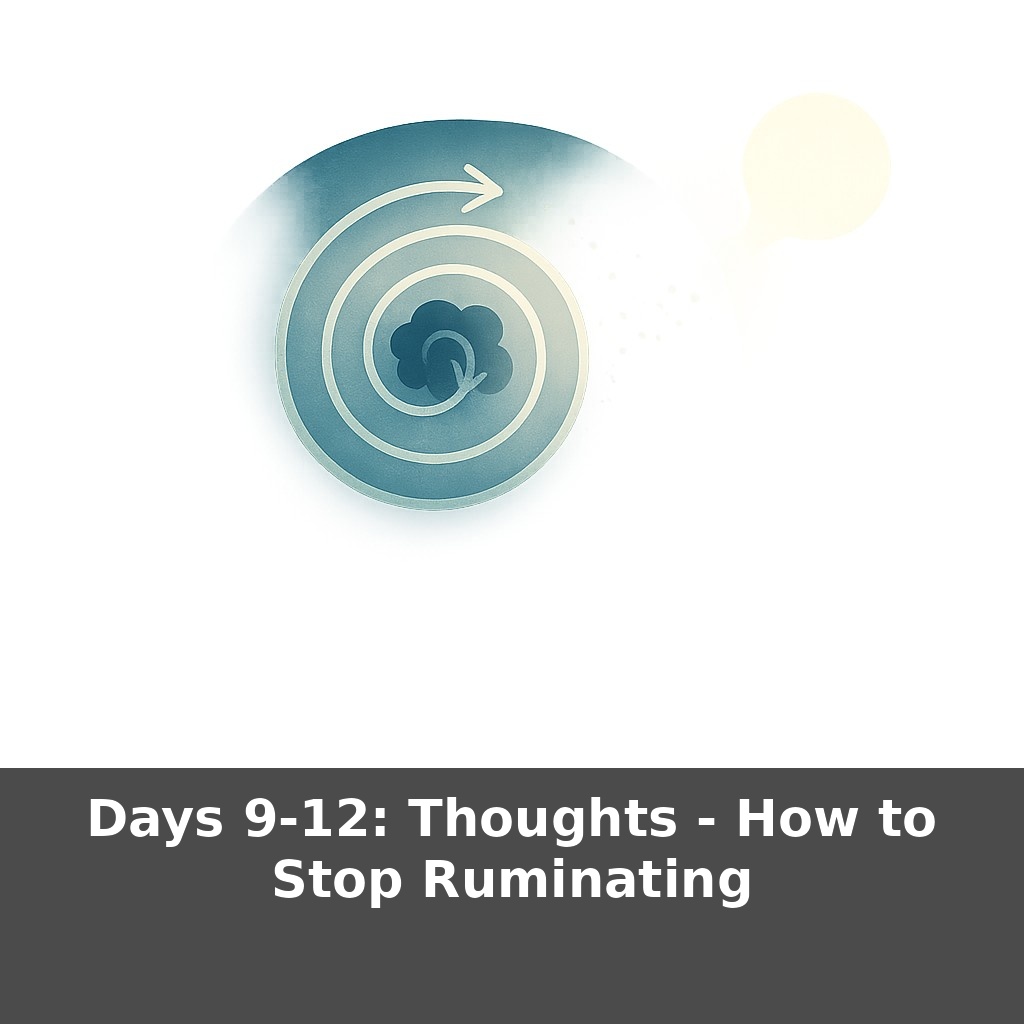
Rumination takes that everyday mental replay and turns it into something heavier: the same painful clip running again and again, without resolution. It feels like “thinking it through,” but the evidence says otherwise. When you’re stuck reviewing an argument from three days ago, or predicting disaster before a meeting that’s 48 hours away, you’re not solving—you’re looping.
On brain scans, this loop is tied to an overactive Default Mode Network, the system that lights up when you’re turned inward. Left unchecked, it can drag your mood down and keep it there. That’s why people who ruminate a lot are far more likely to slip into full-blown depression, and more likely to relapse even after they recover.
The good news: you can train your brain out of this pattern. Starting today, we’ll use simple, science-based tools to interrupt the loop and steer your attention back under your control.
And here’s the trap: rumination feels useful. You tell yourself you’re “just analyzing” or “trying to understand what happened.” But check the scoreboard. After 20 minutes, 40 minutes, even 90 minutes of replaying that meeting or conversation, how often do you have a clear decision, a next step, or a plan written down? For most people, fewer than 1 in 10 rumination episodes produce anything concrete—only more self‑criticism, anxiety, or fatigue.
Over the next few days, you’ll learn to spot that shift: from brief reflection that leads to an action, to mental spinning that just deepens the groove.
When you’re stuck in that loop, it feels like the only option is to “think it through harder.” In reality, you have three very different levers you can pull: how you relate to the thought, what you pay attention to, and what your body is doing in that moment.
First, how you relate to the thought. In CBT this is called cognitive restructuring. Instead of asking, “Why did I mess that up?” (which usually creates 20 more self‑attacks), you practice asking more useful questions. For example:
- Rumination thought: “I blew that presentation. Everyone thinks I’m incompetent.” - Restructured version: “What’s the actual evidence? Out of 12 slides, which 1–2 went poorly, and what would I change next time?”
This tiny shift—from global judgment to specific, factual review—matters. Global judgments keep the loop running; concrete details open the door to a plan. Aim for numbers: “I interrupted my colleague 3 times” is something you can work with; “I’m the worst” is not.
Second, what you pay attention to. When researchers train participants to deliberately move their focus, even for 30–60 seconds at a time, rumination drops. This is attention‑training, not “thinking positive.” You might decide: “For the next 30 seconds, I will place 100% of my attention on the feeling of my feet in my shoes.” When (not if) the thought pops back, you notice, label it “ruminating,” and return to the chosen target. Ten reps of this is like 10 reps at the gym: small on its own, powerful when repeated daily.
Third, what your body is doing. When you’re looping, your breathing is often shallow and fast, which quietly tells your nervous system there’s a threat. Two minutes of slow diaphragmatic breathing—about 6 breaths per minute, with the exhale slightly longer than the inhale—can start to flip that signal. If you count, that’s roughly 12 full breaths. During those 12 breaths, you’re not arguing with the thought; you’re changing the state that keeps feeding it.
Think of it like a doctor adjusting three dials on a monitor: thoughts, attention, physiology. You don’t have to crank them to the maximum. A 10–15% shift on each can be enough to interrupt today’s episode and make tomorrow’s less sticky.
Here’s how this looks in real life.
Example 1 – Thought dial: You catch, “I always say the wrong thing.” Instead of wrestling with it for 30 minutes, you grab a pen and give yourself 3 minutes to list exactly 3 recent conversations. For each, you write 1 sentence: what went fine, what felt off, and 1 concrete tweak for next time. When the timer ends, you stop. You’ve turned a foggy attack into 9 clear data points and 3 tiny experiments.
Example 2 – Attention dial: Set a 1‑minute timer. For the first 30 seconds, place all your attention on sounds: count at least 5 distinct noises. For the next 30 seconds, switch to your sense of touch: notice 5 contact points (chair, clothes, air on skin). That’s 60 seconds where you practiced moving attention on purpose, instead of letting it be dragged.
Example 3 – Body dial: Choose one daily “trigger moment” (opening email, lying in bed, waiting in line). Each time, do exactly 10 slow breaths, exhale slightly longer, eyes open or closed. No debate with thoughts—just 10 reps.
Anti-rumination skills will likely become routine “mental safety gear.” Within 5–10 years, you may complete a 3–minute DMN‑calming drill before high‑stakes tasks as routinely as you wash your hands. Expect companies to bake 60‑second attention‑shifting breaks into meeting agendas and schools to teach 2–breath resets between classes. Your best move now: pick 1 setting (commute, email, bedtime) and run a 14‑day experiment practicing a 10‑breath reset there, every single time.
Over the next 24 hours, notice 3 rumination “hotspots” (for many people: bedtime, shower, commute). For each one, pre‑decide a response: 1 go‑to question, 1 attention target, 1 breathing pattern. Write them on your phone. By tomorrow night you’ll have 3 tiny protocols. Repeat them for 7 days and you’re no longer “stuck”—you’re running a plan.
Try this experiment: For the next 24 hours, every time you notice yourself replaying a past conversation or worrying about a “what if,” say out loud, “That’s a thought, not a fact,” and then set a 2‑minute timer to deliberately ruminate as hard as you can. During those 2 minutes, exaggerate the rumination to the point of absurdity—make the scenario so over‑the‑top that it starts to feel cartoonish. When the timer ends, stand up, touch three objects in the room while naming them, and then rate from 1–10 how intense the rumination feels now compared to before the timer. At the end of the day, quickly note which types of thoughts lost their power the most when you forced them into this “scheduled, exaggerated rumination” box.