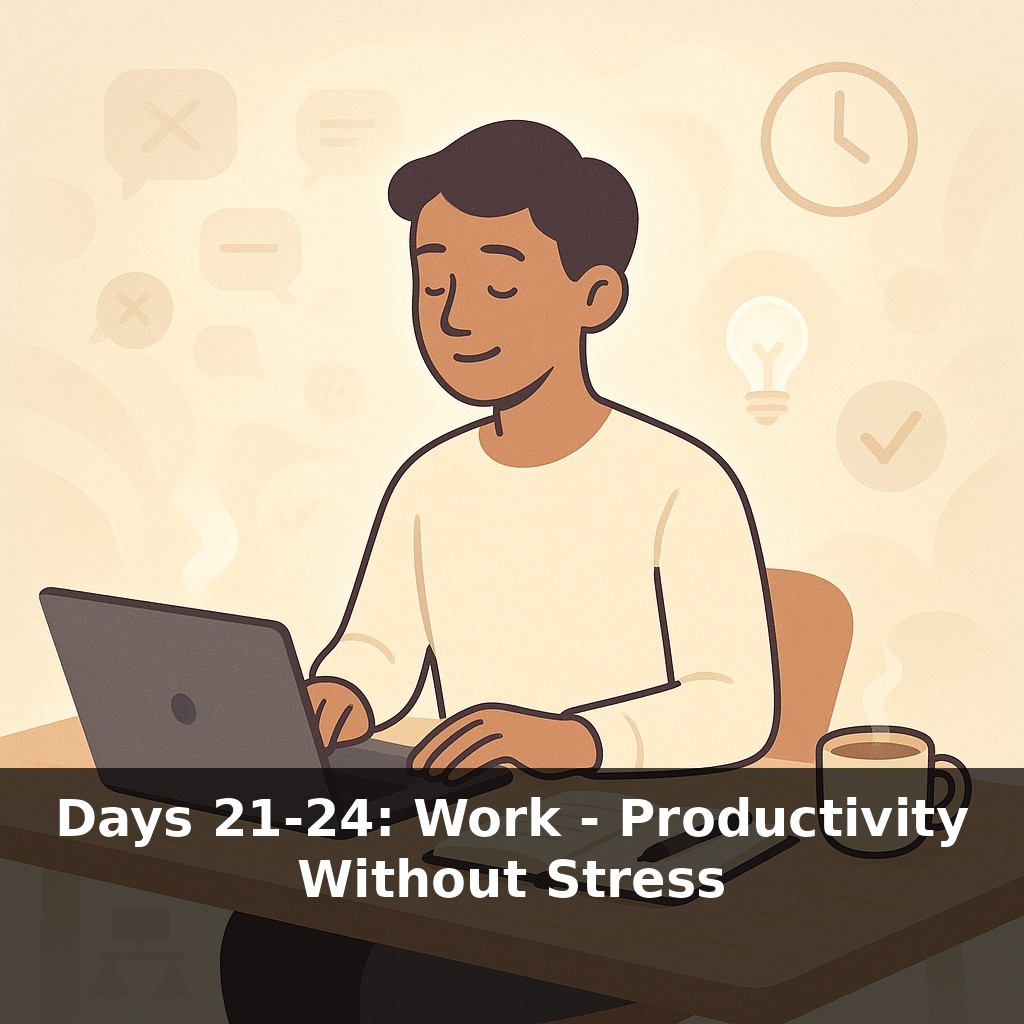
Right now, most people are working harder than ever—and still feeling behind. One moment you’re deep in a project, the next you’re checking a “quick” message that steals your focus. If being productive is exhausting, how can doing less sometimes produce better work?
Stress-related absenteeism costs businesses hundreds of billions each year—not because people are lazy, but because their workdays are designed like obstacle courses. Constant pings, shifting deadlines, and “quick questions” quietly tax your brain until even simple tasks feel uphill. This isn’t just unpleasant; over time it reshapes your nervous system toward threat mode, where every email feels urgent and your body never fully powers down.
Over the next few days, we’ll treat your workday less like a to‑do list and more like a system you can redesign. We’ll look at how to structure tasks so your brain can actually complete them, how to draw boundaries without starting a war with your inbox, and how micro‑recovery—small, targeted breaks—can stabilise your mood and energy. The goal isn’t perfection. It’s to create a work rhythm where you can be effective without your stress response running the show.
Most workplaces quietly reward the person who looks busiest, not the one whose brain is working smartest. That’s a problem, because your brain has limits as real as your phone’s battery. It can’t run every app at once, all day, and still perform well tomorrow. Research shows that switching tasks and contexts hundreds of times a day drains mental energy far more than sustained, intentional effort. Over the next few days, we’ll zoom in on three levers you do control: how you shape tasks, how you protect your time and attention, and how you design your environment so it refuels you instead of wearing you down.
Stress at work isn’t just “too much to do.” It’s often a mismatch between how your brain works and how your day is structured.
Cognitive science shows your attention behaves less like a spotlight you control and more like a muscle that tires, recovers, and has a limited “power zone.” Most people’s sharpest thinking happens in 2–4 blocks of 60–90 minutes across the day. When your hardest work is scattered between meetings, notifications, and “just checking,” you’re using those blocks on fragments instead of progress.
One practical shift: design tasks to be “winnable.” Vague items like “Work on report” keep your brain in low‑grade uncertainty. Concrete verbs plus clear end‑points—“Draft 3 bullet points for section 2,” “Email Alex 2 options for timeline”—give your mind something it can actually complete. Completion is not just organisational; it triggers a small reward response that restores a bit of drive for the next step.
Prioritisation matters just as much. Your brain cannot treat ten items as equally important without stress. A simple rule: identify the 1–2 tasks that, if finished today, would genuinely move things forward—and protect those first. Everything else is optional until those are done. This isn’t about being rigid; it’s about giving your nervous system a stable anchor in a shifting day.
Boundaries are the second pillar. Temporal boundaries (when you start, pause, and stop), digital boundaries (when tools are allowed to talk to you), and interpersonal boundaries (how quickly you respond) all quietly teach your brain what is “urgent.” If every channel can interrupt you at any time, your body learns to stay braced for impact. Deciding in advance when you’ll be reachable, and through which channels, reduces that constant low‑level alarm.
Finally, your environment can either amplify stress or buffer it. Lighting, noise, posture, and even the position of your screen influence how tense your body feels. Slight tweaks—like a consistent workspace for focused tasks, a different spot for calls, and brief movement between them—signal “mode changes” to your brain. Over time, these design choices add up to working with your biology instead of against it.
On paper, two people can have the same job, tools, and calendar—but tiny design choices in their day send them down completely different paths. One manager blocks a 45‑minute “quiet window” after lunch, turns off pop‑up notifications, and stands by a simple rule with her team: urgent = phone call, everything else = batch emails. Another keeps every channel open “just in case,” answers within minutes, and squeezes real work into the gaps. By Friday, both are equally “busy,” but only one feels clear‑headed instead of frayed.
Research from companies that trialled shorter weeks or meeting‑free afternoons found something striking: people didn’t just cram more into less time; they dropped low‑value tasks almost automatically. Limits acted like a filter. That same principle applies personally. When you pre‑decide a latest “stop time” at the end of the day, you often discover which tasks were never worth the late‑night effort in the first place—without anyone formally telling you to do less.
Teams that redesign work this way often notice side effects they didn’t plan for. Meetings shrink because people show up prepared. Status updates move into shared dashboards, freeing live time for decisions, not recaps. Hiring shifts: roles are shaped around thinking time, not “instant responsiveness.” Career paths may reward “boundary leadership”—people who protect clarity for others, not just themselves. Over time, this can turn a burnt‑out culture into one that quietly sustains bold work.
You don’t have to overhaul everything at once; even tiny redesigns can ripple outward. Treat this phase like adjusting a recipe: change one ingredient, taste, then tweak again. As you notice which boundaries and break patterns leave you calmer by day’s end, you’re quietly drafting your own user manual—and proving that “high-performing” and “well” can coexist.
Try this experiment: Tomorrow, work in three 45-minute “no-stress focus blocks” where you only do pre-decided tasks and are not allowed to add anything new to your to‑do list during those blocks. Before you start the day, circle just three existing tasks that matter most and commit to doing only those in your focus blocks, letting everything else wait. Every time you feel the urge to switch tasks, bargain, or check something “quickly,” jot a tiny mark on a sticky note instead of acting on it, then go back to the task. At the end of the day, compare how many marks you made with how much of those three tasks you actually finished, and notice whether your body feels more or less tense than on a usual workday.