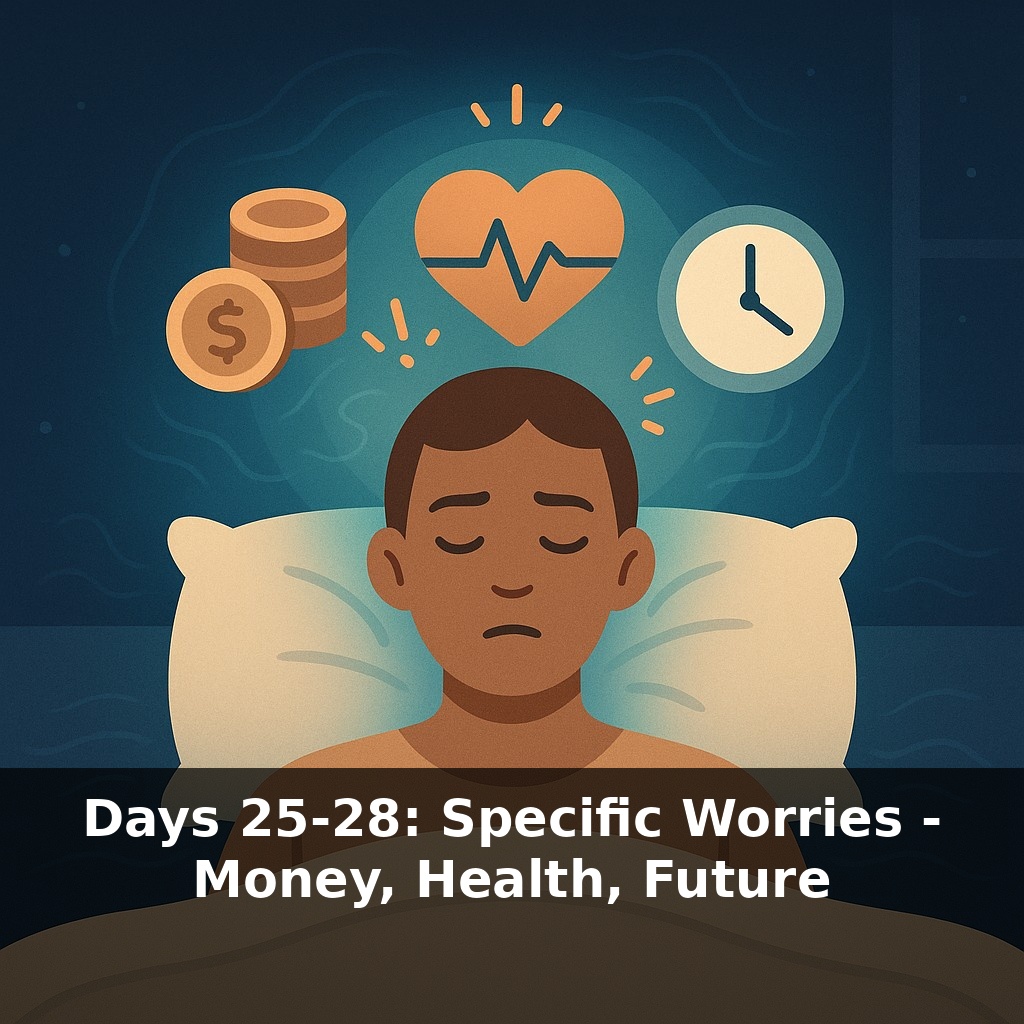
About half of people with constant money worries also struggle to sleep—but it’s usually not the numbers in their bank account keeping them up. It’s mental “what if” scenarios. You’re paying bills, scrolling health headlines, picturing the future… and your brain won’t hit pause.
Money, health, and “what will my life look like in 10 years?” might seem like three totally different problems—but in your brain, they often ring the same alarm. One bad headline, one unexpected bill, one weird symptom, and your mind can launch into a late-night strategy meeting you never scheduled. It’s not just about fear of losing what you have; it’s also about fearing you’ll never have enough safety, time, or control.
Here’s the twist: research shows these worries run on a shared circuit in your brain, which means calming one type can often soften the others. That’s why tools like reframing, mindfulness, and structured planning don’t just help “in general”—they can directly quiet money fear, health fear, and future fear together.
Over the next few days, we’ll zoom in on each: your wallet, your body, and your future story—and train your brain to respond instead of react.
So today, instead of zooming out, we’re zooming in. We’ll take those big, foggy categories—money, health, the future—and start turning them into specific, workable problems. Think of it like opening your banking app, not to obsess over the total, but to see which single transaction needs attention first. Research shows that when vague dread becomes concrete, your brain’s alarm system eases up and your planning circuits switch on. Across these days, we’ll map your main worries, sort signal from noise, and test small experiments so your life—not your fear—starts setting the agenda.
Look closely at your worries about money, health, or the future and you’ll notice something: they almost never arrive as neutral facts. They show up as stories. “I’m going to end up broke.” “This symptom means something terrible.” “I’m falling behind and it’s too late.” The details differ, but the script is strikingly repetitive.
Research on generalized anxiety finds that what keeps the amygdala–prefrontal loop overactive isn’t just how *much* you worry, but the *style* of your worrying. Three styles, in particular, drive money, health, and future fears:
First, *catastrophic forecasting*: jumping straight from “bill I didn’t expect” to “lifelong financial disaster,” or from “twinge in my chest” to “serious illness.” The brain skips all middle chapters and lands on the worst possible ending.
Second, *intolerance of uncertainty*: the sense that unless you know *exactly* what will happen with your job, your body, or the economy, you can’t relax. Studies show that this intolerance—not the actual risk level—strongly predicts anxiety severity.
Third, *safety-seeking loops*: behaviours that temporarily lower fear but keep the circuit wired tight. Refreshing your banking app every hour, googling symptoms late at night, asking for repeated reassurance about your career path. Each check settles you for a moment, then teaches your brain, “I *must* do this to feel okay,” so the urge grows.
Money, health, and future worries each have their own “flavour” of these patterns:
- With money, people overestimate permanent damage from temporary setbacks and underestimate their ability to adjust spending, earn differently, or seek support. - With health, frequent checking and reassurance give short relief; however, data show they rarely change long-term outcomes. - With the future, ruminating on “what if I choose wrong?” often delays *any* choice, which ironically makes the feared scenarios (stagnation, regret) more likely.
The encouraging part: these styles are learned, which means they’re trainable. Across domains, studies on cognitive and behavioural approaches find that when people gently test their forecasts against reality, open up to “not knowing” in small doses, and reduce safety behaviours, symptom scores drop substantially.
Over the next few days, we’ll treat your money, health, and future worries as overlapping case studies. You’ll learn to spot your particular style in each area and run tiny, low-risk experiments that give your planning brain more data and your alarm system fewer reasons to blare.
Think of three real people:
One client, a graphic designer in her 30s, used to spiral every time a freelance payment was late. Instead of trying to “stop worrying,” she wrote down her last five late invoices and what actually happened. Every single one paid within 21 days. Her brain had been predicting “ruin”; her history showed “annoying delay.” That simple comparison didn’t erase stress, but it shaved the panic edge off each new bill.
Another person, a teacher, decided to handle health dread differently. Rather than checking their body all evening, they set a rule: one 15‑minute window a week to list concerns, then one email to their doctor or a nurse line if something met a clear threshold (new, severe, or worsening). Visits went down, clarity went up.
A third, mid‑career and stuck on “what if I choose wrong?”, tested futures the way you’d try recipes: small batches. One online course, one informational interview, one volunteer shift. Tiny steps produced real data—and the next step got easier to see.
In the next decade, worries about money, health, and the future will likely be met with tools as personalized as a tailored prescription—apps that adjust in real time to your patterns, not just your symptoms. Employers may fold financial coaching into standard benefits, the way gyms became routine perks. On a larger scale, climate-smart policies and social safety nets can act like storm shelters: not stopping the storm, but cutting the damage your mind expects each time dark clouds gather.
As you practice this, notice how your worries start lining up like tabs in a browser instead of one crashing window. Money, health, and future fears won’t vanish, but they can become signals instead of orders—points of data you consult, not dictators you obey. Think of this phase as seasoning, not replacing, the life you’re already cooking.
Here’s your challenge this week: Pick **one** of your three big worry categories—money, health, or future—and run a 20‑minute “reality check” experiment on it today. For money, open your banking app and list your **exact** recurring monthly expenses and income in two columns, then circle one expense you’ll shrink by a specific dollar amount this week. For health, schedule **one** concrete thing (like a doctor’s appointment, blood test, or a 20‑minute walk after lunch) and put it in your calendar with a reminder. For future worries, write a **single sentence** “worst case,” then look up **two real-world facts or stats** that either contradict or clarify that fear, and say out loud what’s actually most likely to happen. Finish by rating your worry about that topic from 0–10 before and after the exercise to see the shift.