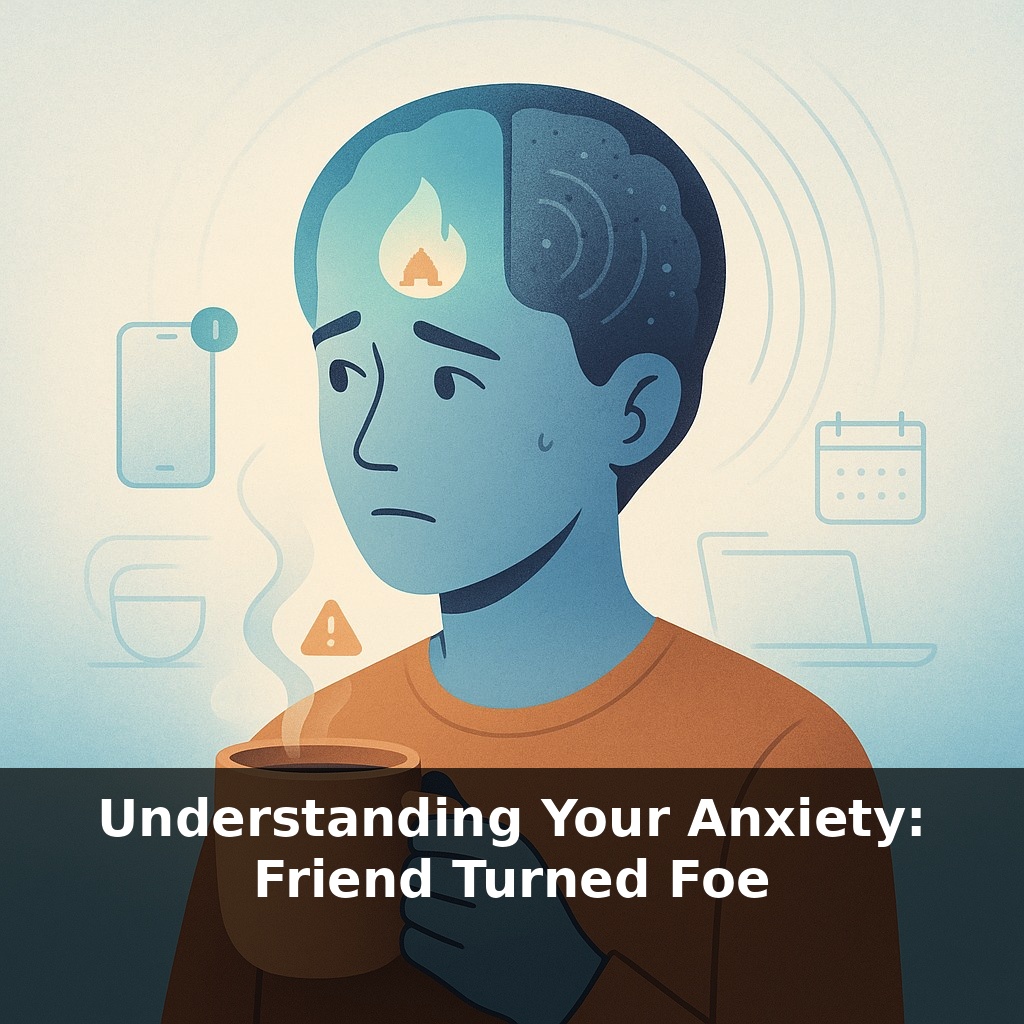
Understanding Your Anxiety: Friend Turned Foe
📝 Transcript
Right now, as you listen, your brain may be running its ancient threat system as if you’re in danger—while you’re just commuting or washing dishes. Here’s the twist: the very alarm that once kept humans alive might now be quietly reshaping your entire day.
Maybe you’ve noticed it: your heart jumps when your phone dings, your shoulders tense before a meeting, your mind fast‑forwards to disaster while you’re just trying to sleep. None of this feels dramatic enough to count as a “panic attack,” but it quietly drains your energy, narrows your choices, and makes ordinary life feel like walking through a hallway lined with tripwires.
Anxiety isn’t only those big, cinematic moments of terror. It often shows up as subtle background noise—constant “what if” thinking, second‑guessing every email, replaying conversations like a stuck audio clip. Over time, your brain starts treating these everyday moments like tests you must pass or threats you must outthink.
In this episode, we’ll map how that background hum becomes a loop: how your thoughts, body sensations, and habits can accidentally train your system to stay on high alert, even when nothing dangerous is happening.
That loop doesn’t start in your head; it starts in your brain’s threat‑detection circuitry, which can misread “pressure” as “danger.” A demanding email, an uncertain tone in someone’s voice, even your own racing heart can get flagged as a problem to solve. Over time, your system starts favoring caution the way a GPS keeps rerouting you away from traffic, even if it means a longer, more stressful route. The more your brain predicts trouble, the more it scans for confirming evidence, quietly editing your day so that risk, spontaneity, and rest feel less and less available.
Anxiety becomes a problem less because it exists, and more because of how it starts to organize your choices.
Think about a moment when you felt keyed‑up before something low‑stakes: replying to a message, joining a group chat, starting a task you’ve put off. The spike of unease shows up. Your brain quickly runs a prediction: “If I do this, something bad might happen.” Then, almost automatically, you do something to shrink that feeling—delay the reply, over‑edit the message, scroll your phone instead of starting the task.
That move usually works in the short term. Your body settles a bit. The tension drops from a 7 to a 4. On a brain level, that relief is powerful “evidence.” It quietly teaches your system: “Avoiding worked. Let’s do that again next time.” You don’t decide this consciously; it’s more like a tiny behavioral experiment your nervous system keeps running and re‑running.
Now layer in modern life: constant notifications, performance reviews, social comparison, financial strain, news alerts. Each one is a fresh opportunity for your brain to predict threat and reach for the same playbook: worry more, plan harder, shrink your world, or numb out. Over weeks and months, patterns form:
- Worry: mentally rehearsing worst‑case scenarios to feel more prepared - Checking: rereading, seeking reassurance, tracking others’ reactions - Avoiding: skipping situations, conversations, or risks that feel edgy - Numbing: using work, food, substances, or screens to blunt the noise
These responses aren’t random; they’re attempts at self‑protection. The twist is that they slowly confirm your brain’s fearful predictions. If you always cancel plans when you feel awkward, your nervous system never gets to learn that awkwardness usually rises and falls on its own, and that you can handle it.
Biology stacks the deck, too. Some people inherit a more “twitchy” baseline—genes that make stress chemicals spike higher or calm down more slowly. Early experiences matter as well: growing up around criticism, chaos, or unpredictability can tune your system to expect threat and over‑prepare for it. By adulthood, this can look like a personality trait (“I’m just like this”), when it’s partly a learned adaptation.
The hopeful piece: loops can be rewired. Short, repeated exercises that gently lean toward what you fear—rather than away from it—can teach the brain new predictions. In clinical studies, even brief, structured exposure practices have been shown to dial down over‑reactions in key fear circuits over time. Daily mindfulness practice, even in 10‑minute doses, can help you notice the first sparks of the loop before it becomes a full blaze, and let sensations and thoughts move through without instantly reacting.
In other words, the goal isn’t to delete anxiety, but to change the relationship between the first flicker of unease and what you do next.
Think about a workday where three small things happen: your manager’s tone is flat in a chat, a friend leaves your message on “read,” and your heart skips a beat after coffee. None of these events are dramatic on their own, but your mind quietly starts stitching them into a story: “I messed up. People are pulling away. Something is wrong with me.” The story feels so convincing that you act as if it’s true—typing slower, censoring yourself, keeping your camera off, staying vague with your friend. By evening, you feel oddly disconnected and on edge, which seems to confirm the story your mind started telling that morning.
Or consider social plans. You agree to go, feel a flicker of unease, then send a last‑minute “so tired, rain check?” text. Relief arrives fast—but now your brain has one more data point that canceling “kept you safe,” and one less experience of noticing nerves, going anyway, and discovering how the night actually unfolds.
Soon, your phone might notice subtle shifts in your breathing or typing speed before you do and quietly suggest a two‑minute reset, the way maps reroute you around traffic. Clinics are testing medicines and therapies that temporarily “loosen” rigid fear patterns so new learning sticks better. Workplaces may be nudged by policy—and culture—to treat mental strain like a sprained ankle: expected, treatable, and not a moral failing or private shame.
You don’t have to fix everything at once; you’re learning to read your own signals. Over the next episodes, we’ll explore tiny “experiments” that nudge your brain toward safety, the way dimmer switches soften a bright room. Your challenge this week: notice one moment of tension each day and simply label it—without changing a thing yet.
From this course
Beyond Anxiety: Transform Your Relationship with Fear
8 episodesUnlock all episodes
Full access to 8 episodes and everything on OwlUp.
Subscribe — $1.99/monthLess than a coffee ☕ · Cancel anytime