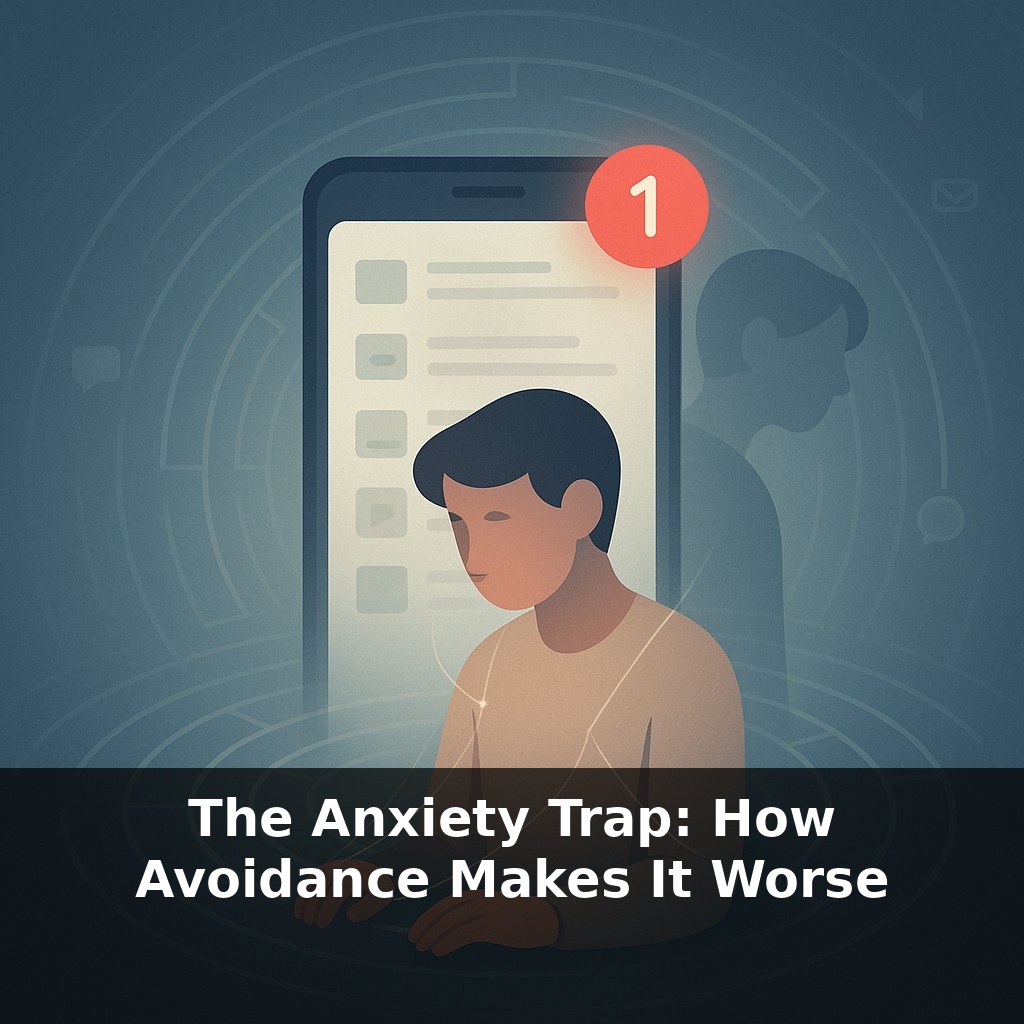
Your brain can learn to fear an email notification the same way it learns to fear a speeding car. You dodge the inbox once, feel instant relief, and—without realizing it—teach your mind, “Avoiding worked.” Next time, the little red badge feels twice as dangerous.
So your world quietly rearranges itself around what you’re scared of. You stop opening certain messages, then start drafting replies in your head but never send them. You decline one social invite, then begin “being busy” every weekend. You tell yourself you’re just tired, just picky, just better when you work alone. On the surface, life still functions. Underneath, your options shrink.
Anxiety rarely announces, “I’m running your life now.” It sounds more like, “Today’s not a good day,” “You’ll handle it later,” or “It’s not that important anyway.” The trap is subtle: the more decisions anxiety makes for you, the more reasonable its arguments start to feel.
Over time, this doesn’t just shape your schedule; it reshapes your identity. “I’m someone who can’t do presentations.” “I’m not relationship material.” “I just don’t travel.” In this episode, we’ll start teasing apart what you truly value from what anxiety has quietly edited out.
Anxiety’s edits don’t just remove “big” things like careers or relationships; they quietly trim the everyday moments that make life feel like yours. You might skip asking a question in a meeting, delay booking a dentist appointment, or stay in the car a few extra minutes before going into a gathering. Each tiny detour feels harmless, even sensible. But added up, they function like slow leaks in a tire—you often don’t notice the loss of pressure until steering gets harder. In this episode, we’ll zoom in on those small, nearly invisible moments where avoidance slips in and starts steering for you.
Here’s where things get sneaky: most people only notice “anxiety problems” at the point of visible disruption—panic attacks, missed deadlines, big arguments, a life that suddenly feels too small. But the real engine runs much earlier, in those quick mental negotiations you do dozens of times a day.
You feel a tug to do something that matters to you—speak up, apply, call, show up—and a counter‑voice appears:
“I’ll just do it after lunch.” “I should wait until I’m more prepared.” “Today’s not ideal; tomorrow I’ll be in a better headspace.”
On the surface, these sound rational. Underneath, something else is happening: your brain is quietly running cost–benefit calculations. It overestimates how unbearable short-term discomfort will feel and underestimates the long-term cost of stepping back. What looks like a neutral choice is often a lopsided equation your nervous system has rigged in favor of safety.
Over time, many people start building entire routines around these micro‑calculations. You arrive early or late so you won’t have to walk into a room “on display.” You overprepare emails so you never have to risk sounding unsure. You only meet friends one‑on‑one so you can avoid group dynamics. Life starts to revolve less around “What do I care about?” and more around “What can I tolerate without feeling activated?”
This has two important consequences. First, your internal bar for “too much” keeps drifting downward. Situations that once felt mildly uncomfortable now register as “absolutely not.” Second, your sense of what you’re capable of gets built from a very biased sample—moments when you felt safest, not moments when you were most alive or most aligned with your values.
Notice, none of this requires dramatic avoidance. You can be busy, successful, even admired while still living inside a shrinking radius. From the outside, it may look like you’re thriving. From the inside, it can feel like you’re always arranging furniture around a fragile object no one else can see.
The turning point usually isn’t “becoming fearless.” It’s getting curious about this invisible radius: where it sits today, how it got there, and what it’s quietly costing you. That curiosity is the doorway to working with anxiety differently—not by arguing with it, but by changing what you do in those tiny decision points it currently wins by default.
Think of a day when you quietly adjusted plans: you walked the long way around the office to avoid someone, answered with “maybe” instead of “yes,” or kept your camera off so you wouldn’t be “on the spot.” None of these moments felt dramatic. Yet each one slightly rewrote what “a normal day” looks like for you.
For one person, that might mean always choosing email over phone calls; for another, only applying to roles that don’t involve leadership, travel, or visibility. Someone else might become the friend who “organizes everything,” not only because they’re generous, but because hosting feels safer than arriving unsure of their place.
Across weeks and months, these micro‑choices start to cluster. You might notice your calendar full of solo tasks, your social life narrowed to a couple of “safe” people, or your work projects skewed toward what you can do perfectly rather than what you actually find meaningful. In this series, we’ll keep zooming in on those clusters—not to blame you for them, but to map where new options could exist.
As tech, schools, and workplaces wake up to this pattern, our options may look very different. Instead of waiting until life feels unmanageable, you might get prompts—like gentle “check engine” lights—when your routines start tightening. Apps could flag shrinking social or behavioral ranges the way fitness trackers flag low activity, not to shame you, but to suggest tiny, values‑based experiments. Over time, “playing it safe” might feel less like a default and more like a conscious, revisitable choice.
So the experiment isn’t to “fix” yourself; it’s to widen your range by a few degrees at a time. Treat each small approach—sending the message, joining the call, staying five minutes longer—as a data point, not a verdict. Like testing a new recipe, you adjust based on results. Over time, those tiny trials can add up to a life that fits you better than avoidance ever did.
Before next week, ask yourself: 1) “What’s one specific situation I’ve been avoiding because of anxiety (like a hard conversation, opening an email, or going to a social event), and what do I imagine will *actually* happen if I face it versus if I keep dodging it?” 2) “If I rated that situation from 0–10 on a fear scale, what tiny version of it could I handle at a ‘3–4’ level this week (for example, sending a brief text instead of a full call, or staying at the event for 10 minutes instead of an hour)?” 3) “Right after I do that small exposure, what changes do I notice in my body, my thoughts, and my anxiety level—did anything happen that *didn’t* match the scary story my brain told me?”