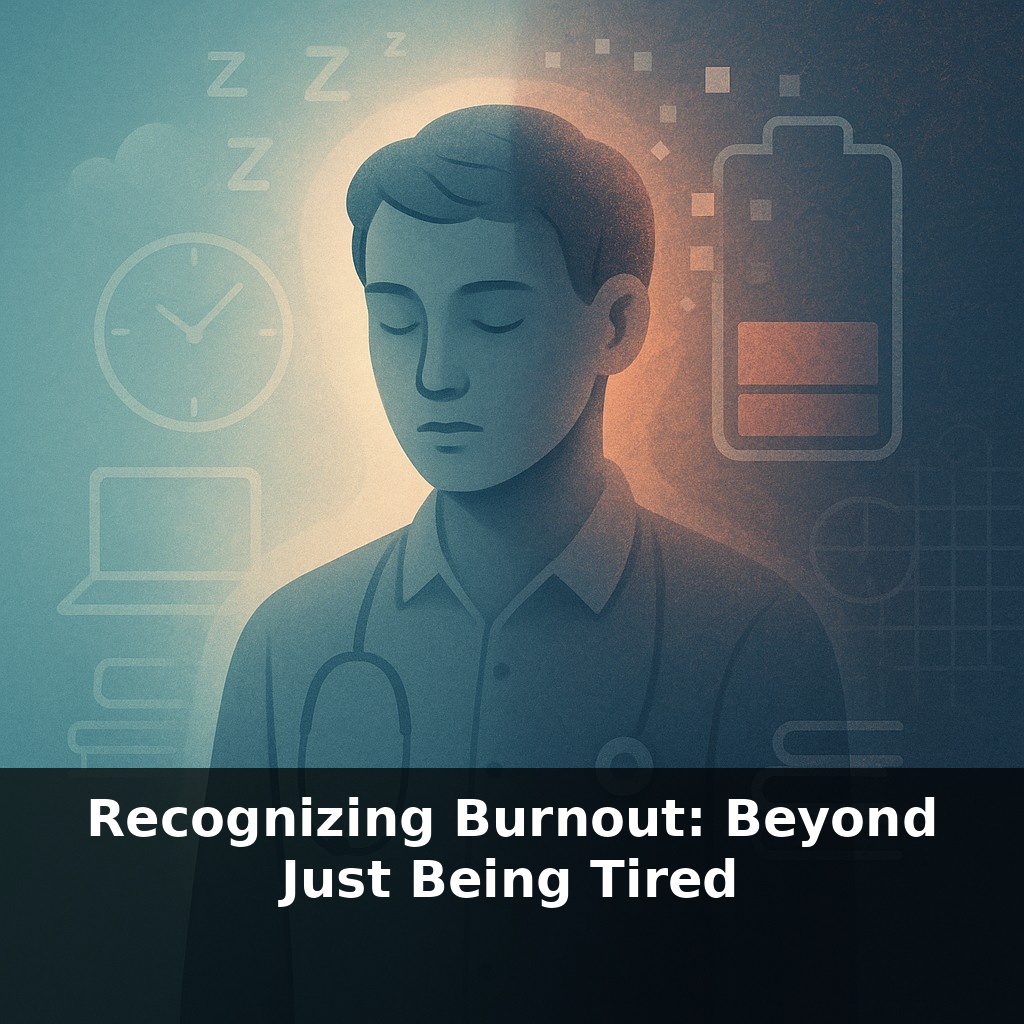
Recognizing Burnout: Beyond Just Being Tired
📝 Transcript
About half the people who say “I’m just tired” are actually describing something else entirely. A nurse staring at her badge in the parking lot. A manager scrolling job sites at 2 a.m. A teacher snapping at kids she loves. Same phrase, very different problem.
So how do you know when “tired” has quietly crossed a line into something riskier? Biology starts leaving fingerprints. Your sleep gets choppy or unrefreshing, even when you’re in bed longer. Your focus frays: simple tasks feel like decoding a foreign language. You notice odd swings—wired and restless at night, flat and slow in the morning. Small hassles trigger big reactions, or no reaction at all.
Burnout also warps how you see your work. The projects you used to lean into now feel like a wall you’re leaning against. You might catch yourself caring less, not because your values changed, but because your system is secretly rationing energy. Colleagues’ emails feel heavier, meetings feel sharper, and recovery windows keep stretching: one good weekend no longer “resets” you.
This series is about learning to spot those early shifts while change is still manageable.
Here’s the tricky part: burnout rarely announces itself with a dramatic collapse. It creeps in through small, explainable changes that are easy to blame on “a busy season” or “just getting older.” You stay late a bit more often. You skip breaks “just this week.” You stop raising your hand for projects that once felt energizing. One by one, the habits that used to keep you steady get traded for shortcuts—more caffeine, less movement, fewer real conversations. On paper, you’re still functioning. Inside, the margin for any extra stress is quietly disappearing.
Here’s where the distinction between “tired” and “burned out” becomes clearer: look at what *stops working*, not just at how drained you feel.
When you’re just stretched, your usual tools still help. A normal night of sleep sharpens your thinking. A day off lightens your mood. A decent conversation with a colleague restores some perspective. Under burnout, those levers lose power. Rest feels oddly inefficient: you do the “right” things and still come back foggy, detached, or on edge.
Researchers pick this up in ways you can’t see in the mirror. People in sustained burnout show changes in attention, working memory, and decision speed—even when they think they’re “pushing through.” Error rates climb. You reread the same paragraph. You miss details you’d normally catch. Over time, your brain quietly shifts into a conservation mode: it narrows focus to get through the next task and stops investing in bigger-picture thinking, creativity, or learning.
Emotionally, something else starts happening: you don’t just feel “a lot”; you start feeling *less*. Not in a calm, Zen way, but in a dulled, far-away way. This is that depersonalization piece researchers talk about—treating yourself, your work, or other people as objects on a checklist rather than as humans in a story. It’s a short-term survival strategy that becomes corrosive if it lasts.
At the body level, chronic stress hardens from “response” into “background setting.” Your system gets stuck closer to “alert” than “rest,” which helps you hit deadlines this month but quietly taxes your cardiovascular, metabolic, and immune systems. That’s how we get those links to diabetes risk and other long-term health problems.
Workplace context matters more here than personal willpower. Burnout rates spike in environments with constant overload, low autonomy, or a sense that effort and reward are out of sync. The same person can wither in one team and do well in another, not because their character changed, but because the conditions did.
So the real question isn’t “Am I tough enough?” but “Is the way my work is structured sustainable for a human body and brain?”
Consider three people in the same office. One starts triple-checking emails and still misses small mistakes. Another finishes the day with unread messages and an odd sense of “nothing actually moved.” The third gets every task done but quietly drops anything not strictly required—mentoring, creative ideas, offering help. On a spreadsheet, they’re all “performing.” Under the surface, their systems are quietly reallocating energy away from long-term, meaningful work and toward bare-minimum survival.
In medicine, this pattern sometimes shows up before lab numbers go bad: a clinician becomes less curious, less likely to ask one more question or reconsider a diagnosis. Their technical skills are intact; their *bandwidth for nuance* is what’s thinning. In high-pressure teams, this can spread like secondhand smoke. When everyone is operating on narrowed bandwidth, empathy, feedback, and learning are often the first things to evaporate. The cost isn’t just how you feel, but what your team slowly stops being able to do well.
Burnout’s ripple effects won’t stay confined to “wellness” programs. As careers stretch over decades, companies may have to treat recovery like scheduled maintenance, not a perk—rotations off intense roles, mandatory debriefs after crunch periods, even “psychological safety audits” alongside financial ones. Like checking storm forecasts before sailing, teams may start reading early stress signals before green‑lighting big launches, tying ambition to actual human capacity.
So the next step isn’t to “try harder,” it’s to get more curious. Instead of judging yourself for feeling off, treat your day like a lab notebook: which meetings leave you oddly flattened, which tasks quietly lift you? Patterns here are like contour lines on a map—they don’t fix the terrain, but they show you where to walk differently.
Here’s your challenge this week: Three times a day (morning, mid-afternoon, and evening), pause for 2 minutes and rate your energy, irritability, and sense of accomplishment on a 1–5 scale, and note exactly what you were doing right before each check-in. If you hit “3 or below” on energy or “3 or above” on irritability twice in a row, you must take a 10-minute recovery break that does NOT include screens, scrolling, or email—walk, stretch, or sit outside instead. At the end of the week, circle the 3 activities that most often showed up before your lowest scores and commit to reducing or delegating at least one of them next week.
From this course
Beyond Burnout: Transform Your Work and Life
8 episodesUnlock all episodes
Full access to 8 episodes and everything on OwlUp.
Subscribe — $1.99/monthLess than a coffee ☕ · Cancel anytime