About 8 in 10 workers say their job is harming their mental health, yet most still blame themselves for “not being strong enough.” In this episode, we’ll step into three everyday workdays and ask a daring question: what if burnout isn’t a personal failure at all?
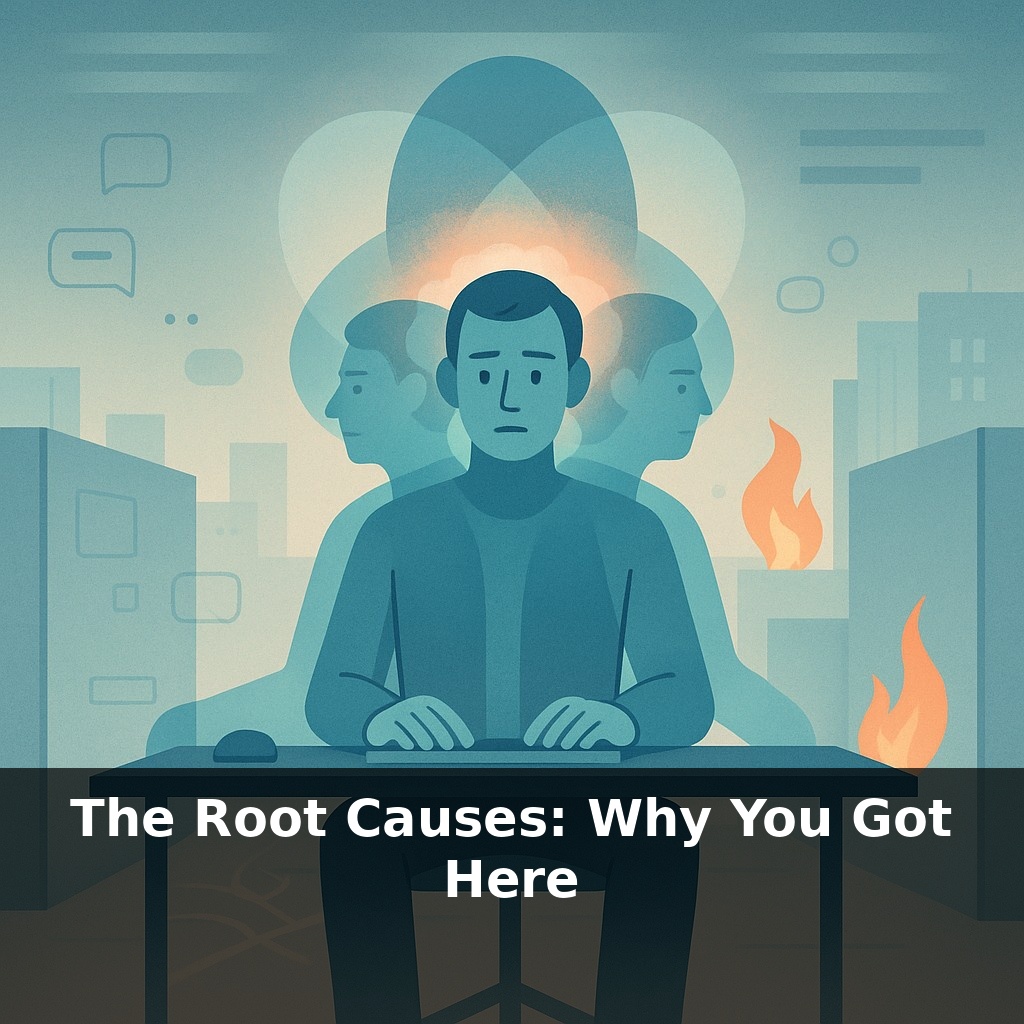
The catch is: burnout rarely has a single villain. It usually forms at the crossroads of three forces quietly stacking up over months or years. First, there’s the environment around you—unspoken rules about “face time,” Slack messages at 10 p.m., leaders who praise all-nighters but never model boundaries. Second, there’s the story you tell yourself: “I should be able to handle this,” “If I slow down, I’ll fall behind,” “Rest is earned, not needed.” Third, there’s your body’s capacity: sleep debt, skipped meals, no real downtime, and a nervous system that never gets the signal to stand down. On their own, each might feel manageable. Together, they create a kind of chronic headwind that makes ordinary tasks feel like pushing a shopping cart with a stuck wheel—against a steep hill. In this episode, we’ll map how those three forces show up in your actual week.
So instead of hunting for a single “root cause,” think of your week as layers stacked on top of each other. On the surface: the obvious stuff—back-to-back meetings, shifting priorities, the email that ruins your Sunday night. Under that: quieter frictions, like a manager who praises speed over thoughtfulness, or a team norm that rewards answering messages instantly. Deeper still: small daily trades you’ve stopped noticing—working through lunch, cancelling movement, scrolling late. Each layer seems minor in isolation; together, they tilt the whole playing field just enough that every step costs more than it should.
Start with the three signals the WHO highlights, and you can often reverse‑engineer how you got here.
First: exhaustion. Not just “tired,” but that bone‑deep sense that even small tasks feel oddly heavy. Research shows it’s rarely only about hours worked. More often, it’s the mismatch between what’s demanded and what you can realistically recover from. Maybe your calendar says 8 hours, but your brain is context‑switching 40 times a day. Each switch is tiny, but together they act like hidden “micro‑taxes” on your attention, quietly draining energy before lunch.
Second: cynicism or mental distance. This is the part that can scare people: “Why do I feel numb about work I used to care about?” Studies of burnout in physicians, teachers, and engineers show a pattern—when people feel they have no real say in decisions that affect their work, they start protecting themselves by caring less. It’s not that your values vanished; it’s that your mind is trying to reduce pain from repeated disappointments, broken promises, or value clashes.
Third: reduced sense of efficacy. You might still be hitting deadlines, but it feels like you’re moving through molasses. APA data showing motivation drops under chronic strain hint at why: when effort no longer reliably leads to a sense of progress or recognition, your brain updates its equation—“Why bother?” That’s not laziness; it’s learned inefficiency. Your system is noticing that the return on effort has fallen.
Now layer in lifestyle patterns that amplify all three. Regular short‑sleep weeks spike cortisol, nudging your baseline stress up so far that normal feedback feels like criticism, and minor glitches feel like proof you’re failing. Skipped movement, social isolation, and always‑on devices close off the usual pressure valves that would let stress dissipate between spikes.
Think of a traffic system where every light is slightly mistimed: one by itself is annoying; many in a row turn a 15‑minute drive into 40. In the same way, burnout often emerges not from one catastrophic event, but from dozens of small misalignments between you, your role, and the way your days are structured.
Your challenge this week: pick one recent day that felt especially draining. Without editing or judging, reconstruct it hour by hour. For each hour, mark three things: 1) energy level (0–10), 2) sense of control (low/medium/high), 3) whether your effort felt noticed or useful. When you’re done, circle the stretches where low energy, low control, and low usefulness cluster together. That cluster is your first real clue about why you’re here.
Think about the last time your day went sideways by 10 a.m. It often starts with something small: a meeting moved up without warning, a “quick favor” that’s actually an hour, or a tiny comment that lands wrong. None of these alone explain why you end up wiped out and strangely detached by evening—but they do explain where your energy is leaking.
To see it more clearly, it helps to zoom in on **mismatches**: the gap between what a situation quietly asks of you and what you actually have to give in that moment. A 30‑minute “brainstorm” that really needs three people and 90 minutes of focus. A “flexible” role that still expects instant replies. Each mismatch adds friction you don’t consciously track.
In medicine, clinicians talk about “allostatic load”—the wear and tear from constantly adjusting to stressors. It’s not the single spike that does the damage; it’s your system never quite returning to baseline between them. Your workdays can function the same way: dozens of minor readjustments, never fully reset, slowly bending your sense of what “normal” should feel like.
Hybrid work will likely magnify these hidden pressures. Commutes may shrink, but meetings often multiply, and home boundaries blur. Expect more employers to track “psychological sustainability” the way they once tracked safety incidents—dashboards flagging overload trends, tools suggesting when to decline work, even nudges to step away. Helpful, maybe—but also intrusive. The real test will be whether these systems restore your choice, or just repackage constant availability in softer language.
Conclusion: Treat this week like opening the “developer settings” on your life—you’re not fixing everything, just turning on hidden diagnostics. As patterns emerge, you may notice specific people, times, or tasks that drain you like slow leaks. That clarity isn’t blame; it’s a map. In the next episode, we’ll start redrawing that map so it fits *you* again.
Before next week, ask yourself: 1) “If I replay the last 6–12 months like a movie, what 2–3 repeating choices, habits, or relationships clearly nudged me toward the situation I’m in now—and what was I telling myself in those moments to justify them?” 2) “When I’m most stressed or ashamed about ‘how I got here,’ what story do I automatically jump to about myself (lazy, broken, not enough, etc.), and what hard evidence actually supports—or challenges—that story?” 3) “If I chose one tiny ‘root’ to experiment with this week (a specific belief, a recurring behavior, or a person I keep saying yes to), what would it look like to respond differently just once, and what does that teach me about how much power I actually have to change the trajectory?”