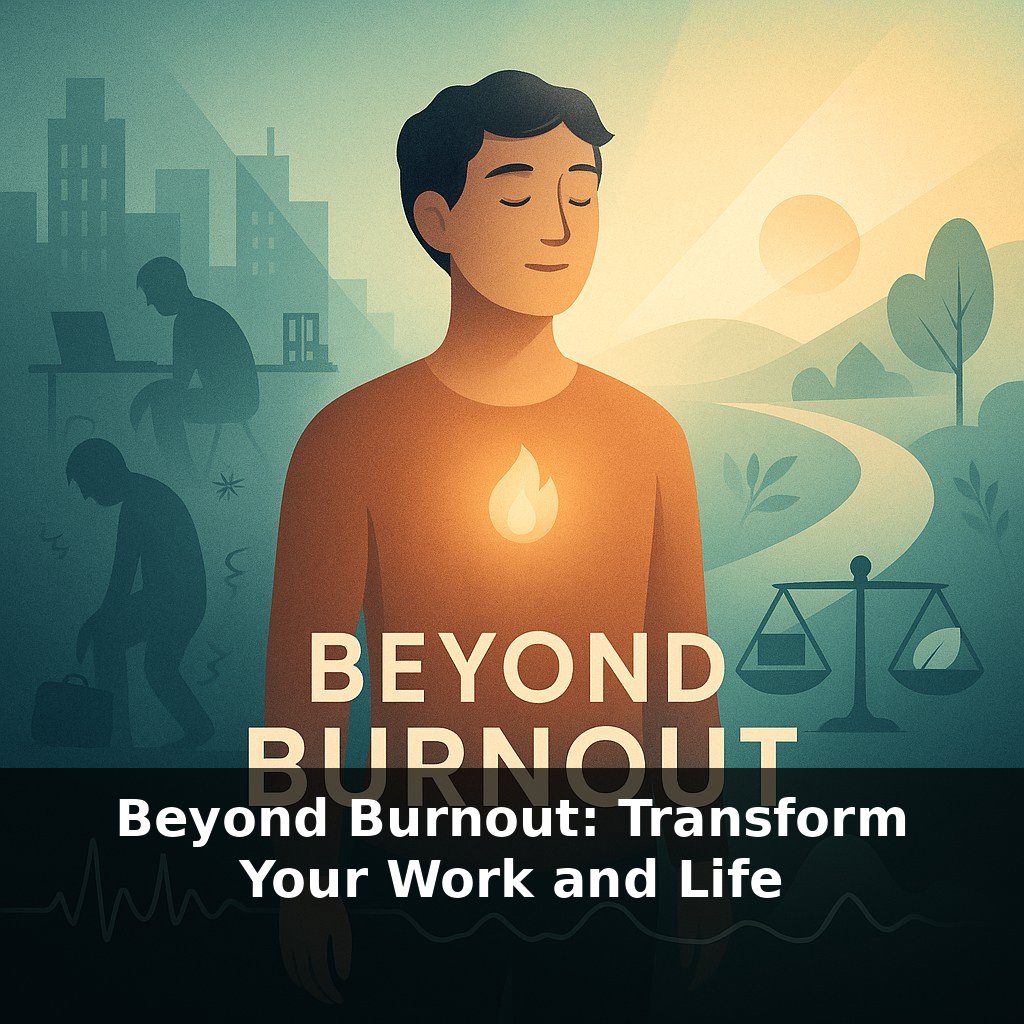
Burnout now appears in the World Health Organization’s disease manual, yet many workplaces still treat exhaustion as a personal weakness. In one office, people cut a full workday and got *more* done. In another, longer hours quietly killed results. How can both be true?
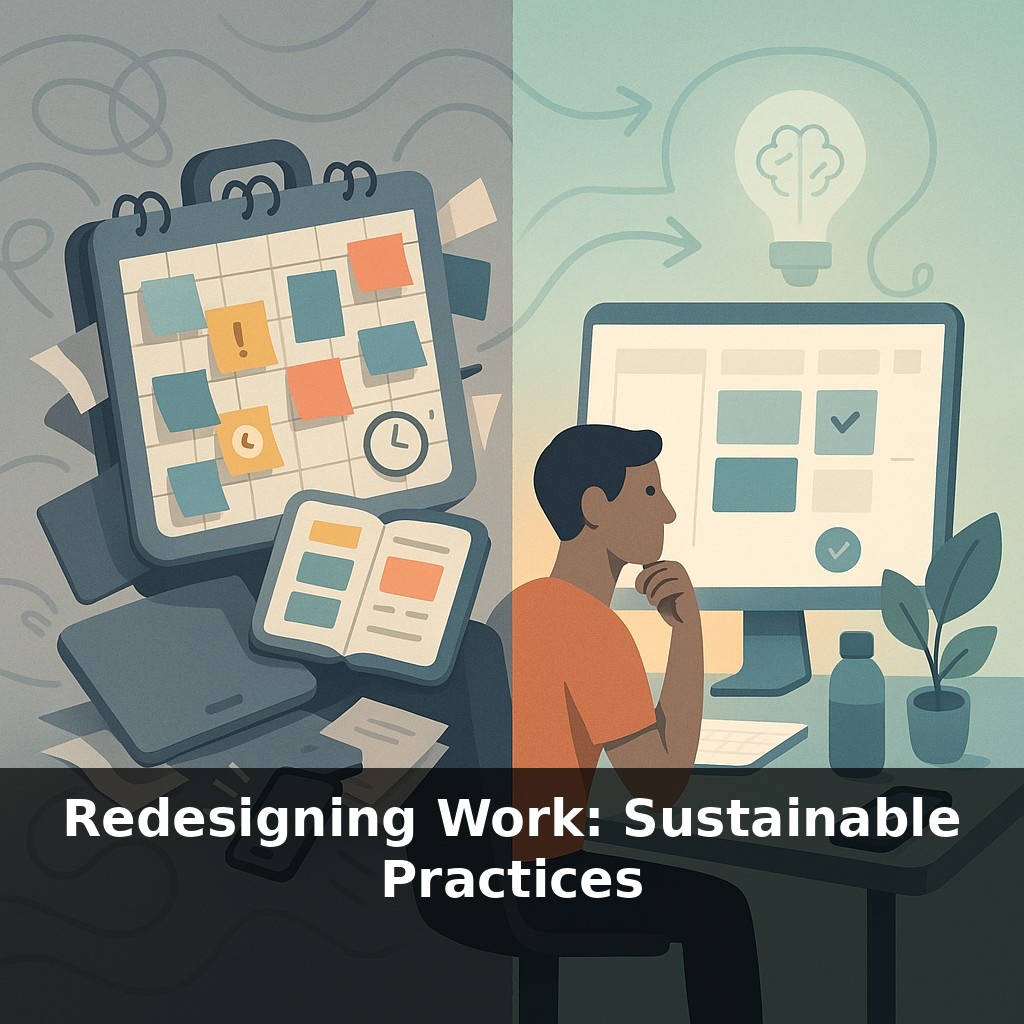
The twist is that many “wellness” fixes never touch the real problem: the way work itself is designed. You can meditate at 6 a.m., meal-prep on Sundays, and still feel crushed by a calendar packed like an overstuffed suitcase. The emerging research points away from tougher individuals and toward smarter systems: fewer friction points, clearer priorities, and rhythms that match how human brains actually operate during the day. Some companies are quietly experimenting—shorter weeks, meeting-free blocks, project-based planning—and finding that when they adjust the *structure* of work, people don’t just feel better, they perform better. In this episode, we’ll zoom in on what “sustainable work” really looks like in practice, and how small redesigns—team-level or personal—can start shifting your load from barely bearable to steadily sustainable.
Think less about squeezing more effort from the same 8–10 hours, and more about *how* those hours are shaped. Our brains aren’t assembly lines; they cycle through peaks, dips, and rebounds of focus. Neuroscience shows that switching tasks too often scatters attention, while predictable patterns let the nervous system “anticipate” effort and recover faster. Occupational psychologists see similar effects at team level: clear limits and autonomy reduce hidden drag—status meetings that add no value, tools that don’t talk to each other—freeing energy for the work that actually moves the needle.
Microsoft Japan didn’t just lop off Fridays and hope for the best—they rewired *how* work flowed. Meetings were capped at 30 minutes, default attendance shrank, and teams clarified which tasks genuinely required collaboration. That mix of reduced time plus sharper focus is what drove their 40% productivity jump, not a magic calendar trick.
This is the pattern behind most successful “sustainable work” experiments: they combine three ingredients.
First, **load visibility**. Many teams fly blind. No one can see that one person is quietly carrying three “urgent” projects while another is between big deadlines. Simple tools—kanban boards, shared capacity charts, rotating “work in progress” reviews—turn invisible overload into something you can actually negotiate. Once the true load is visible, leaders can delay, drop, or redistribute instead of silently expecting heroics.
Second, **energy-aware design**. Neuroscience shows that high-focus work and shallow work draw on different kinds of mental effort. Sustainable teams don’t treat all hours as interchangeable. They might cluster deep work in the part of the day when most people’s focus peaks, then batch low-stakes tasks in natural dips. Some companies formalize this with “core collaboration hours” and protected focus windows; others simply agree on signals—status-light colors, chat norms—that reduce constant interruption.
Third, **micro-autonomy**. You don’t need a full 4-day week pilot to benefit from autonomy. Small levers—choosing *sequence* (which task first), *method* (how to reach the goal), and sometimes *location*—can have outsized effects. Evidence from occupational psychology consistently links this kind of control to lower strain and better performance. When people can adjust the “how” and “when” around fixed outcomes, they naturally pace themselves closer to their real limits.
Taken together, these changes shift the default question from “How do we get people to push harder?” to “How do we let the system carry more of the weight?” Your calendar, your team rituals, your tools—all of them can either add hidden friction or quietly return time, focus, and capacity back to humans who are trying to do their best work.
A software team in Lisbon tested this in a low-risk way: for one quarter, they treated their calendar like a prototype. Monday mornings became “load visibility” check-ins where each person tagged work as green, yellow, or red based on effort, not emotion. Reds triggered a concrete choice: postpone, split, or swap. Nobody’s hours changed, but by the end of the quarter, weekend work had dropped by half because crises were surfaced before they boiled over.
Elsewhere, a hospital unit couldn’t cut shifts, so they focused on energy-aware design. Nurses mapped their alertness across a typical day, then re-ordered tasks: medication rounds during natural focus peaks, paperwork in predictable low-energy windows, a protected 15-minute regroup before the evening rush. Error rates nudged down; sick days did, too.
Think of this less as “doing less work” and more as learning to plate the right “courses” at the right time, instead of serving everything at once and calling the chaos normal.
Soon, the real differentiator won’t be who can push hardest, but who can recover fastest and *learn* from that cycle. AI will quietly strip out more “busywork,” exposing where human effort actually matters: judgment calls, creative leaps, sensitive conversations. As that happens, teams that treat recovery like a design parameter—not a personal luxury—will adapt first. Their calendars, tools, and norms will behave more like a responsive climate system than a fixed schedule: sensing pressure, then adjusting before storms hit.
Your week doesn’t need a revolution to change its shape; it needs one small lever pulled on purpose. Try swapping a recurring hassle for a tiny, repeatable relief: a five-minute reset between contexts, a standing “no new priorities” window, a shared stop signal. Like seasoning in a recipe, these details seem minor but quietly change the whole flavor of your days.
Here’s your challenge this week: Pick one recurring meeting on your calendar and redesign it to be both low‑carbon and human‑friendly. Convert it to a 25‑minute walking or cameras‑off call, cut the attendee list by at least 30%, and share a one‑page async update in advance so the live time is only for decisions. At the end of the week, compare total meeting time, number of people involved, and your own energy level to how that meeting usually feels—and decide which parts of the redesign you’ll keep permanently.