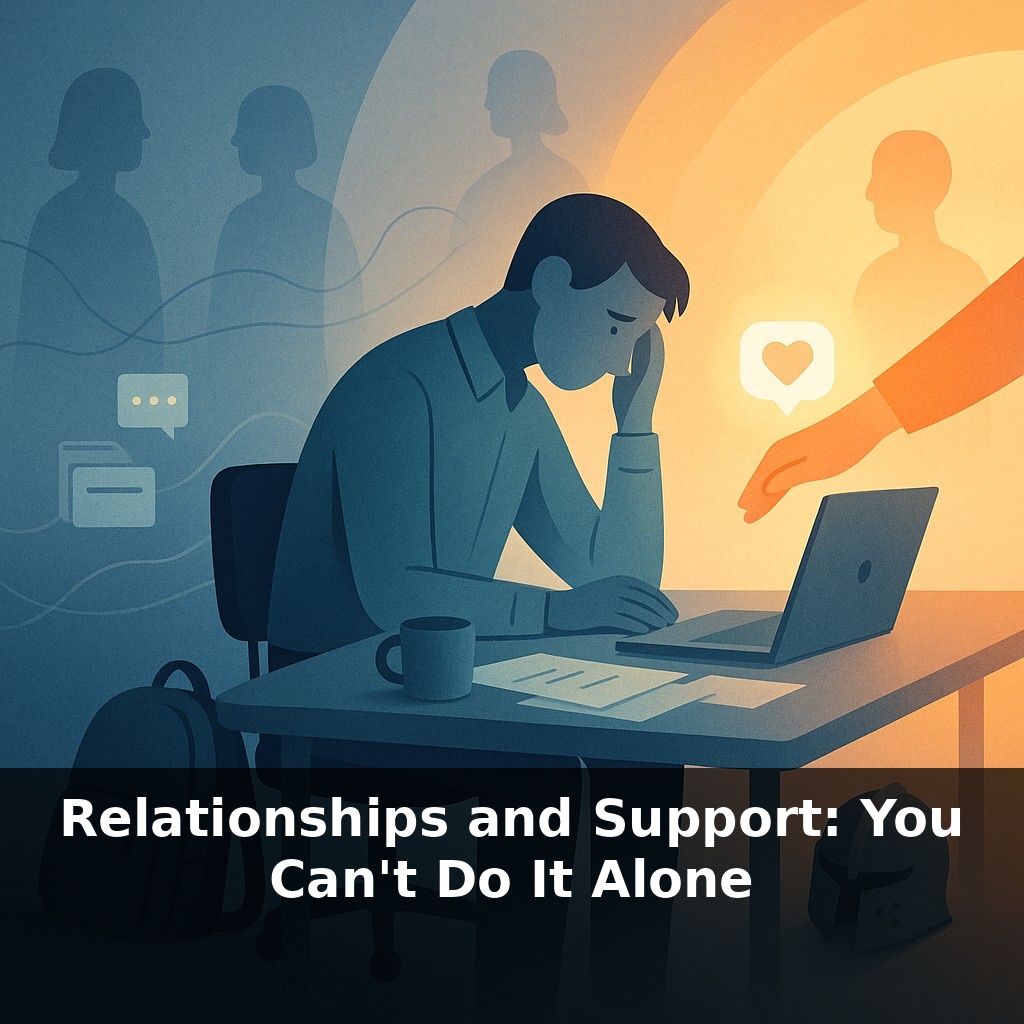
About half of workers say they feel drained most days—yet many still treat stress like a solo sport. You push harder, stay later, armor up. Then one day, a small mistake at work hits you so hard it feels personal. The paradox: you’re burning out *because* you’re carrying it alone.
One of the quiet myths that keeps burnout in place is the belief that “strong” people cope on their own. You might recognize the script: once you’ve handled your work, your inbox, your family, *then*—if there’s time—you’ll reach out, catch up, connect. Support becomes a luxury for when things calm down. But the research is blunt: waiting until you “deserve” help is like waiting to drink water until after you’ve finished a marathon. The further you go without it, the worse your judgment gets—and the more isolated you feel. What actually protects you is not a single “go‑to” person, but a web of different kinds of relationships: the colleague you can vent to without editing, the mentor who helps you zoom out, the friend who reminds you there’s more to your identity than your job. In this episode, we’ll get concrete about how to build that web on purpose.
So where do these relationships actually come from if your days already feel packed? They rarely appear in grand, cinematic moments; more often they grow out of tiny, repeatable interactions: the coworker you always debrief with after a chaotic meeting, the neighbor you swap “how was your day, really?” texts with, the former teammate you still send articles to because they’d “get it.” Over time, these micro‑connections form a quiet infrastructure under your life—like the hidden wiring that keeps a building lit, even when one circuit fails. In this episode, we’ll map out how to build that wiring intentionally.
Think of this part as shifting from “support is nice” to “support is strategy.” The research you heard about isn’t just feel‑good science; it points to *specific* kinds of relationships that change how your body and brain handle overload.
At work, there are usually three layers:
- **Buffer people.** These are the colleagues who make hard days survivable: the person you debrief with after a rough client call, the teammate who quietly says, “I’ll sit in on that meeting with you.” They don’t fix the system; they reduce the *impact* of the system on you.
- **Perspective people.** Mentors, former managers, or peers in other departments who aren’t knee‑deep in your day‑to‑day. They help you calibrate: Is this actually urgent? Is this normal for our field? Are there options you’re not seeing?
- **Belonging people.** The ones who know you as more than a job title—friends, communities, interest groups. They protect the part of you that doesn’t rise or fall with performance reviews.
A resilient network isn’t five copies of the same relationship. It’s diversification: different people for different needs—emotional, practical, strategic, even playful. When support is diversified, you’re less vulnerable to one person leaving, burning out, or being unavailable just when you need them.
Notice, too, that support doesn’t always look like a deep, vulnerable talk. Sometimes it’s:
- A quick “sanity check” message before you reply to a difficult email - Sharing a template or script so someone doesn’t have to start from zero - Co‑working on video with cameras off, just to feel less alone - A neighbor dropping off groceries during a crunch week
For introverts or remote workers, this often works *better* when it’s structured and time‑bound: a 20‑minute check‑in, a monthly peer circle, an online group with a clear focus. Depth doesn’t require constant interaction; it requires reliability and psychological safety.
The crucial shift is from hoping support will appear when things get bad, to treating it like sleep or nutrition: something you build into the baseline of your life, long before you’re at your limit.
Think about the last time you left a meeting feeling hollowed out but then laughed with someone in the hallway about how bizarre it was. That tiny exchange didn’t “fix” anything, yet you walked away lighter. Now contrast that with the projects where you quietly shouldered everything: no one to ping for a quick review, no one to say, “That deadline is ridiculous.” Same workload on paper, radically different wear‑and‑tear on you.
You can also layer support: a peer who helps you draft a brave email, plus a friend outside work who reminds you that, regardless of how it lands, you’re still you. Or a small group chat where you swap “scripts that worked,” so no one is starting from scratch when they need to push back.
One helpful way to see this is like a smart medication regimen: you’re not relying on one “miracle pill,” but combining low doses of different treatments—each targeted, each manageable—that, together, change the whole course of the illness.
Teams, cities, even nations will likely start treating relational health the way they treat cybersecurity: not optional, and continuously monitored. You might one day see dashboards where “relational load” sits beside financial KPIs, or onboarding that pairs you with a rotating “care squad,” not just a manager. Like crop rotation prevents soil from being stripped bare, shifting who you lean on—and when—may become a standard practice to keep human systems from quietly exhausting their people.
Your relationships will keep evolving: some drift, some deepen, a few surprise you. That’s not failure; it’s pruning. What matters is noticing who leaves you more grounded after contact—and then protecting that time the way you’d guard a key meeting. Over time, those small, consistent choices reshape your days like a river quietly reshapes stone.
Start with this tiny habit: When you finish listening to a podcast episode, send one specific sentence of appreciation to someone who has supported you (for example: “That time you checked in on me after my rough week is still helping me today”). Do it in whatever way feels easiest—text, DM, or a quick voice note—no long message needed. If someone pops into your head while you’re doing dishes or scrolling your phone, just pause long enough to send that one line. Over time, you’ll be quietly strengthening the support system this episode is talking about, one 10-second thank-you at a time.