Burnout is now officially listed as a workplace hazard by the World Health Organization, but most people still treat it like a personal weakness. You’re rushing between meetings, answering late-night emails, and somehow calling this “normal.” So why hasn’t your life system caught fire—yet?
A growing body of research shows most people design their days backward: they plan for output and squeeze in recovery “if there’s time.” That formula quietly fails. In one study, sleeping 6 hours or less didn’t just make people tired—it increased the odds of burnout by 2.5 times. And across 27 controlled trials, structured mindfulness programs cut burnout symptoms by an average of 26%. These aren’t soft perks; they’re performance infrastructure. On a larger scale, when Microsoft Japan tested a 4‑day workweek, productivity jumped 40% while electricity use fell 23%. The lesson isn’t that everyone needs Fridays off—it’s that systems built with recovery in mind outperform those that treat rest as an afterthought. In this episode, we’ll zoom out from quick fixes and show you how to design your life and work so chronic overload never becomes your default.
Most people try to “fix” exhaustion with one-off solutions: a weekend away, a new app, an inspiring book. Research shows that without changing the conditions that create overload, gains fade within 2–4 weeks. Long-term protection comes from stacking three layers: personal habits, team norms, and organizational rules. For example, teams that set clear response-hour windows see email volume drop by up to 25%. Companies that cap meeting time at 20–25 hours per week report higher focus and lower error rates. In this episode, we’ll turn those ideas into practical levers you can actually pull—whether or not your workplace is on board yet.
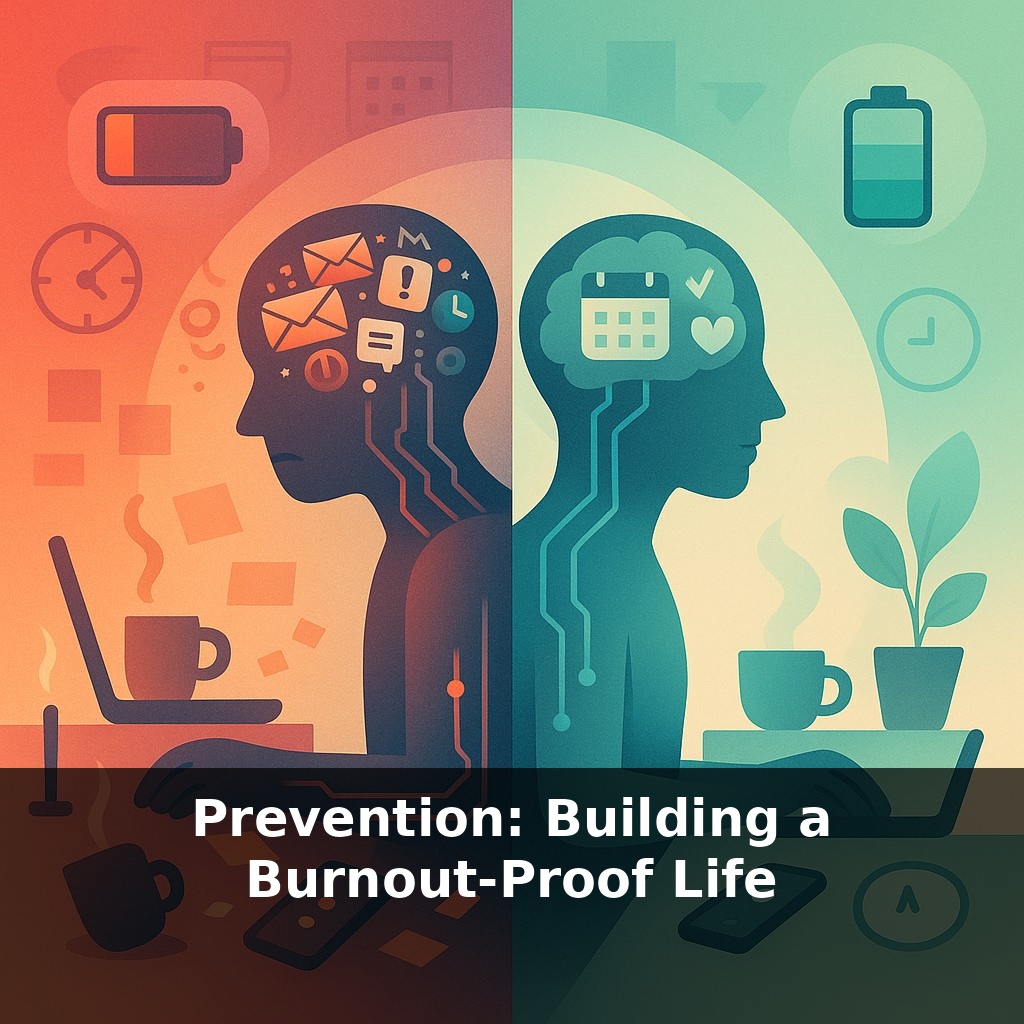
Burnout moved into the ICD‑11 not because people suddenly became weaker, but because the way we live and work quietly exceeds human limits. Prevention starts with redesigning three layers of your life so demands rarely outrun resources.
First, the personal layer: your default day. Look at three high‑leverage dials. 1) Cognitive load: Knowledge workers now switch tasks every 40 seconds on average. Each switch can cost 15–23 minutes to fully refocus. Protect at least one 90‑minute block per day with notifications off and a single target. Fewer switches = less hidden strain. 2) Bio‑rhythms: Around 75% of people have a clear “peak focus” window of 2–3 hours after fully waking. Put complex work there and reserve low‑stakes tasks for your natural dips. 3) Micro‑recovery: Studies on “pause practices” show that even 5 minutes of deliberate unwinding every 60–90 minutes lowers heart rate and stress markers. That’s 5% of an hour protecting the other 95%.
Second, the team layer: the norms you share. Most overload is socially reinforced. Simple agreements can shift this without costing output. – One global consulting firm set a rule: no recurring meetings longer than 45 minutes. Over 6 months, total meeting time fell by 18% while project delivery times stayed stable. – A software team of 30 people introduced a “quiet channel” policy: no @here or @channel tags outside a 3‑hour daily window. Message volume didn’t drop much, but interruptions did—and self‑reported end‑of‑day energy rose by 21%.
Third, the organizational layer: structural guardrails. Even if you don’t run your company, you can spot—and influence—pressure points. – Schedule density: A hospital reduced average daily meetings for physicians from 7 to 4; self‑rated burnout declined 12% in a year. – Workload transparency: A call center added a live dashboard showing queue length and staffing. When queues exceeded a threshold, nonessential tasks were auto‑delayed. Overtime hours dropped 15% without hurting service ratings.
Think of these three layers as mutually reinforcing. When your habits, your team’s rules, and your organization’s defaults all nudge toward sustainable pacing, stress spikes still happen—but they’re less likely to calcify into burnout.
A practical way to “burnout‑proof” your life is to treat recovery like a non‑negotiable appointment, not a reward. For example, one marketing manager blocked a 15‑minute “reset” after every 90‑minute deep‑work block. In 6 weeks, she cut her average daily screen time by 52 minutes and reported finishing critical tasks 30% faster, simply by arriving less mentally flooded to each block. At team level, a 12‑person product squad tested “focus mornings” three days a week: no internal meetings before 11 a.m., plus a shared status doc. Bug backlog fell by 19% in a quarter, while average login time to work tools dropped by 40 minutes per person, per week. At the organizational level, a 500‑employee firm introduced a “red zone” flag in their project tool—if someone hit 45+ hours for two weeks, their manager had to re‑prioritize tasks. Within 4 months, instances of 55‑hour weeks fell by 63%, and voluntary turnover dropped from 18% to 11% annually.
As more countries test right‑to‑disconnect laws, early data from France show a 25% drop in off‑hours email traffic within two years. Wearables are also shifting from step counters to stress dashboards: some firms now offer opt‑in programs where elevated HRV‑based strain triggers optional lighter days. Your edge is to pilot this personally: track your own signals—sleep debt, mood, focus—for 14 days and adjust workload by at least 10% when two or more stay red for 3 days.
Your challenge this week: run a “stress audit” with hard numbers. For 7 days, log: hours slept, meetings attended, and true focus time (no multitasking). Cap meetings at 4 hours daily and protect a single 90‑minute block. If your average sleep drops below 7 hours twice, cut next day’s workload by 15%. Notice how small shifts compound over just one week.