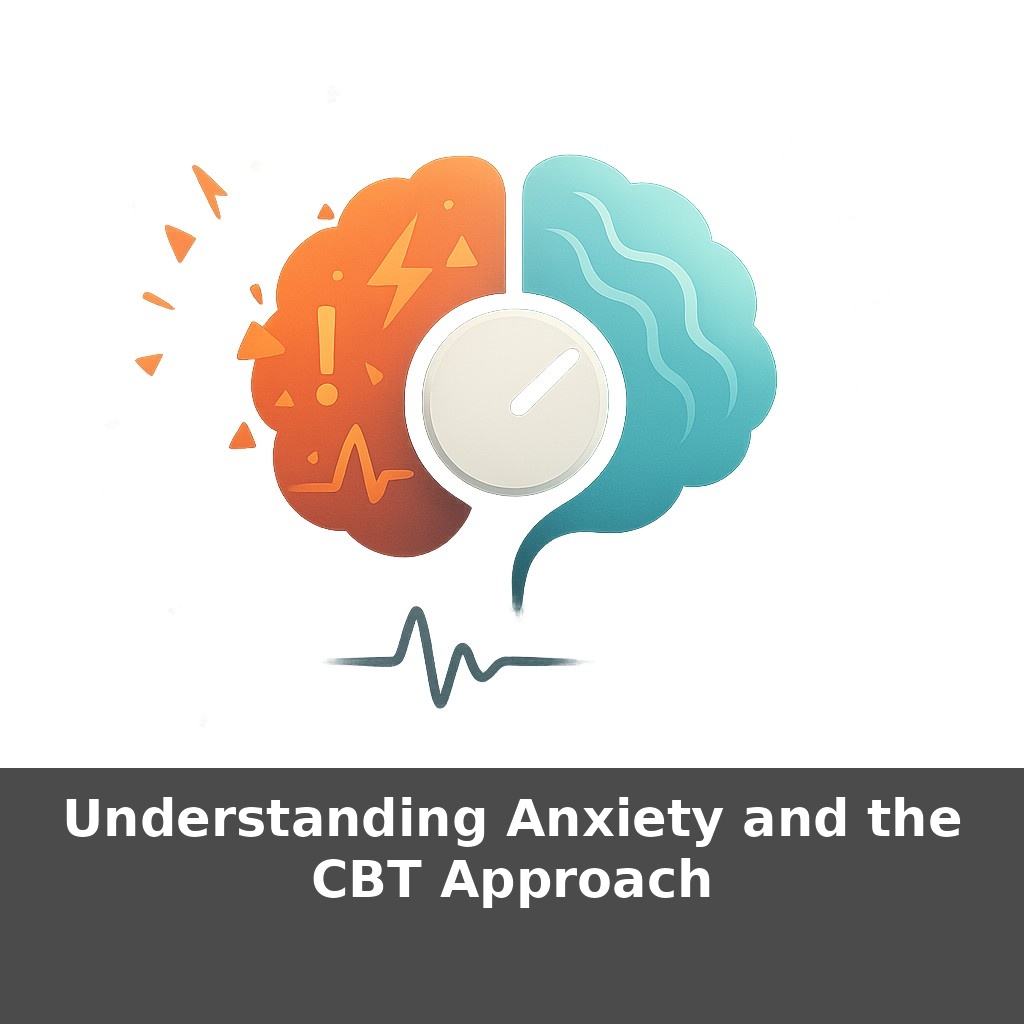
Understanding Anxiety and the CBT Approach
📝 Transcript
Right now, your brain may be falsely yelling “danger” while you’re just checking email or walking into a meeting. Here’s the twist: the same brain that learned that alarm can also learn to turn it down. Stay with me as we explore how that switch actually works.
Anxiety isn’t just “being a worrier” or “too sensitive.” It’s a whole pattern where thoughts, body, and habits start pushing in the same direction: threat. You might catch yourself scanning for what could go wrong in a meeting, feeling your shoulders creep toward your ears, and then “solving” it by cancelling plans or staying silent. In the moment, that avoidance feels like relief. But under the surface, your brain quietly learns: “Good call. That *was* dangerous.” So the next time, the alarm comes on even faster. Over weeks or years, this can shrink your world—fewer social events, fewer risks at work, less rest, more rumination. CBT steps in here, not to judge these reactions, but to gently map them, question them, and experiment with doing something different.
CBT starts by zooming in on *moments*, not your whole personality: that spike of dread before you unmute on a call, the knot in your stomach when a new email lands, the urge to check something “just one more time.” Instead of asking, “Why am I like this?” it asks, “What went through my mind *right then*?” Often it’s a quick, quiet thought—“I’ll sound stupid,” “They’ll be upset,” “I can’t handle this.” These are called automatic thoughts. They show up fast, feel convincing, and quietly steer your choices, like a GPS set to “safest route only,” even when you’d truly rather explore.
If CBT zooms in on moments, the next step is to see what those moments are *made of*. In CBT, we often break them into three parts: what you think, what you feel in your body, and what you do. The point isn’t to dissect everything you experience; it’s to slow down just enough that you can see how a tiny mental shift can change the whole chain.
Take a common work example: your manager messages, “Can we talk later?” Thought: “I’m in trouble.” Body: tight chest, heat in your face. Action: you replay every recent email, delay replying, maybe work late “just in case.” Another person might see the same message and think, “Probably an update,” feel mild curiosity, and carry on with their day. CBT is curious about that fork in the road—how two people can walk into the same situation and walk out with completely different internal weather.
This is where CBT’s “cognitive” side becomes very concrete. It treats thoughts like *hypotheses* about reality, not like facts you must obey. Instead of trying to “calm down” first, you look at the evidence: What else has my manager said or done recently? How often have “we need to talk” chats actually gone badly? What are three neutral or positive explanations? That kind of questioning doesn’t magically erase worry, but it usually softens the certainty that the worst outcome is guaranteed.
The “behavioral” side then asks: if I took these alternative explanations seriously, what small action would I try? Maybe you reply, “Sure, what’s the topic?” or you keep your evening plans rather than cancelling them. That action feeds new data back to your brain. If the conversation turns out neutral or even positive, your threat system quietly updates: “That signal wasn’t as dangerous as I predicted.”
Over time, repeated experiments like this reshape the patterns that kept anxiety looping. It’s less about being brave in dramatic ways and more about making dozens of small, deliberate choices that gather new evidence. Like a traveler gradually updating an old, inaccurate map, you start finding more routes than just “avoid” or “endure and panic.”
Think of a recent moment when your anxiety spiked: maybe seeing “typing…” linger in a chat window, or noticing a pause in someone’s voice. In CBT, that moment becomes raw material for a mini-experiment. You don’t have to change anything yet; you start by observing. For instance, you might notice: “Heart racing when the dots appear, urge to close the app, quick story that they’re annoyed with me.”
From there, CBT often uses “micro-questions” like: - “What did I predict would happen in the next 10 minutes?” - “How did my body react in the next 30 seconds?” - “What did I *not* do because of that spike?”
These questions aren’t about catching yourself doing something “wrong”; they’re about building a high-resolution picture of your personal anxiety pattern. Many people discover surprising details—like realizing the spike happens *before* they’ve even read the full message, or that their shoulders tense every time a notification sound plays, even if they don’t feel “stressed” yet. That clarity becomes the starting point for change.
CBT’s future may feel less like sitting in a therapy room and more like walking around with a quiet coach in your pocket. Emerging tools can already notice when your sleep, movement, or phone use shifts, then suggest a tiny experiment in the moment—a brief exposure, a reframing prompt, a choice to stay rather than escape. Instead of waiting for the next appointment, support can surface right at the crossroads where old reactions usually take over.
As you start noticing your own loops, the goal isn’t to “fix” yourself but to get curious, like a scientist watching the weather. Some days will feel like clear skies, others like sudden storms. Both are data. Over time, those small check‑ins can add up to a quiet confidence: you may not control the forecast, but you’re learning to steer your day through it.
Try this experiment: Pick one anxiety trigger mentioned in the episode (like giving a presentation at work or answering emails from your boss) and deliberately do just a “20% version” of it today. Before you start, quickly rate your anxiety from 0–10 and write down the exact scary thought you’re having (“I’ll mess up and everyone will think I’m incompetent”). Then do the 20% version (for example, practice the first 2 minutes of the presentation out loud, or reply to just one email without over-editing) and rate your anxiety again right after, and 10 minutes later. Compare the numbers to see whether your fear prediction matched what actually happened—and keep that result as “data” for next time your anxiety tells you the same story.
From this course
Cognitive Behavioral Techniques for Anxiety Management
8 episodesUnlock all episodes
Full access to 8 episodes and everything on OwlUp.
Subscribe — $1.99/monthLess than a coffee ☕ · Cancel anytime