Right now, your brain is running thousands of thoughts in the background—and most slip by unnoticed. Yet a few sticky ones can quietly crank up your anxiety. In this episode, we’ll zoom in on those “loudest” thoughts and explore what they might really be telling you.
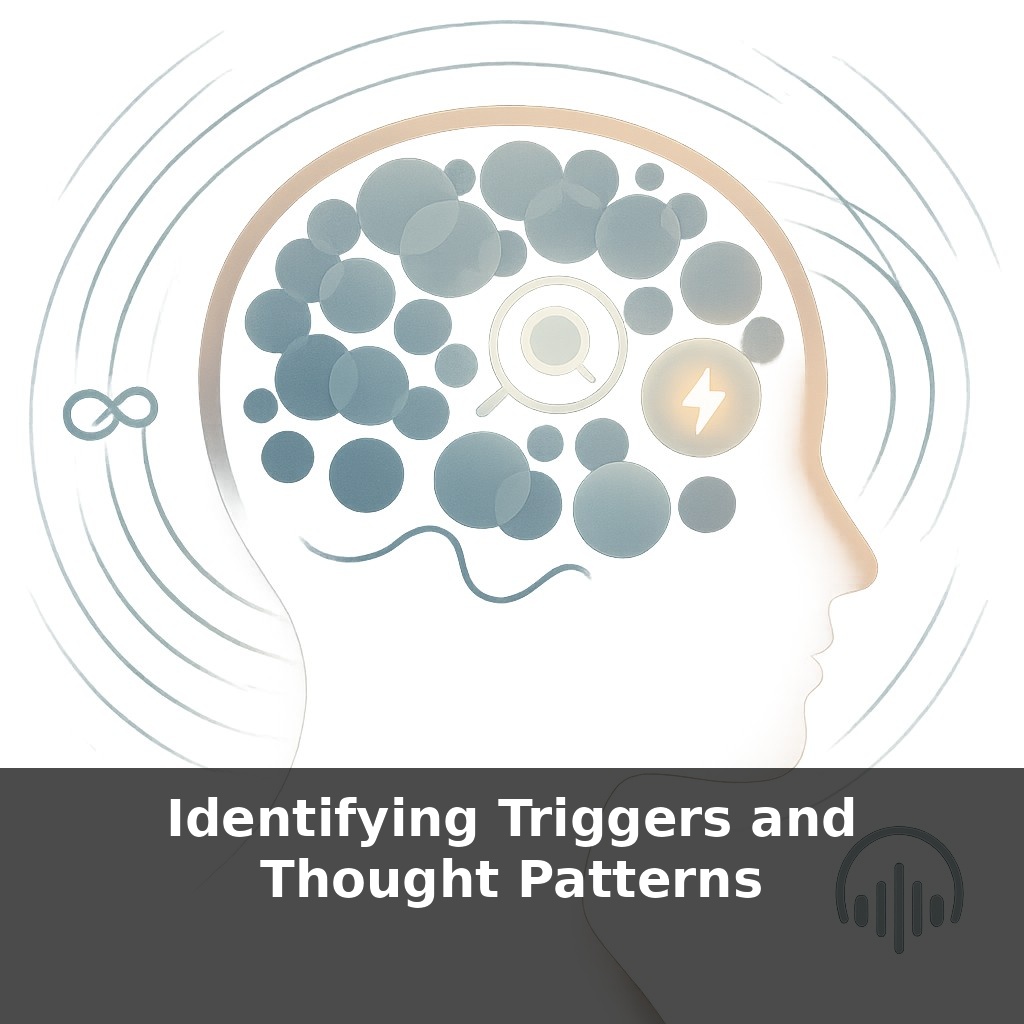
If you’ve ever walked into a room and suddenly felt tense without knowing why, you’ve already met today’s topic: triggers. They can be obvious, like a difficult email, or subtle, like a certain tone of voice that reminds you of past criticism. On their own, triggers are like sparks—brief, neutral events. What really fans them into a blaze are the patterns in how you interpret them: “This always happens,” “I know this will go badly,” “They must be upset with me.” These patterns tend to repeat in predictable ways, but they’re hard to spot in real time. In this episode, we’ll slow things down, learn how to catch those patterns in the wild, and see how even small shifts in how you respond to familiar triggers can gradually change the whole emotional “weather” of your day.
If we slow the moment down between a trigger and your reaction, there’s usually a split second where your mind “fills in the blanks.” That tiny gap is where familiar storylines jump in: “This will never work,” “I always screw up,” “They’re definitely judging me.” On a busy day, these storylines can blend together like background noise—you just feel the tension, not the script. Our goal now isn’t to silence them, but to spot which ones keep showing up, how extreme they are, and how they color your choices, like tinted glasses you forgot you were wearing.
Think of this step as shifting from “Why am I like this?” to “What exactly is happening, and when?” That means getting concrete. Rather than “I just get anxious at work,” CBT zooms in on specific moments and breaks them into pieces you can actually work with.
Research shows that when people literally write down those pieces—situation, emotion, and thought—the patterns stop being vague and start becoming visible. Not every passing idea matters; the ones we’re interested in are the recurring, believable ones that reliably spike your anxiety. A practical rule of thumb: if a thought shows up in similar situations, feels very convincing in the moment, and pushes you toward avoidance or safety behaviors (like canceling, checking, reassuring), it’s a good candidate to track.
Here’s where CBT gets very specific. Instead of just noting “I felt bad in that meeting,” you might capture:
- Situation: “Manager asked how the project is going.” - Emotion: “Anxiety 7/10; shame 6/10.” - Initial thought: “I’m obviously behind; they’re disappointed.”
Once you have a few of these snapshots from different days, you can lay them side by side and ask: what are the repeating “moves” my mind is making? Many people find familiar cognitive distortions popping up:
- Catastrophizing: jumping from a small setback to a disaster scenario. - Fortune-telling: predicting failure as if it’s already fact. - All-or-nothing thinking: rating yourself as either complete success or total failure. - Selective abstraction: zooming in on what went wrong and ignoring what went okay.
You don’t need to memorize the labels to benefit. The key is noticing the flavor: “Oh, there’s that all-or-nothing voice again,” or “That’s my inner catastrophizer talking.” Naming the pattern creates a bit of distance, which makes the next step possible: testing.
CBT doesn’t ask you to “think positive.” It asks you to become a curious investigator of your own mind. Is there evidence for this thought? Against it? Is there a more balanced way to describe what’s happening? For example, shifting from “I completely blew it” to “I stumbled on one question, but answered the rest clearly” might sound small, yet repeated shifts like this are exactly what, over weeks, start lowering your baseline anxiety.
You might notice some patterns most clearly in “in-between” moments. For instance, standing in line for coffee, your mind might replay yesterday’s meeting on loop, but always pause on the one awkward sentence you said. That’s a great moment to jot a quick note in your phone: “Coffee line – replaying meeting – zooming in on one mistake.” No need for a full journal entry; tiny snapshots add up.
Try collecting a few from different parts of your life: work, family, health, money, social plans. Over a week, you may spot that certain areas reliably trigger “I’ll never catch up,” while others cue “People will lose respect for me.” Those phrases are like recurring motifs in a song—once you hear them, you can’t un-hear them.
One helpful approach is to pick just *one* recurring phrase and track where it shows up across your day. Think of it as following a single red thread through different situations, noticing where it tightens and how strongly it pulls your actions.
A few years from now, the “thought record” might partly keep itself. Wearables and apps could quietly notice when your heart rate, sleep pattern, and digital behavior shift in a way that usually precedes your spirals. Instead of waiting for the full storm, you’d get a gentle prompt—like a weather alert for your mind: “Conditions are forming for that familiar narrative. Want to check in?” The opportunity is huge, but so are the questions: Who sees this data, and who gets access to these tools?
As you collect these “mental snapshots,” you’re also sketching a map of where you tend to get lost. Over time, that map can guide tiny course corrections—choosing a slightly different response, testing one prediction, pausing before you hit send. Think of it less as fixing yourself and more as learning the subtle terrain of your own mind, curve by curve.
Start with this tiny habit: When you notice your mood suddenly dip (like when a text goes unanswered or someone’s tone feels off), quietly say in your head, “Pause—what did I just tell myself?” Then, name that thought in 3–5 words, like “They’re mad at me” or “I always mess up.” After you name it, gently add the phrase, “Maybe that’s just my old story talking.” That’s it—no journaling, no fixing—just a quick mental label and a soft challenge whenever a trigger shows up.