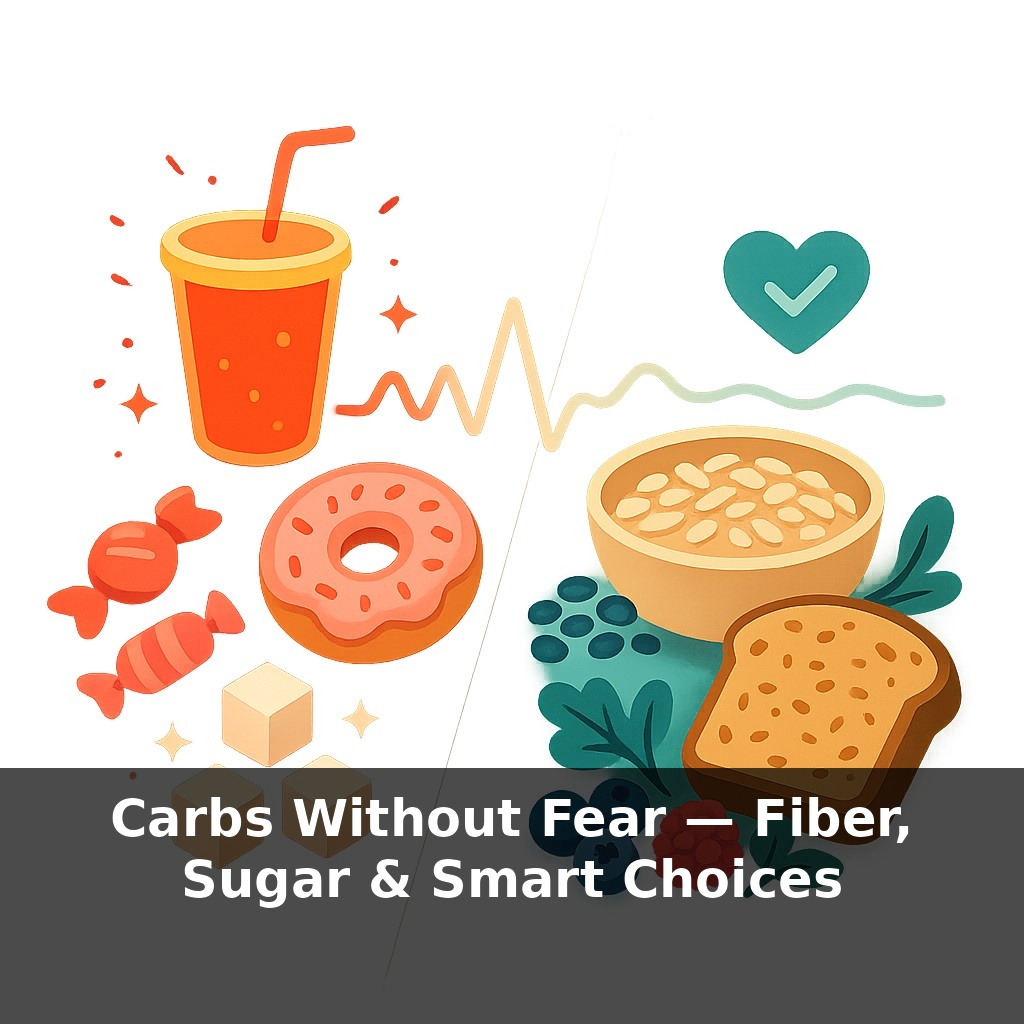
Most people eat far more sugar and far less fiber than their body can comfortably handle—yet both are technically “carbs.” You grab a granola bar, a smoothie, some “multigrain” bread, and by afternoon you’re wired, then wiped out. But what if the carb itself isn’t the villain?
About 90% of adults miss the daily fiber target, yet many easily hit—or exceed—their added sugar “allowance” before dinner. That mismatch doesn’t just show up on lab tests; it shows up in your day. You might crush a morning workout, then feel strangely hollow by 3 p.m., standing in front of the vending machine, half “hungry,” half just restless.
Today we’re zooming out from single foods and looking at carbohydrate *quality patterns*: how your usual breakfast, snacks, and dinners either stack the deck toward steady energy or set you up for constant chasing. Instead of labeling everything “good” or “bad,” we’ll look at how to quickly spot smart choices on labels and menus, and how small upgrades—like swapping one ingredient or adding one side—can shift a whole meal from blood-sugar whiplash to smooth, reliable fuel.
So how do you turn all this into something you can actually *see* on your plate? One useful lens is to ask, “What does this carb come *with*?” Some options show up dressed like a complete outfit—bringing protein, healthy fats, and micronutrients—while others are more like a plain white T‑shirt: fine, but doing very little on its own. A bowl of lentil soup, berries over yogurt, or oats topped with nuts each delivers that more “fully dressed” package, especially when their labels or recipes hit the sweet spot: at least 3 g fiber, no more than 6 g added sugar per serving.
Here’s where the “smart carb” idea stops being abstract and starts changing what actually ends up in your cart or on your plate.
Begin with what you already eat most often. For most people, that’s breakfast and snacks. Instead of asking “Is this low-carb?” shift to “Does this give me *enough* to work with?” Two quick clues on a label:
- Does it hit that ≥3 g fiber and ≤6 g added sugar per serving “smart carb” zone? - Does the first ingredient name a whole food (oats, beans, brown rice, fruit, vegetables), not a refined starch or syrup?
You don’t have to overhaul everything at once. If you typically grab cereal, scan the shelf for a version with visible grains and nuts, not frosted flakes or “crispy rice.” If your go‑to snack is crackers, look for ones where whole grain or chickpea flour appears first, then pair them with something that brings protein or fat—cheese, hummus, nut butter—to make that carb work harder for you.
Meals are similar. Think in “slots” rather than rules: one slot on the plate for a grain or starchy vegetable, one for protein, one for color (non‑starchy vegetables), plus a source of healthy fat somewhere in the mix. Your grain/starch slot is where quality matters most: quinoa instead of white rice, roasted potatoes with skin instead of fries, whole‑wheat pasta instead of regular. Same food *type*, upgraded version.
Watch out for stealth sugar in “health” foods. Flavored yogurt, granola, bottled coffee drinks, protein bars, and plant-based milks can each carry nearly a day’s worth of added sugar in what looks like a modest portion. When you see several forms of sugar in the ingredient list—cane sugar, brown rice syrup, agave, fruit juice concentrate—that’s a red flag, even if the front says “organic” or “gluten-free.”
Fruit and dessert can absolutely fit; the trick is context and portion. A cup of berries mixed into plain yogurt, or an apple with peanut butter, will land very differently than juice or sorbet on an empty stomach. You’re not chasing perfection; you’re stacking the deck. Each time you nudge a choice closer to whole, minimally processed, and fiber‑rich, you’re quietly shifting the default from “quick hit” to “stays with you”—and over weeks, that adds up.
Think of your day like writing prescriptions for your own energy and mood. At breakfast, you can “dose” yourself with a bowl that keeps you clear-headed through a tough meeting, or with something that leaves you mentally paging the snack drawer by 10:30. A “smart carb” bowl might be steel‑cut oats with chia, sliced banana, and a spoon of almond butter, while the quick option is a pastry and latte combo. Same rough calories, wildly different staying power and hunger curves.
Out in the real world, upgrades are often about sidekicks, not centerpieces. Grabbing takeout? Keep the main you enjoy, but trade the fries for a side salad with beans, or swap the white roll for a whole‑grain one. At coffee shops, pair a sweeter drink with a protein‑rich snack instead of another sweet; that small buffer changes how the whole thing lands.
Over time, patterns matter more than isolated choices. If most meals follow your “smarter carb plus something that sticks with me” template, the occasional dessert or convenience food has far less impact on how you feel day to day.
Supermarkets are already shifting: breakfast aisles look more like lab benches, with “net carbs,” “slow-release,” and gut-health claims everywhere. Expect apps and wearables to turn your usual lunch into a kind of mini-experiment, nudging you toward options that keep your mood and focus steadier. Kids’ products may change fastest—school policies and parent demand can push companies to remake classics, the way playground rules slowly retired the most dangerous equipment.
You don’t have to chase perfection; you’re learning your own “settings.” Notice which menus or routines leave you calm and focused, the way a well-tuned playlist keeps a drive easy instead of chaotic. As you adjust, your tastebuds often follow—foods that once seemed “too plain” can start to feel like relief after a day of syrupy sauces and ultra-sweet snacks.
Here’s your challenge this week: At one meal each day, swap your usual refined carb (like white bread, regular pasta, or sugary cereal) for a high-fiber option (such as lentils, chickpeas, black beans, steel-cut oats, or a whole intact grain like quinoa or barley) and hit at least 8–10 grams of fiber in that meal. Pair that carb with a source of protein or healthy fat (like eggs, Greek yogurt, tofu, salmon, avocado, or nuts) to steady your blood sugar. Do this for 7 days in a row and jot down, right after each of those meals, how your energy and hunger feel 2 hours later, using a simple 1–5 scale for both.