Why You Can't Sleep: The Science Behind Your Restless Nights
📝 Transcript
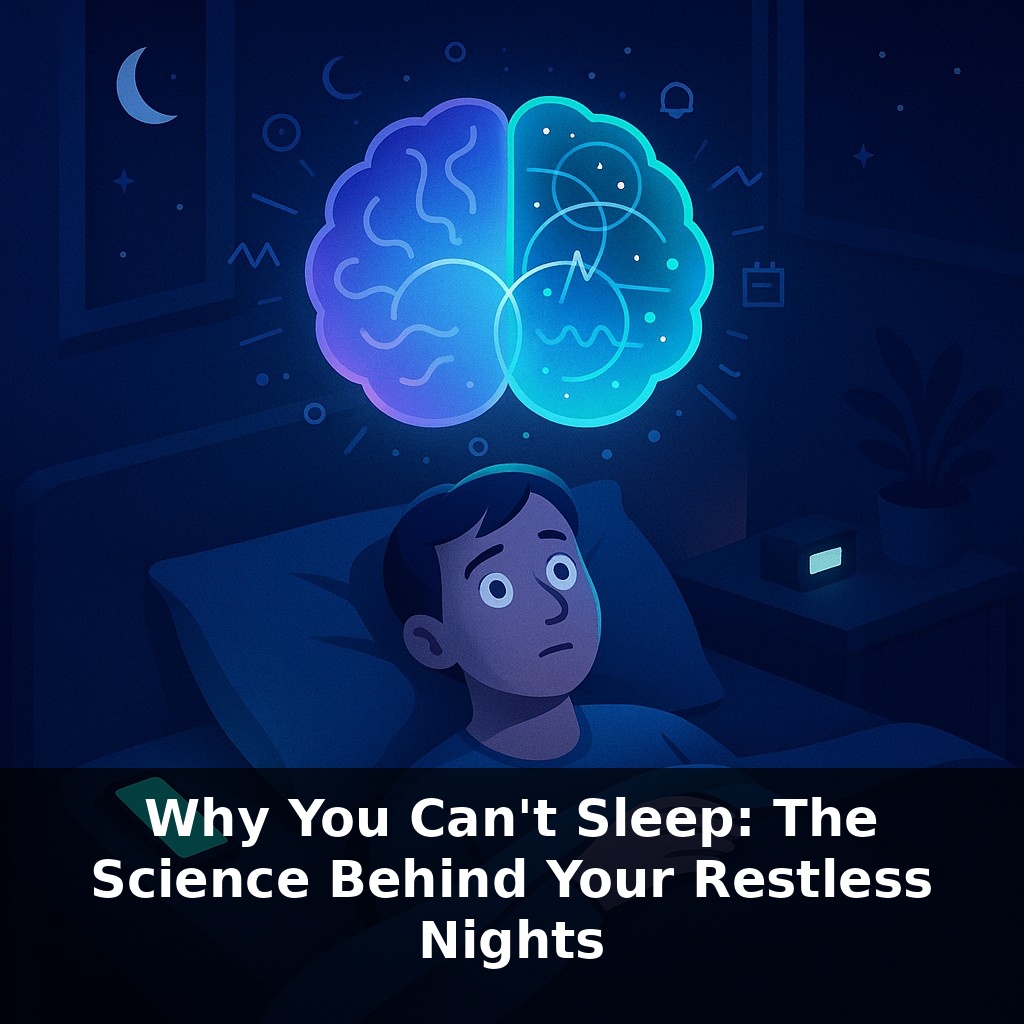
You fall into bed exhausted… and your brain hits the gas instead of the brakes. Hours pass, you scroll, you toss, you rehearse tomorrow. Here’s the twist: your body is actually trying to put you to sleep. Tonight we’ll explore why that built‑in system keeps misfiring.
So why does that system feel so unreliable on the nights you need it most? One big reason: your brain is running two overlapping schedules that don’t always agree. One follows the sun and darkness outside; the other follows what you actually do with your time. When those schedules slip out of sync, you get that jet‑lagged feeling without ever boarding a plane. Late‑night emails, weekend sleep‑ins, and random naps quietly rewrite your internal timetable, while bright screens whisper “daytime” to a brain that’s trying to wind down. On top of that, stress chemicals act like loud neighbors in the hallway, keeping the “quiet hours” from really starting. This episode, we’ll zoom in on those timing conflicts, how they scramble your sleep stages, and what that has to do with why you wake up feeling like you barely went to bed.
That mismatch doesn’t just make you feel “off”—it changes what your night is made of. Beneath the tossing and turning, your brain is supposed to cycle through lighter non‑REM, deep non‑REM, and REM in a predictable rhythm, about 4–6 times per night. When your day runs late, light stays bright, or your worries spike, certain neurochemicals shift the odds: adenosine, the pressure that builds with wakefulness; melatonin, the darkness signal; and orexin, the wake‑on switch. Depending on when and how strongly they show up, your sleep can become shallow, choppy, and oddly timed instead of steady and restorative.
Here’s where those quiet, invisible systems start colliding with your actual life.
Start with how long you’ve been awake. As hours stack up, your brain’s need for sleep climbs steadily. Stay up late a few nights in a row, and that “pressure” is high enough that you might crash on the couch at 8 p.m.—yet still pop awake at 3 a.m. Why? Because that pressure drops the moment you finally sleep, but your internal clock is still convinced “night” isn’t over yet. You end up in a no-man’s‑land: not tired enough to dive back into deep sleep, not alert enough to feel normal.
Layer in light. Step outside for bright morning light, and your clock anchors earlier; soak in intense light late at night, and it drifts later. That drift is subtle—15–30 minutes a day—but over a workweek of late-night screens, your brain is quietly shifting your “natural” bedtime toward midnight or beyond. Wake‑up time, however, stays fixed for work or kids, shrinking your sleep window even if you spend the same number of hours in bed.
Now add substances. Caffeine doesn’t just keep you from feeling tired; taken late, it reshapes the night. You may fall asleep on time but spend more minutes hovering in lighter stages, which makes you more vulnerable to every door slam, phone buzz, or worry that floats through. Alcohol flips the pattern: you slide out quickly, then your sleep breaks apart later as your body metabolizes it, fragmenting the very hours when your brain usually concentrates its deepest, most restorative work.
Chronic stress and irregular schedules push this even further. Rotating shifts, frequent all‑nighters, or constantly changing bedtimes keep your clock from stabilizing. That instability is why shift workers are more likely to report insomnia, depression, and metabolic problems. The biology isn’t “weak”; it’s being pulled in incompatible directions.
A helpful way to see this: think of a storm front in weather—when hot and cold air masses collide, you don’t get an average day, you get turbulence. Restless nights are often that turbulence made visible. Your biology is not broken; it’s responding, predictably, to mixed signals.
Think about the last week of your life as a kind of lab record. One night you fell asleep on the couch at 9:30 after a brutal day; another you stayed up past midnight answering messages; on the weekend you “caught up” with a 10 a.m. wake‑up. Those choices don’t just shift your bedtime; they change *which* kind of sleep gets sacrificed. Cut off the last hour, and you usually lose more REM. Start the night too late, and the earliest, deepest part gets squeezed. Over time, you might notice you’re sharp on facts but strangely touchy emotionally—or the reverse. People with sleep apnea often describe something similar: technically “asleep” for 7–8 hours, but yanked toward the surface so often that memory, mood, and blood pressure all pay the price. Restless‑legs sufferers tell a different story: the body won’t stay still long enough for deeper waves to settle in. Very different problems, eerily similar next‑day fog.
Soon, your “bad sleeper” label might be as outdated as calling everyone the same “blood type.” Labs are already testing personal circadian profiles, so bedtime advice could shift from generic rules to something closer to a tailored prescription. Neurologists are exploring gentle brain stimulation during deep sleep, nudging memory circuits the way a conductor shapes a late‑night rehearsal. Even city planners are testing darker, warmer streetlights so whole neighborhoods aren’t quietly jet‑lagged year‑round.
So instead of asking, “Why am *I* broken?” you can start asking, “What signals is my brain actually getting?” Bedtime then becomes less like flipping a switch and more like tuning an instrument: light, food, movement, and worry all nudging the pitch. Tiny adjustments—earlier light, calmer evenings, steadier hours—can shift the whole song of your night.
Before next week, ask yourself: 1) “Looking at my last three nights, what was I actually doing in the 2 hours before bed (screens, late emails, doomscrolling, snacking, caffeine), and which of those feels most likely to be keeping my brain ‘on’ when I’m trying to sleep?” 2) “If I had to choose just one consistent wind-down cue this week—a 10-minute dim-light routine, a warm shower, or a specific ‘no-phone-after-this-time’ rule—what would I realistically stick to every night, and what time will it start?” 3) “When I wake up at 3 a.m., what thoughts usually grab me, and what’s one simple script I can try (like ‘I’ll park this until tomorrow at 10 a.m.’ plus a breathing pattern) instead of lying there fighting my brain?”
From this course
Sleep Better Tonight: The Science of Rest
7 episodesUnlock all episodes
Full access to 7 episodes and everything on OwlUp.
Subscribe — $1.99/monthLess than a coffee ☕ · Cancel anytime