Tonight, your sleep will start changing about an hour *before* you even get near your pillow. In one study, people who tweaked that pre-bed hour fell asleep dramatically faster—without sleeping pills. Now, here’s the twist: most of them never changed their actual bedtime.
A single overhead light in your living room—just 30 lux of blue‑heavy brightness—can quietly push your body’s melatonin back by up to 90 minutes. Now layer on one more quiet disruptor: unresolved thoughts. In lab settings, people who simply wrote a specific to‑do list for the next day drifted off meaningfully faster than those who wrote about gratitude. Not because gratitude is bad, but because the brain relaxes when it sees a clear plan waiting for tomorrow. The hour before bed is where these tiny decisions stack: the lamp you leave on, the email you answer “quickly,” the workout you start too late, the drink you add “to unwind.” Each one tilts the odds for or against deep, efficient sleep. In this episode, we’re going to turn that messy, accidental hour into a deliberately designed sequence—simple, repeatable, and surprisingly powerful.
Most people think “bedtime” starts when they slide under the covers, but your biology quietly starts the countdown long before that. In lab studies, a consistent 60‑minute wind‑down doesn’t just make you *feel* calmer; it actually shifts your nervous system out of fight‑or‑flight and into “rest and digest.” Heart rate slows, stress hormones drop, and your brain stops scanning for the next alert. The twist is that this isn’t about perfection or monk‑like discipline. It’s about running the same simple moves, in the same rough order, so your body learns: *when this sequence begins, sleep is coming next.*
Most people treat that last waking hour like a junk drawer: random texts, half‑finished chores, “one more” episode, scrolling until your eyelids burn. The research points in the opposite direction. When that 60‑minute window becomes structured—same start time, same rough order—people don’t just feel calmer; they fall asleep 20–40% faster and spend more time in the deep, restorative stages your brain uses for repair and memory.
Think of this as a three‑phase protocol, not a rigid ritual.
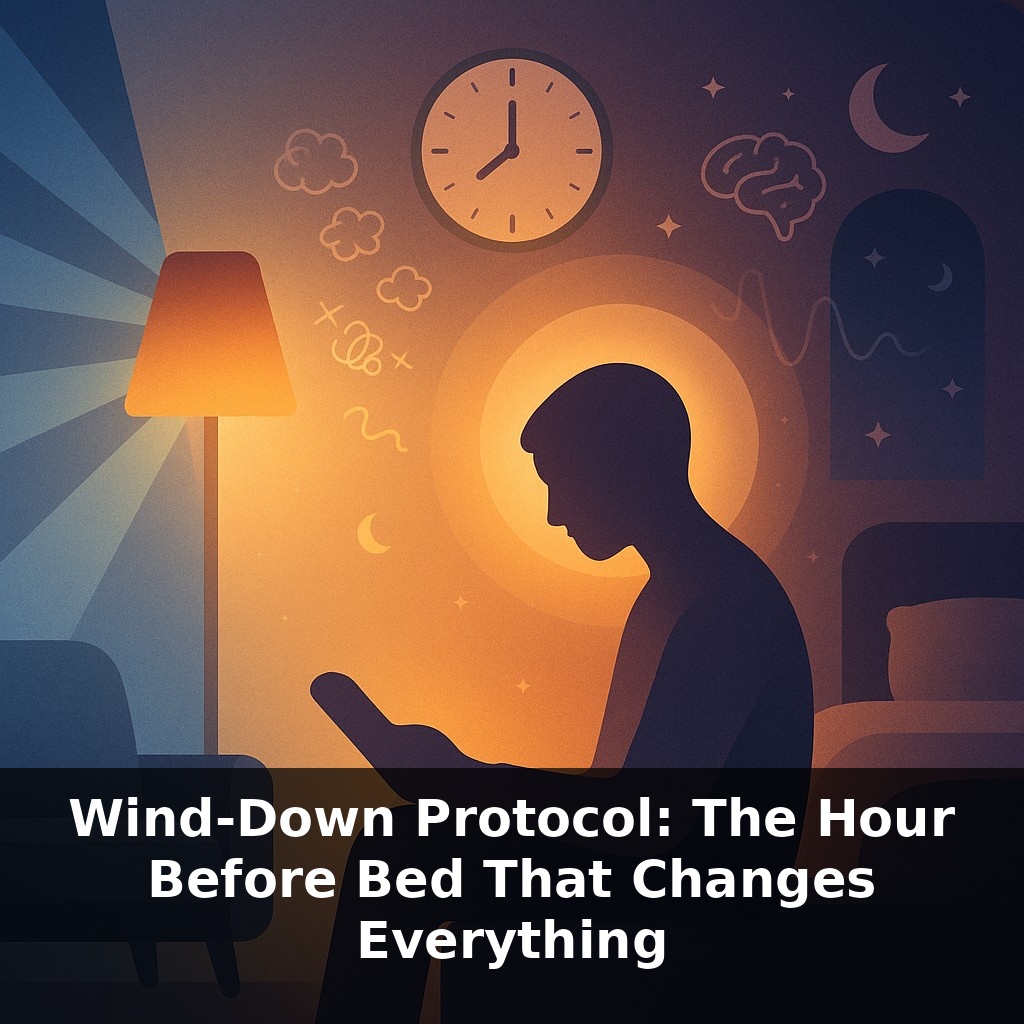
**Phase 1: Power Down (‑60 to ‑40 minutes)** Your first move is environmental, not mental. Screens dimmed or off, overheads swapped for lamps or warm bulbs, notifications silenced. This isn’t about perfection; it’s about making stimulation slightly harder to access. Even a small drop in brightness and incoming demands starts shifting your body from “perform” to “coast.”
If you’re going to exercise, it should already be done. Vigorous workouts inside this hour keep core temperature and adrenaline higher for too long, which is why that 90‑minute cutoff matters. Gentle stretching or a slow walk is fine; breathless intervals are not.
**Phase 2: Off‑Loading (‑40 to ‑20 minutes)** Now you clear mental clutter. This is where that short, specific list for tomorrow fits. Add any “don’t forget” items swirling in your head, plus one concrete first step for the morning. You’re showing your brain that problems are parked, not ignored. People often notice that once something is on paper, the urge to ruminate on it drops sharply.
You can pair this with a relaxing practice: progressive muscle relaxation, paced breathing, or a brief body scan. Across dozens of trials, these techniques reliably cut insomnia severity—about a 30% drop on standard scales.
**Phase 3: Downshift (‑20 to 0 minutes)** Now you narrow your world. Bathroom, hygiene, bed. Cool the room slightly; a small drop in temperature signals your body that it’s time for the night shift. No alcohol “nightcap” here: it may feel like it helps, but even a moderate dose can carve roughly 9% out of your REM, especially in the second half of the night.
In bed, pick one low‑stakes, repeatable cue: the same calming podcast style, a few pages of light fiction, or gentle breathing. Over a week or two, this cue becomes a kind of prescription: your body learns to associate it with shutting down, the way a specific piece of music can instantly pull you back to a particular memory.
Think of a good wind‑down like a physician writing very precise orders: each small instruction supports the next, until the whole system starts behaving differently. For some people, that order set starts in the kitchen. One client swapped his late‑night snack for a fixed “closing time” on caffeine—no coffee or tea after 2 p.m.—and noticed his wind‑down started feeling less like a battle and more like a slide. Another person learned that even “quiet” group chats kept her keyed up; she now sets an 8:30 p.m. auto‑reply that says, “Off my phone for the night—talk tomorrow.” No drama, just a boundary that protects the sequence.
You can also add a very short “review” step. Rather than replaying the day in your head, try a two‑line note: one thing that went *fine* (not amazing, just fine), and one thing you’ll handle differently tomorrow. This keeps your mind from drifting into open‑ended analysis.
Your challenge this week: choose one 10‑minute block inside that final hour—anywhere in it—and script it. Same start time, same actions, every night. Don’t overhaul the whole hour yet; just defend that single block like an appointment. At the end of seven nights, ask: Did falling asleep feel *more predictable*? If yes, extend your script to 20 minutes the following week. If not, tweak *one* element—swap screens for stretching, or chatting for reading—and run the same experiment again.
Soon, the same way fitness trackers nudged people into counting steps, “evening dashboards” may nudge you into protecting this hour: a gentle alert when email should shut off, lights that shift like a slow sunset, temperature that drops a notch without you touching a dial. Clinics may hand out sleep protocols the way they hand out inhalers, and companies might treat protected evenings like PPE for burnout—less a luxury, more standard safety gear for your mind.
Treat this like learning a new instrument: clumsy at first, then oddly automatic. As your evening starts to feel more scripted, notice what else shifts—late‑night snacking, doomscrolling, even arguments often lose their grip. You’re not chasing “perfect” nights; you’re training your body to expect rest, the way sunrise quietly trains you to wake.
Here’s your challenge this week: For the next 7 nights, run a strict 60-minute wind-down protocol before bed—no screens, no email, no social media, and no bright overhead lights. In the first 20 minutes, switch your environment to “night mode” (dim lamps only, set the thermostat cooler, and lay out tomorrow’s clothes and essentials). In the next 20 minutes, do a low-stimulation routine: a hot shower or bath, followed by light stretching or breathwork (e.g., 4 seconds in, 6 seconds out for 5 minutes). Spend the final 20 minutes in one calm, offline activity in the same room you’ll sleep in—like reading a physical book or listening to calm audio—then get in bed at the same time each night and note how long it takes you to fall asleep.