Last night, your bedroom decided how well your brain would work today—before you even closed your eyes. In one home, a slightly warmer room and a glowing screen delay deep sleep. Next door, a cooler, darker, quieter setup helps someone drift off quickly and wake up unusually clear-headed.
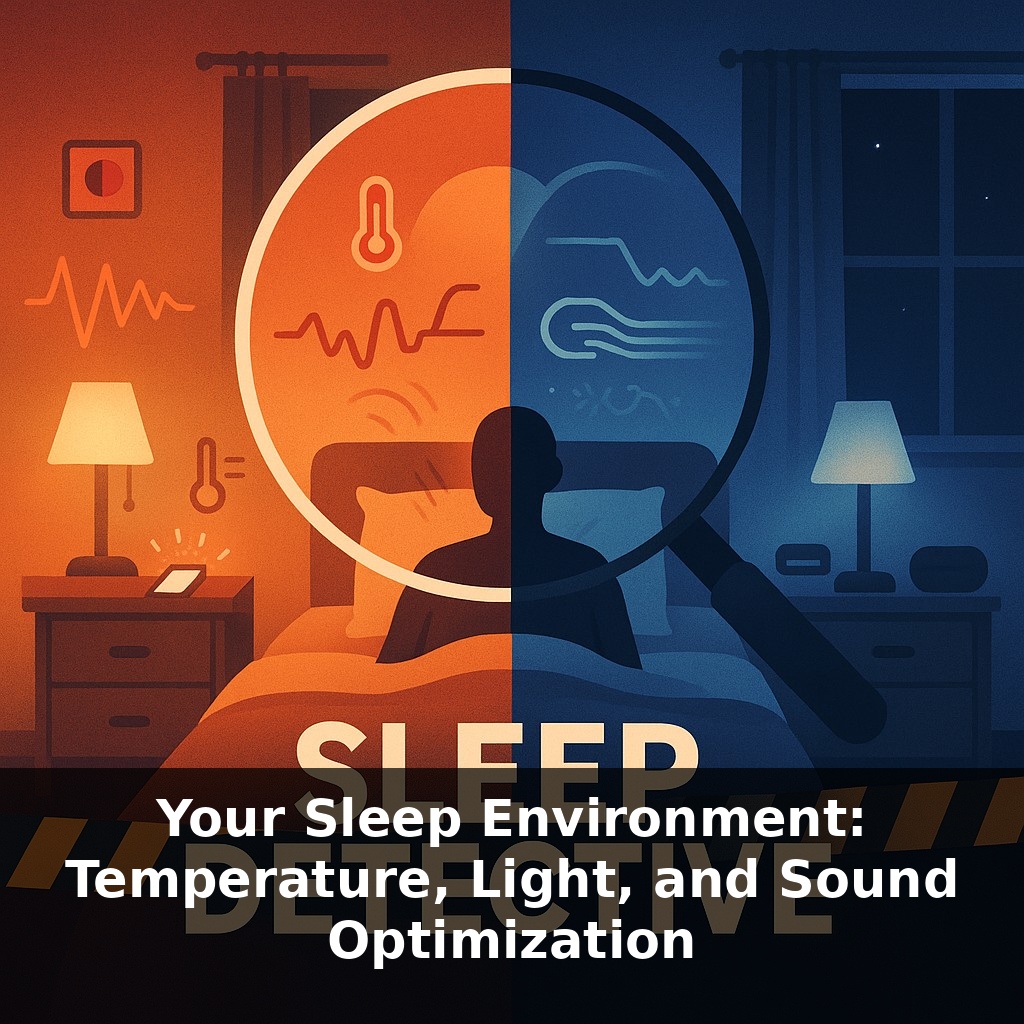
Walk through your bedroom in slow motion and treat it like a crime scene for stolen sleep. Start with what *changes* from day to night. The temperature that feels cozy at 7 p.m. might be sabotaging you by 2 a.m. as your body tries to cool down. The lamp that seems “dim enough” can still signal daytime to your brain. Even the hum of an appliance that you’ve “tuned out” might be keeping your nervous system slightly on guard, like a security guard who never fully clocks out.
Instead of chasing a perfect, magazine-worthy bedroom, think like a curious scientist: which small environmental tweak gives you the biggest improvement? In this episode, we’ll zoom in on three levers you can adjust—how cool the room actually stays all night, how your lighting shifts from evening to morning, and how predictable your soundscape is while you sleep—and turn them into experiments you can run this week.
Now zoom in on how your body “reads” the room. Under your skin, sensors constantly sample the air, light, and noise and forward that data to your internal clock, the suprachiasmatic nucleus in your brain. It doesn’t care what *time* your phone says it is; it cares what story your environment is telling. A small shift—like a streetlight sneaking around the curtains, or a heater cycling on and off—can nudge that story toward “still daytime” or “potential threat nearby.” The goal isn’t silence or perfection, but a space whose signals all agree: “It’s safe, it’s night, and it’s okay to power down.”
Shift your focus from vague “better sleep” goals to variables you can actually measure and control. Start with temperature. Most people set a thermostat once and forget it, but your body doesn’t stay constant through the night. Core temperature naturally dips, while your skin and extremities warm a bit. If the room heats up after midnight—because of a timed radiator, sun on a thin roof, or too much bedding—you may find yourself waking at almost the same time every night without knowing why. Look for hidden heat sources: a gaming PC left on, a closed door trapping warmth, a thick comforter plus pajamas that made sense in January but not in April.
Light is trickier, because “dim” to your eyes isn’t necessarily “night” to your biology. The 100-lux level that can suppress melatonin isn’t very bright by everyday standards—it’s a couple of small lamps or an uncovered tablet screen. The real issue is *when* and *where* light hits your eyes. Overhead fixtures and bright bathroom lights in the last hour before bed are stealth culprits. So are motion-activated hallway lights that flare on if you get up to use the bathroom, giving your brain a brief, misleading sunrise.
Sound adds another layer. Your nervous system tracks not just volume, but *change*. A truck downshifting outside, a neighbor’s door slam, a fridge that roars to life, each can trigger tiny micro-awakenings that you’ll never remember but will feel as “unrested.” Counterintuitively, a steady, low-level sound can make these intrusions less jarring by narrowing the contrast between quiet and sudden noise. That’s why some people sleep better with a fan or a noise machine than in “perfect” silence.
One practical way to think about these three levers is like adjusting vital signs in a clinic: temperature, light, and noise each have a therapeutic range. Outside that range, your sleep system works harder to compensate; inside it, it can do its job with less effort. Your task is not to hit a magical number, but to notice which small, specific adjustments move you closer to feeling refreshed when you wake.
Think of this like adjusting three sliders on a mixing board rather than hunting for one magic switch. For temperature, your “slider” might be as simple as swapping in a lighter duvet and cracking the window 2 cm, then noticing whether you still kick the covers off at 3 a.m. With light, you could run a two-night experiment: one night, keep all overheads off after dinner and rely only on a warm bedside lamp; another night, leave your usual lights on. Compare how quickly your mind settles both nights, and how groggy you feel the next morning.
For sound, try pairing a consistent background audio (a fan, or pink-noise track around 40 dB) with a small test: leave your window slightly more open than usual on a night with traffic, and see if the constant sound makes sudden bumps less intrusive. Subtle changes like rotating your bed so your eyes don’t face a doorway crack or noisy wall can also pay off. Over a few nights, patterns emerge: maybe your “sweet spot” is cooler than you thought, light lower than you assumed, and sound slightly louder—but steadier—than you’ve been aiming for.
Your bedroom might soon behave less like furniture and more like a quiet, observant clinician. As materials learn to “breathe” heat away, windows tint themselves like changing skies, and cities carve out acoustic safe zones, your nightly baseline could improve without you lifting a finger. The interesting twist: once the basics are automated, the question shifts from “Can I fall asleep?” to “What do I want my nights to *do* for me—recovery, learning, mood repair, or all three?”
Your challenge this week: run a 3-night lab-on-yourself.
Night 1 – Temperature test: Set your room 1–2 °C (2–3 °F) cooler than usual, but keep bedding the same. Note: how long you *feel* it takes to fall asleep and how many times you recall waking.
Night 2 – Light test: Keep all overhead lights off for the last 60 minutes before bed; use only one warm bedside lamp and avoid screens facing your eyes. On waking, rate morning alertness from 1–10.
Night 3 – Sound test: Add a steady sound source (fan or pink-noise app on low). Don’t change anything else. In the morning, note whether you recall fewer nighttime disturbances.
At week’s end, pick *one* change that helped the most and lock it in for the next month.
Each tweak you make becomes a tiny “nudge” your biology starts to anticipate: cooler air cues winding down, softer light hints at off-duty mode, steadier sound reassures the brain that nothing urgent is happening. Over time, these nudges stack, like small brushstrokes on a canvas, until your nights feel less like a battle and more like a routine your body recognizes.
Start with this tiny habit: When you first walk into your bedroom at night, tap your thermostat or AC one notch cooler (even just 1–2 degrees) and say out loud, “Cooling for sleep.” Then, before you turn off your bedside lamp, cover just one small light source (like the LED on a charger or power strip) with a piece of tape or a sticker. If you usually play something on your phone in bed, switch tonight to a 5-minute pink noise audio instead of scrolling.