Right now, as you’re listening, your brain is ticking through a hidden ninety‑minute rhythm that doesn’t care what your alarm is set to. In one case it makes you sharp and clear; in another, it leaves you foggy and impulsive. Same brain, same day—completely different outcome.
You already know that ninety‑minute rhythm is quietly steering your sharpest and dullest moments. Now zoom out: your calendar, alarm clock, and to‑do list usually ignore it completely. We slice our days into tidy 30‑ or 60‑minute chunks, then wonder why a “simple” 8 a.m. meeting feels like thinking through wet cement while a late‑morning task suddenly feels effortless. That mismatch isn’t just annoying; it’s costly. Research shows that waking abruptly from the wrong part of this rhythm can temporarily trash your judgment as much as being mildly drunk. And we don’t only mistime sleep—we mistime focus, cramming deep work into the exact windows when our biology is drifting. The quiet opportunity here isn’t to sleep more or work more, but to place the same hours differently so your body’s clock finally gets a vote in your schedule.
Think about the parts of your day that feel strangely “out of sync”: the meeting where everyone stares blankly, the late‑night scroll that somehow stretches past midnight, the afternoon where your to‑do list grows but your brain feels like it’s on mute. Those aren’t random weak spots; they’re often where your schedule collides with the natural rise and fall of your alertness. Chronobiology research shows that, on top of your 24‑hour circadian rhythm, shorter ultradian waves shape when you’re primed to dive deep, coast, or rest. Most calendars bulldoze over these waves; this series is about finally surfing them instead.
Here’s where that 90‑minute pattern stops being an abstract lab finding and starts messing with (or upgrading) your real life: the clock on the wall and the clock in your brain almost never line up by accident.
Sleep researchers see a repeating structure in a normal night: lighter stages, then deeper, physically restorative stages, then a burst of dreaming activity. That arc repeats several times, but not like copy‑paste. Early in the night, you spend more time in deep, body‑repair sleep; later, the balance tilts toward longer dreaming episodes that are tightly linked to emotional processing and memory. When you yank yourself awake at a random wall‑clock time, you’re effectively placing a blind bet on which part of that arc you’re cutting through.
Now add two complications. First, those arcs are not identical between people. One person’s average might hover around 80 minutes, another’s around 100, and the same person can shift night to night based on stress, alcohol, exercise, or light exposure. Second, your “start time” is rarely stable. Weekend bedtime drift, late‑night emails, or a streaming cliff‑hanger push the whole sequence forward, so that 6:30 a.m. alarm slices through a different internal moment on Monday than it did on Thursday.
This helps explain why six and a half hours can feel fine one day and brutal the next, even if the number is the same. It’s not just how long you slept, but whether you happened to surface near the natural end of one of those arcs. Over a full night you’ll usually get four to six of them; the closer your rise time lands to the edge of one, the less “drag” you feel in the first half‑hour of your day.
The same pattern quietly shapes your waking performance. Intense focus, then a dip; creative fluency, then a flat patch. When you try to plow straight through that dip with caffeine and willpower, you’re not only fighting biology; you’re also blurring the contrast between genuinely prime windows and low‑gear ones.
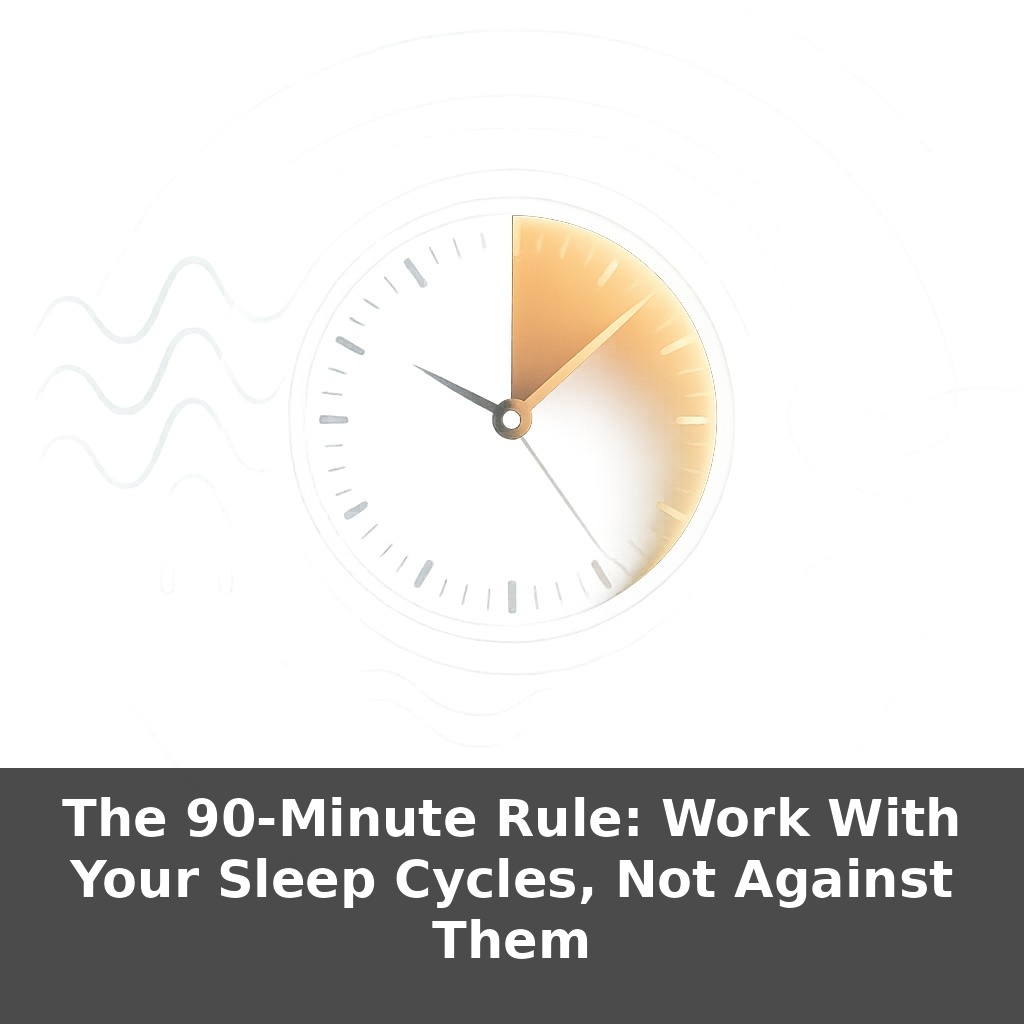
Instead of treating each hour as interchangeable, you can begin treating those ninety‑ish‑minute runs as the basic unit of your day—one for heavier lifting, another for lighter administrative load, another held back for recovery. The art is not in hitting a perfect number, but in consistently aiming your toughest mental work, and your wake‑up time, at the “edges” of these cycles rather than their deepest troughs.
Think about three very different people using the same 90‑minute idea in totally different ways.
A surgeon schedules her hardest procedures to start right after a focused 90‑minute prep block, then insists on a brief reset before moving to the next case. She’s not working fewer hours, just stacking the most delicate decisions into her natural “high‑clarity” windows.
A designer plans her day in 90‑minute lanes: one for deep sketching, one for feedback and emails, one for revisions. When she feels that familiar mental fade, she doesn’t push harder—she swaps to low‑stakes tasks and lets the next wave of alertness carry the creative work again.
A parent who can’t change their alarm time still experiments with shifting bedtime in 15‑minute steps, noticing which wake‑up times feel “clean” versus brutally heavy. Over a month, they map a personal pattern that no app could guess.
Like a cardiologist reading an ECG trace, you’re learning to see the repeating pattern under the noise—and then place the critical moments of your day on the most stable parts of that line.
Your alarm clock is about to get competition. As consumer wearables slowly creep toward brain‑level accuracy, they won’t just count steps—they’ll start “reading the room” of your nervous system. Your phone might delay an alarm by five minutes because your current phase looks like landing in turbulence, not a smooth glide path. Offices could shift from rigid 9–5 blocks to timetables that flex like a tide chart, matching demanding meetings to each person’s rising cognitive “tide” instead of the boss’s calendar.
Start by watching for one small clue: moments when tasks feel strangely “frictionless,” like green lights on an empty road. Those are hints of timing that fits you. Your challenge this week: pick one regular activity—bedtime, wake‑up, or deep‑work block—and shift it by 15 minutes every few days, hunting for that smoother, more natural click.