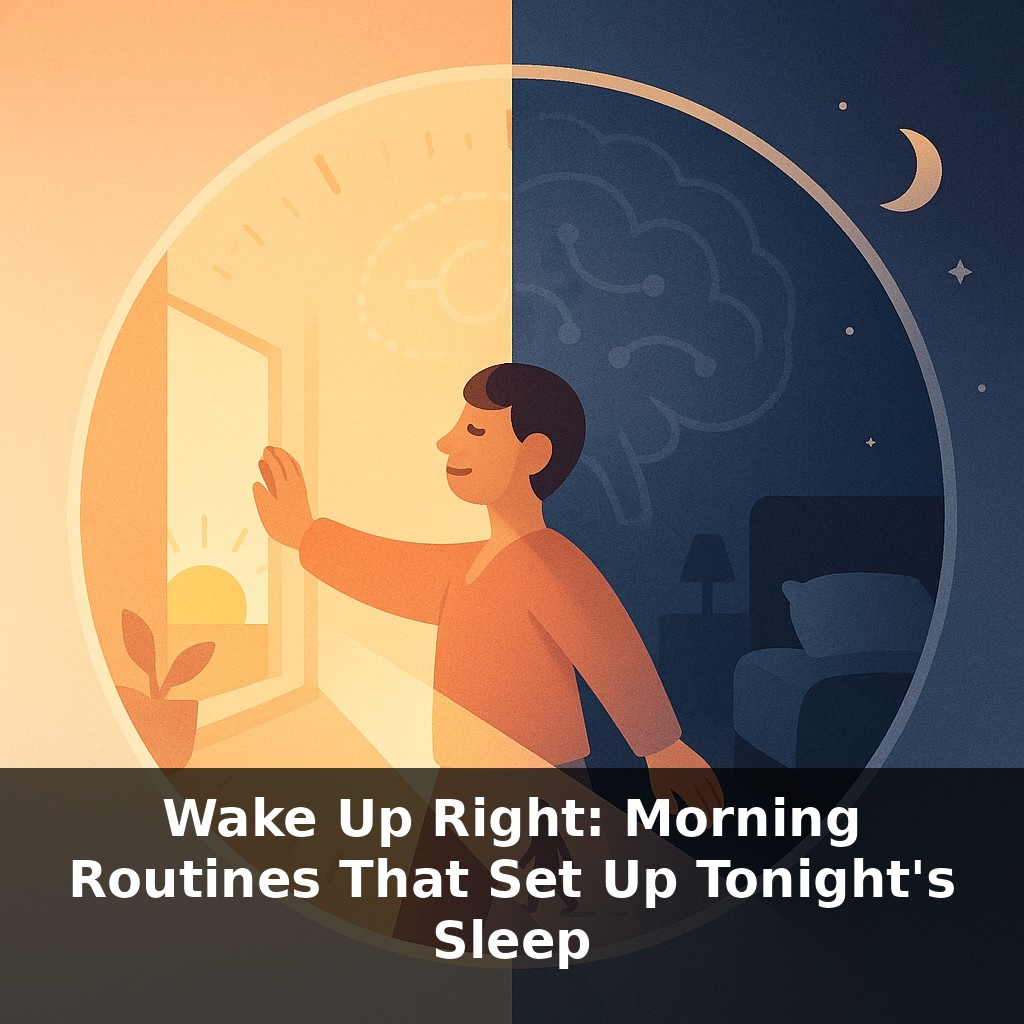
You decide to fix your sleep with a new bedtime—but the real countdown started hours earlier, when you first opened your eyes. One short walk in morning light can shift your body’s “sleep switch” by more than an hour. So if better sleep begins at dawn… what are you doing after you wake?
Most people treat morning like a groggy prelude to the “real” day, but your body treats it like a briefing for the next 24 hours. In those first couple of hours, your brain is quietly taking notes: how bright is it, how much are we moving, what’s in the bloodstream, are we rushing or grounded? Later tonight, it will replay that briefing almost line by line.
Step outside for a few minutes, and your internal clock reads that as “we’re daytime people.” Scroll in the dark with a double espresso, and it adjusts the script toward “jet-lagged indoor worker.” These tiny morning choices stack up—like adding brushstrokes to a painting you won’t see clearly until bedtime.
In this episode, we’ll zoom into those first 1–2 hours after waking and turn them into a simple, repeatable setup for easier sleep tonight.
So what exactly are those first hours after waking telling your body? Think of them as your daily “sample day” that your brain assumes will repeat: if mornings are bright, active, and steady, it predicts a clear day–night pattern; if they’re dim, jittery, and chaotic, it plans for a blurry one. Light is your headline, movement is the supporting paragraph, caffeine sets the font size on your alertness, and your mindset adds margin notes in the form of stress or ease. Change any of these, and tonight’s sleep story changes, even if your bedtime and total hours in bed stay the same.
Here’s where the science gets very practical.
Within about 30–90 minutes of waking, your body runs through a sequence: cortisol rises, temperature starts to climb, and melatonin stays suppressed. That sequence is surprisingly “programmable” by what you do—especially with light, movement, and stimulants.
Light first. Those 10–30 minutes outside aren’t about brightness in a vague sense; they’re about intensity and timing. Outdoor light, even on an overcast morning, can be 10–20 times stronger than most indoor office lighting. Studies show that when people live by dawn and dusk outdoors for a few days, their evening melatonin naturally starts earlier—by up to 1.5 hours in that camping study. Back in “normal life,” you don’t need a tent; you just need to mimic the strong, early light signal: face a window, step on a balcony, walk around the block, or drink your coffee near the brightest spot you can find.
Next, movement. Early exercise isn’t only a “wake-up” trick; it changes how long it takes to drift off at night. In that Appalachian State work, morning workouts made people fall asleep far faster than evening ones. Not everyone can hit the gym at 7 a.m., but you don’t need a full session. Even 5–10 minutes of brisk walking, light cycling, or climbing stairs tells your body, “This is the active phase of the day,” which helps it feel appropriately “off-duty” later.
Caffeine is where many people quietly sabotage themselves. With a ~5-hour half-life, a standard 8 a.m. coffee is usually compatible with 10–11 p.m. sleep for most adults. Stack a second large coffee at 11 and an energy drink at 2 p.m., and suddenly you’ve created a low, lingering level of stimulation that’s still present at bedtime, even if you feel tired. That mismatch—tired but wired—shows up as lying awake, frequent waking, or lighter sleep.
One more piece: how you *enter* the day mentally. A relentlessly rushed first hour—email, news, multitasking—can keep your nervous system slightly revved all day, which shows up at night as mental “spin.” A brief, consistent anchor (two quiet minutes of breathing, stretching, or journaling) acts more like a calibration than a wellness ritual: it sets a reference point of calm your body can more easily return to when it’s time to power down.
Think of three different mornings from your past week. On the “great day,” what actually happened between getting out of bed and starting work? Maybe you opened a window, put on real clothes, made breakfast. On the “chaos day,” maybe you grabbed your phone, skipped food, or sat in dim light until your commute. Track those details, and you’ll notice they often predict how easy it was to fall asleep that night more than your official bedtime did.
You can also borrow from people whose performance depends on recovery. Many elite athletes front‑load structure into their mornings: consistent wake times, quick protein, a few minutes outdoors, no random training late in the day. Not because they’re “morning people,” but because they’ve tested what lets them actually *switch off* later.
One useful lens: instead of asking, “How do I survive mornings?” ask, “What would make 10 p.m. version of me grateful for what I did before 9 a.m.?” That shift tends to simplify your choices—less about doing more, more about removing what scrambles the rest of the day.
Office design might start to feel less like decor and more like a prescription. Floor‑to‑ceiling windows, rooftop meeting spots, even walking paths that purposely cross sunny areas could be marketed as “sleep‑supportive infrastructure.” Personal tech may follow: wearables nudging you outside after waking, or calendar apps that flag late‑day caffeine the way they warn about double‑booking. The more data we gather, the more your “morning signature” could become a vital sign clinicians actually monitor.
So rather than chasing a perfect “miracle morning,” think in terms of a light sketch you redraw daily: a few strokes of daylight, some movement, a gentler mental pace. Over time, you’ll see which lines matter most for you. The experiment isn’t about control; it’s about noticing how small, steady shifts after waking quietly rewrite how tonight feels.
Here’s your challenge this week: For the next 7 days, get outside within 30 minutes of waking and spend at least 10 minutes in natural light without sunglasses, looking toward (but not directly at) the sky. While you’re out there, keep your phone on airplane mode and move your body continuously—walk, stretch, or do light mobility the entire time. On two of those days, finish your outdoor light session by planning a fixed “no-caffeine-after” time (e.g., 12 p.m.) and stick to it to protect your sleep drive tonight.