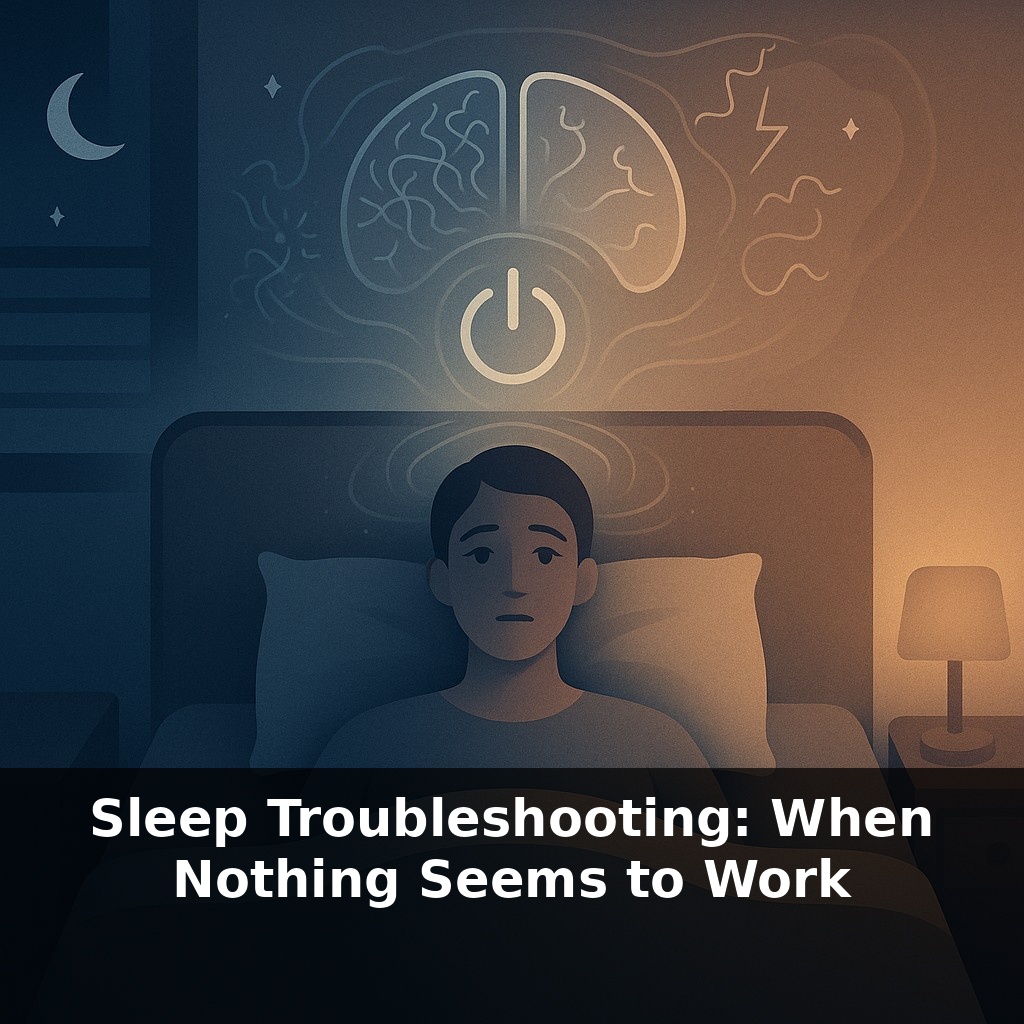
Tonight, millions of people will crawl into bed exhausted, follow every sleep tip they’ve heard… and still lie awake for hours. How can a body be tired, a brain be tired, and yet sleep just *not* start? Let’s rewind that moment and uncover what’s quietly blocking the “off” switch.
One in three adults is officially “sleep-deprived” on paper… yet some of them still *feel* wired at midnight and foggy all day, even when they hit 7–8 hours. So if it’s not just about logging more time in bed or perfecting routines, what actually keeps sleep stuck? In this episode, we’ll zoom out and treat your sleep like a full-body health check, not a bedtime project. We’ll look upstream: subtle breathing issues, iron levels, hormones, mood, even the timing of your first light in the morning. Then we’ll move downstream, into the habits and thoughts that quietly train your brain to associate bed with effort, not ease. Think of this as a systematic audit, peeling back layers until you can see which part of the “sleep system” is really jammed—so you stop guessing, and start testing what works for *you*.
Think of tonight’s episode as stepping back from the pillow and looking at the whole 24‑hour canvas your sleep lives on. We’re not just asking, “What happens at 11 p.m.?” but “What’s been quietly steering you there since breakfast?” For some people, it’s like a fire alarm that keeps going off with no smoke in sight; for others, it’s more like following a map that’s subtly misprinted, sending them to bed at a time their brain treats as midday. Our job now is to separate noise from signal, so you can see whether biology, timing, or training is doing most of the heavy lifting.
Here’s the part most people skip: we’re going to stop asking, “How do I fall asleep?” and start asking, *“What kind of problem is this, exactly?”* Because when nothing works, it’s usually not that you’re “broken”; it’s that you’re using the right tool on the wrong lock.
First lock: hidden biological blockers. Instead of guessing, you gather clues. Do you snore loudly, wake with a dry mouth, or feel like you’ve run a marathon after a full night in bed? That cluster points one way. Do you feel an uncomfortable urge to move your legs in the evening, or get creepy‑crawly sensations that ease with walking? That cluster points another. Night sweats, sudden weight changes, racing heart, or cycles of low mood with worse sleep at specific times of year all sketch different patterns. The goal is not self‑diagnosis; it’s building a tight, specific story you can bring to a clinician so they’re not just prescribing a stronger sleep aid.
Second lock: timing, not quantity. Some people are trying to sleep at what is, for their brain, 6 p.m. “internal time.” A telltale sign is this paradox: you feel wide awake at midnight but impossibly groggy at 7 a.m., *even if* you went to bed early. Here, the levers look less like “relax more” and more like precise, almost boring tweaks: when you see bright light, when you dim it, how consistently you wake up, and whether meals and exercise cluster early or late. These are less about willpower and more about shifting the whole curve of when your brain thinks “day” starts.
Third lock: the training your nights have already had. Months of scrolling, worrying, or clock‑watching in bed teach your nervous system that bed = effort. People in this camp often say, “I’m *exhausted* until I get into bed; then my brain switches on.” That’s a learned loop. Here, the work is surprisingly active: getting out of bed when sleep isn’t happening, capping time in bed to match realistic sleep, challenging catastrophic “I’ll be useless tomorrow” thoughts. It can feel counterintuitive, even confrontational, because you’re breaking rules your fear has been enforcing.
And sometimes, more than one lock is jammed at once. That’s when a team—medical, psychological, and technical—can test each layer systematically, so you’re not endlessly rearranging your bedroom while the real issue lives elsewhere.
Think of three different “stuck sleep” characters and see where you recognize yourself. First, there’s the “all‑nighter accountant”: their numbers look fine on paper—time in bed, dark room, quiet house—yet their brain keeps throwing “error” messages at 2 a.m. This person often discovers a mismatch between when they *try* to sleep and when their internal clock expects to be “on call,” so even minor stress feels amplified late at night.
Second, the “late‑show host”: they don’t feel truly awake until 9 p.m., hit a creative stride when others wind down, and crash hard only toward dawn. For them, carefully shifting morning light, meal timing, and social plans can be more powerful than any supplement.
Third, the “bedtime negotiator”: they start winding down at 9, but every extra minute awake in bed turns into a debate with themselves. They might benefit most from learning to leave the room briefly when sleep stalls, treating wakefulness as a cue to reset—not a verdict on the whole night.
Soon, you may walk into a clinic with months of data from a ring or watch, and instead of vague “bad nights,” your record will show precise signatures—like weather maps of your nights—guiding tailored plans. Meds could be chosen the way glasses are fitted, based on your specific neural and genetic “prescription.” On a larger scale, schools, hospitals, and 24‑hour workplaces might be redesigned around when people actually function best, not just when clocks say they should.
So instead of hunting for a magic trick, you’re learning to map the terrain: which nights feel like clogged city traffic, which flow like a quiet river, which stall like a plane in a holding pattern. Your challenge this week: treat each rough night as a field report, not a failure, and note one small clue you hadn’t noticed before. That’s how real patterns start to surface.