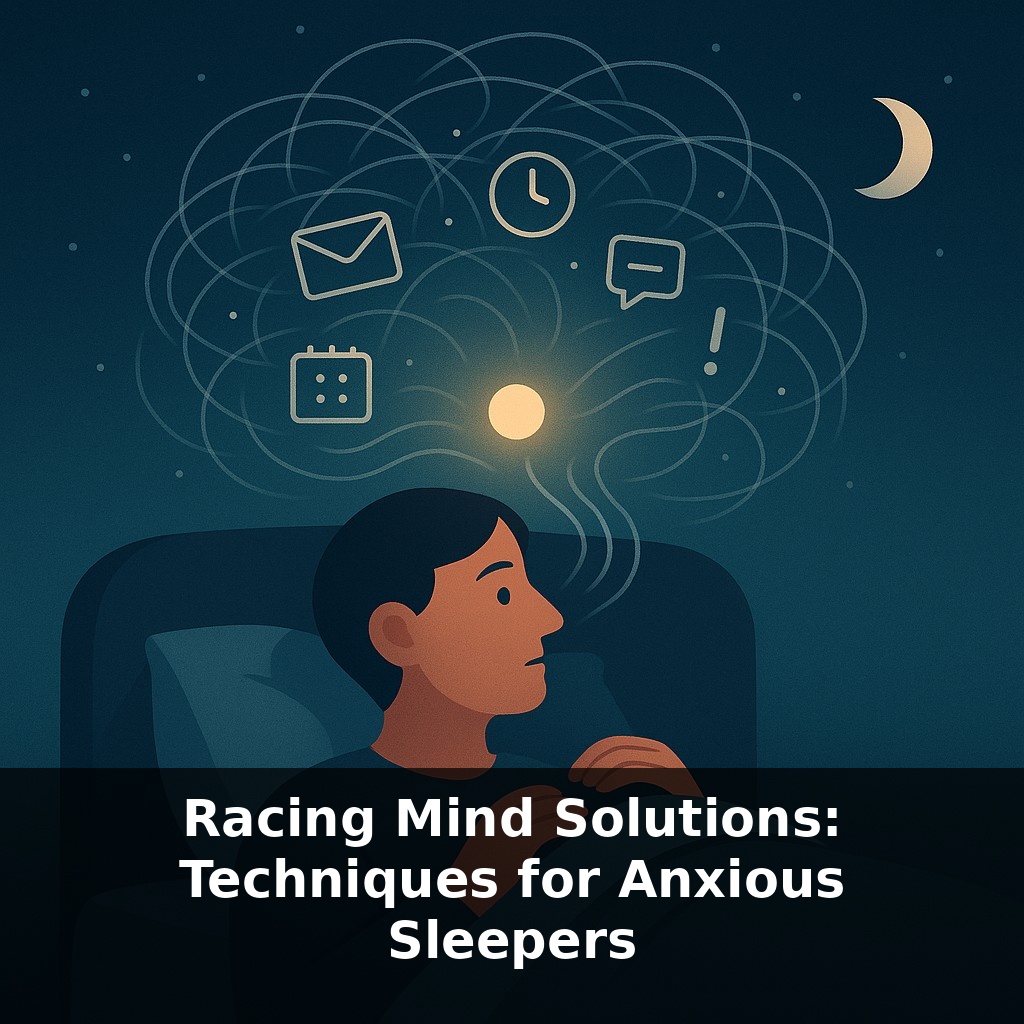
Right now, millions of people climb into bed and get more awake with every minute that passes. The lights are off, the room is quiet, but their brain is busy drafting emails, replaying arguments, planning tomorrow. The paradox? Their body is exhausted—and their mind is on overtime.
About 30 percent of adults say sleep slips through their fingers at least some of the time—and for many, the culprit isn’t noise, light, or caffeine. It’s the brain quietly revving up just when the lights go out. You lie down, and instead of drifting off, your thoughts start arranging tomorrow like files on a cluttered desk, or replaying today in high definition.
In this episode, we’ll zoom in on that “racing mind” specifically: what keeps it running, why simply feeling tired isn’t enough to make it slow down, and what actually works to shift gears. We’ll look at techniques tested in real clinics, not just wellness trends—methods that can shorten the time it takes to fall asleep, cut down on 3 a.m. awakenings, and ease that knot of pre-bed anxiety.
Think of this as building a custom wind‑down system for your brain—one you can start using tonight.
Tonight we’ll get specific about what actually turns the volume down on that mental noise. Researchers talk about “cognitive arousal” and “physiological arousal” as if they’re separate radio channels—one broadcasting thoughts, the other, body signals like heart rate and muscle tension. For many anxious sleepers, both dials are turned up at once. That’s why only changing your thoughts or only relaxing your body often isn’t enough. The most effective approach stacks simple mental shifts with concrete body cues you can trigger on demand, so your system learns a predictable sequence from wide awake to ready to sleep.
Here’s the puzzle scientists have been mapping out: when people say “my mind won’t shut off,” they’re actually talking about several different mental habits that show up at bedtime and feed each other. For some, it’s endless “what if” scenarios. For others, it’s rewinding the day for an internal performance review, or drafting tomorrow’s to‑do list as if the deadline is midnight. The key is that these patterns are learnable—your brain has practised doing them at night—and that means they’re trainable in a different direction.
Researchers break these habits into a few buckets. One is *worry*: future‑focused, threat‑scanning thoughts (“What if I mess up that presentation?”). Another is *rumination*: looping analysis of the past (“Why did I say that in the meeting?”). A third is *problem‑solving and planning* that simply shows up at the wrong time. Each of these keeps attention locked onto content that feels important, which signals the nervous system to stay on alert.
So instead of trying to “stop thinking,” the more realistic move is to give your mind a new job at each stage of the evening. Early in the night, that job might be a short, designated slot for structured problem‑solving—classic “worry time,” where you actually write down the issues, sketch a next step, and consciously park them. Later, closer to bed, the job shifts to something narrow and repetitive: counting slow breaths, mentally scanning the body, or following a brief guided practice. That narrowing of focus is what loosens the grip of spiralling thought.
On the body side, timing turns out to matter as much as the specific technique. Slow breathing, for example, works best when it’s *paced*—say, a few minutes of 4‑7‑8 breathing—rather than a single deep breath whenever you feel tense. Likewise, progressive muscle relaxation has more impact when you move through the same muscle groups in the same order each night, so your brain begins to associate that pattern with “nothing left to do.”
Over a few weeks, this repeatable sequence becomes a kind of mental choreography: handle what can be handled, then gradually step down into simpler, quieter tasks until not responding to thoughts feels safer than engaging them.
Think of a night routine built like a three‑part playlist. The first “track” might be ten minutes at the kitchen table with a notebook, where you dump tomorrow’s logistics and decide on one starter step for each big item. Light on emotion, heavy on logistics—almost like you’re your own project manager clocking out.
The second track shifts location and tempo: lights dimmed, phone in another room, you move through a simple sequence—wash face, stretch, maybe read two pages of something low‑stakes. The details matter less than keeping it in the same order, so your brain learns the pattern.
The final track happens in bed and is deliberately boring: perhaps counting down your breaths from 100, or doing a slow mental walk through a familiar street, noticing small, neutral details—doorways, trees, windows. When other thoughts barge in, you note them briefly and return to the “walk,” the way a radio host gently fades one song out and brings the next one up. Over time, your system starts anticipating that fade.
CBT‑I and relaxation tools are still in their early innings. As wearables get better at spotting subtle spikes in heart‑rate variability, your headphones or bedside speaker could nudge you with a two‑minute custom drill *precisely* when your thoughts start to speed up. Think less “generic sleep app,” more like a jazz musician improvising around your personal rhythms—switching tracks when it senses you tensing, backing off when you’re finally drifting without needing a pill.
You don’t have to “win” against your thoughts in one night; the skill is built like learning an instrument—rough at first, then more fluid as your hands remember where to go. Your challenge this week: notice one tiny moment each evening when your mind *almost* slows. Treat that as your practice bell, and gently extend it by just one more breath.