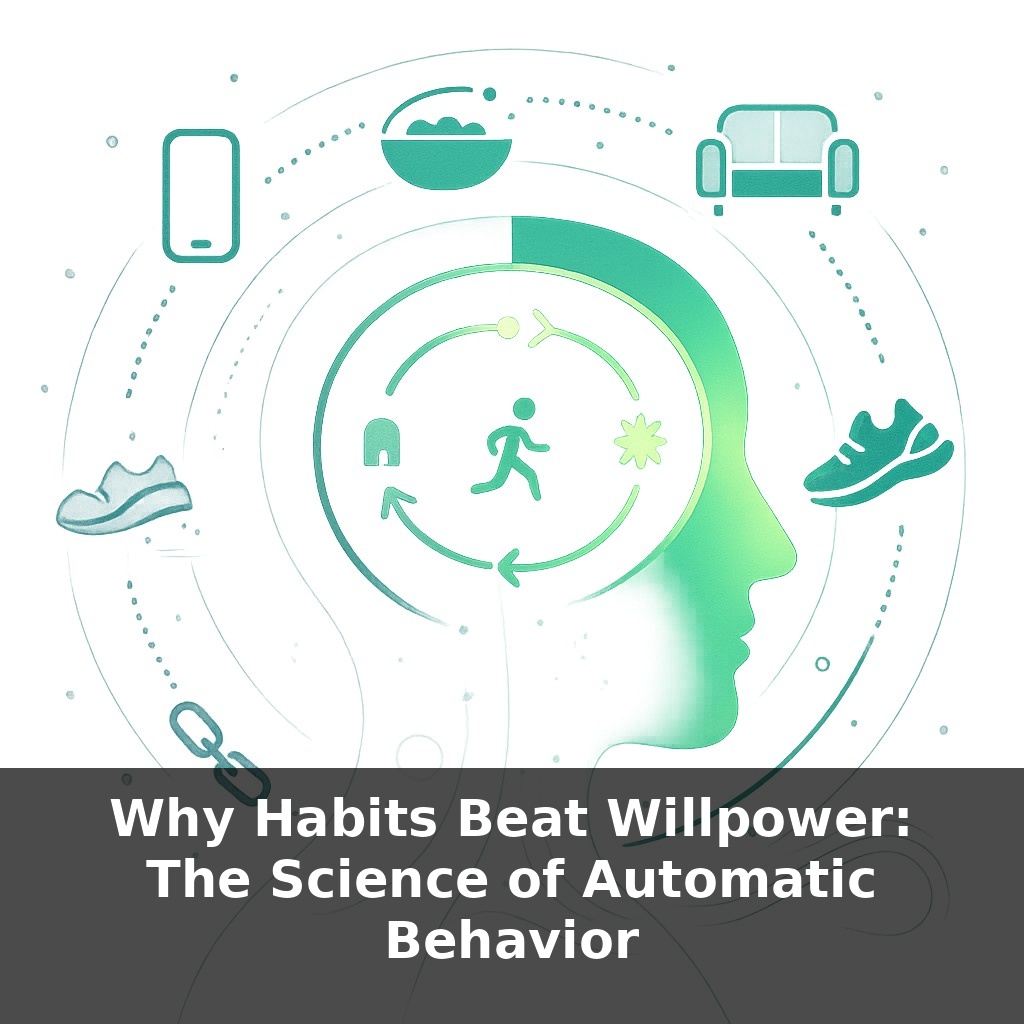
Why Habits Beat Willpower: The Science of Automatic Behavior
📝 Transcript
About half of what you did today, you didn’t really decide—you just ran scripts in your head. You reached for your phone, opened the same apps, ate in the same way. Now here’s the weird part: those mindless moments might be steering your entire health future.
Those “background behaviors” don’t just appear out of nowhere—your brain quietly builds them every time you repeat an action in the same situation. Walk into the kitchen feeling bored, grab a snack, repeat that loop a few dozen times, and your brain treats it like a well-worn path across a grassy field. Soon, your feet just follow it without asking permission. That’s efficient… until the path leads somewhere you don’t want to go: late-night scrolling instead of sleep, skipped workouts instead of strength, drive‑thru dinners instead of real meals. The twist is that the same wiring that locks in unhelpful loops can be turned in your favor. Your brain doesn’t care whether a pattern is good or bad for your health—it only cares whether it’s familiar and easy to run. Our job is to redesign what “easy and familiar” looks like.
Here’s where things get interesting: your “autopilot time” isn’t random. It clusters around specific contexts—waking up, commuting, sitting at your desk, feeling stressed, walking into your living room at night. In those moments, your brain quietly favors whatever action is fastest and most predictable, not necessarily what’s healthiest. That’s why a long day can erase your best intentions while your usual patterns stay rock‑solid. The real leverage, then, isn’t trying to feel more motivated, but redesigning what “fast and predictable” looks like in those recurring situations, so the easy choice and the healthy choice start to become the same thing.
Here’s the tension at the core of lasting change: the part of your brain that makes plans is not the same part that runs your day.
That planning, promising, resolution‑making side lives largely in your prefrontal cortex—the area involved in logic, long‑term thinking, and “I really should” decisions. It’s brilliant at drawing up goals: “I’ll cook more,” “I’ll sleep earlier,” “I’ll exercise after work.” But it’s also fragile. It tires when you’re stressed, underslept, or juggling too many choices. That’s why the version of you that sets ambitious health targets on Sunday night keeps getting overruled by the version of you that just wants the easiest option on Wednesday at 6 p.m.
Habits sit in a different neighborhood: the basal ganglia, a cluster of structures tuned for efficiency and repetition. Once a habit is installed, this system can run whole action sequences with almost no conscious debate. A specific cue appears—time of day, place, emotional state, or even another action—and the behavior fires off with minimal fuel. Studies using brain imaging show that repeated routines literally “chunk” into single control signals there; the brain stops micromanaging the steps and just launches the whole routine.
This helps explain a few things that often feel mysterious from the inside. You can genuinely want to change yet still keep reaching for the same snack, hitting the same snooze, or skipping the same workout. It’s not that your goals don’t matter; they’re just housed in a system that’s easily knocked offline. Meanwhile, your ingrained loops are stored in a system designed to be stubborn. The more exhausted or overloaded you are, the more control quietly shifts from your goal‑setting circuitry to these hardier, automatic routines.
That shift shows up in real‑world data. In an internal Starbucks report, for example, managers found that giving baristas clear “if‑then” scripts for tricky customer moments cut service errors by a quarter. Under pressure, staff didn’t rely on being extra patient or focused; they fell back on rehearsed responses linked to specific triggers. Researchers have seen something similar with exercise: when people create detailed plans like “If it’s 5 p.m. on weekdays, I will walk straight to the gym from my office,” they end up working out two to three times as often as those with the same intentions but fuzzier plans.
Your health, then, is heavily shaped by whichever system—fragile planner or durable autopilot—gets the first move in your recurring situations. The more you can pre‑load those moments with simple, reliable responses, the less you have to count on being your most disciplined self at exactly the right time.
Think about three moments that reliably derail people’s health: late‑night snacking, skipped workouts, and phone‑in‑hand mornings.
Late at night, most people try to “be strong” in front of the pantry. But a more effective move is programming a tiny, default routine: bowl on the counter, herbal tea box visible, chopped fruit ready in the fridge. The cue (walking into the kitchen) quietly launches that sequence before debate starts.
For workouts, notice how often a single friction point kills the plan: hunting for clothes, finding headphones, choosing a routine. Turning that into one pre‑loaded bundle—gym bag packed, simple A/B workout cards, shoes by the door—means the cue (arriving home) triggers a run of small, nearly automatic actions instead of a negotiation.
Morning phone spirals work the same way. If your charger lives outside the bedroom and your notebook and pen live on the nightstand, waking up is more like a prepared “scene change” than a decision gauntlet.
Autopilot still runs—but now it runs something you designed on purpose.
When you zoom out, habits aren’t just personal quirks; they’re quiet levers on whole systems. As AI and cities get smarter, your routines will interact with them like gears meshing in a watch: your default walk to work might sync with dynamic air‑quality routes, or your regular bedtime could trigger home lighting that nudges deeper sleep. The big opportunity is treating habits less like private struggles and more like design inputs for environments that cooperate instead of compete.
So the question shifts from “Do I have enough willpower?” to “What tiny loop could quietly run here instead?” Like a gardener nudging vines along a trellis, you’re not forcing growth; you’re giving it a direction. Each small, repeated choice is a vote, and over time the tally becomes identity: “someone who moves,” “someone who rests,” “someone who eats to feel well.”
Before next week, ask yourself: 1) “Which habit do I currently rely on sheer willpower for (like late-night snacking, scrolling in bed, or skipping my morning routine), and what tiny ‘autopilot’ cue could I change today—such as where I put my phone, snacks, or workout clothes—to make the default choice easier?” 2) “If my environment was silently ‘voting’ for the person I want to become, what’s one object I can move, remove, or add in my kitchen, bedroom, or desk area today to nudge me toward that habit without thinking?” 3) “When and where during my existing day (right after coffee, after brushing my teeth, or after shutting my laptop) does it feel most natural to ‘hook’ this new habit so it can ride on a routine I already do automatically?”
From this course
The Habit Blueprint: Build Behaviors That Last
8 episodesUnlock all episodes
Full access to 8 episodes and everything on OwlUp.
Subscribe — $1.99/monthLess than a coffee ☕ · Cancel anytime