Right now, a bowl of candy moving just a few steps farther away can cut how much people eat by about half. In one office, nothing else changed—same workers, same candy—only the distance. So here’s the puzzle: if tiny shifts like that work, what could your environment be doing to you?
Forty percent of what you do today will happen with almost no conscious thought—and your surroundings will quietly steer a lot of it. A notification buzz, the position of your couch, the default on an app, the way your kitchen is laid out: all of these are “silent instructions” telling your brain what to do next. We tend to blame willpower when habits don’t stick, but much of the time, the arena is rigged before motivation even shows up. Your future choices are being preloaded by layouts, defaults, and little bits of friction (or the lack of it) scattered through your day. Instead of trying to wrestle every urge, you can redesign the arena itself, so the easiest action is usually the one you actually want to take—and the unhelpful option feels just a bit too annoying to bother with.
Most of this “arena rigging” happens long before you decide anything. Office architects choose where food goes. App designers pick where the bright red button sits. Even friends and family help script your habits: who you eat with, who you text first, who expects you to “always be on.” Each of these choices quietly shifts what feels normal. And because your brain loves shortcuts, it tends to follow what’s normal, not what’s ideal. That means two things: first, you’re already being shaped by environments you didn’t design—and second, you can start becoming the designer instead of just the user.
Think of environment design as three overlapping layers: physical, digital, and social. Each one can quietly nudge you toward a habit—or away from it—without you “trying harder.”
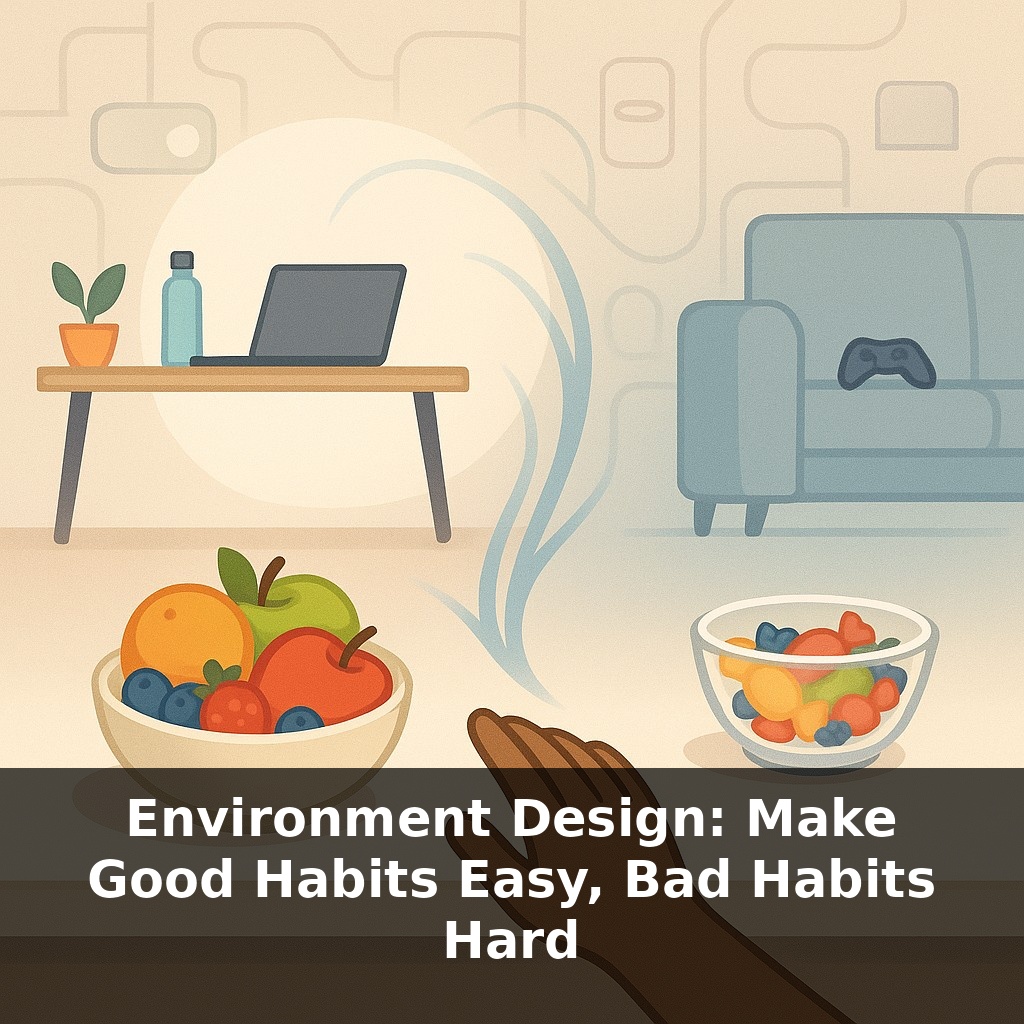
Start with the physical layer. This is everything you can touch or see in a room: where food lives in your kitchen, what’s on your desk, what you see first when you open the fridge. The Wansink & Hanks finding about chocolate distance isn’t just about candy; it’s a template. Change the location, visibility, and reachability of almost anything, and behavior follows. Healthy snacks on the counter, treats in the back of a cupboard. Running shoes by the door, not buried in a closet. The question becomes: what’s in the “fast lane” of your life, and what’s in the “slow lane”?
Then there’s the digital layer. Apps, notifications, home screens, passwords, autoplay—these are your invisible furniture. The Stanford result about adding just one extra click to social media shows how fragile a “quick check” can be. Every added step is a speed bump; every removed step is a ramp. Moving distractions off your home screen, turning off badges, or logging out after each use are tiny, structural edits that change what “just checking” costs you.
Finally, the social layer. The people around you set expectations: whether it’s normal to drink on weeknights, to order dessert, to answer email at midnight. Habits spread through groups the way fashions do. If everyone in your team eats lunch at their desk, leaving the office to walk will feel strangely “extra,” even if it’s healthier. Flip the script—join a group chat where people post their workouts, or schedule a standing walk with a colleague—and suddenly the new behavior is the one that feels default.
One careful analogy: in finance, you can change outcomes not by becoming a stock-picking genius, but by setting better automatic transfers and contribution rates. Environment design for habits works the same way: you rearrange the pipelines, not your personality.
The key shift is seeing every habit as partly a response to how easy, obvious, and socially accepted it feels. You’re not just a person with “strong” or “weak” willpower—you’re an architect, constantly placing ramps and roadblocks in your own way, whether you mean to or not.
A simple way to spot environment design in action is to trace the path of least resistance. Think about your morning: do you reach for your phone before you’re fully awake? That’s not usually a “decision”; it’s that the phone is within arm’s reach, lit up, and begging to be touched. Move it across the room and, tomorrow, your “first move” might quietly change to stretching, jotting a note, or speaking to someone nearby.
You can also look at people who seem “naturally disciplined” and ask where their surroundings are doing hidden work. The coworker who always works out at 6 a.m. might sleep in gym clothes, keep a packed bag by the door, and meet a friend at the same time daily. The person who reads a lot may have a book by the kettle, another in their bag, and a rule that the TV remote never lives on the coffee table. None of these are huge acts of self-control; they’re structural advantages, stacked.
Smart homes and cities will push this further. Walls, lights, and streets will “listen” to your routines and subtly steer you: brightening when it’s time to focus, dimming when screens should wind down, surfacing stairs before elevators. Wearables may become like quiet coaches, tightening or loosening friction based on stress, sleep, and goals. The real frontier won’t be whether nudges exist, but who controls the dials—and how clearly you get to see and adjust them.
Your surroundings are already “editing” your days; now you’re learning to hold the pen. Start small: one drawer, one app, one routine. Notice which setups feel like walking downhill and which feel like wading through mud. Over time, you’re less a passenger in your own life and more like a sound engineer, slowly tuning the levels on what gets louder—and what fades out.
Before next week, ask yourself: 1) “If a stranger walked into my kitchen, desk, and phone home screen right now, what habits would those spaces be ‘inviting’ them to do—and which one spot could I rearrange today so the good habit is literally the easiest option to reach?” 2) “Where do my worst habits usually happen (couch + Netflix, phone in bed, snack cabinet), and what single friction can I add there today—like logging out, moving the remote, or putting snacks on a high shelf—to make that behavior just annoying enough to skip?” 3) “If I had to design my environment so I could almost ‘trip over’ my best habit tomorrow morning (like putting my running shoes by the coffee maker or my book on my pillow), what would I move, prep, or lay out before I go to bed tonight?”