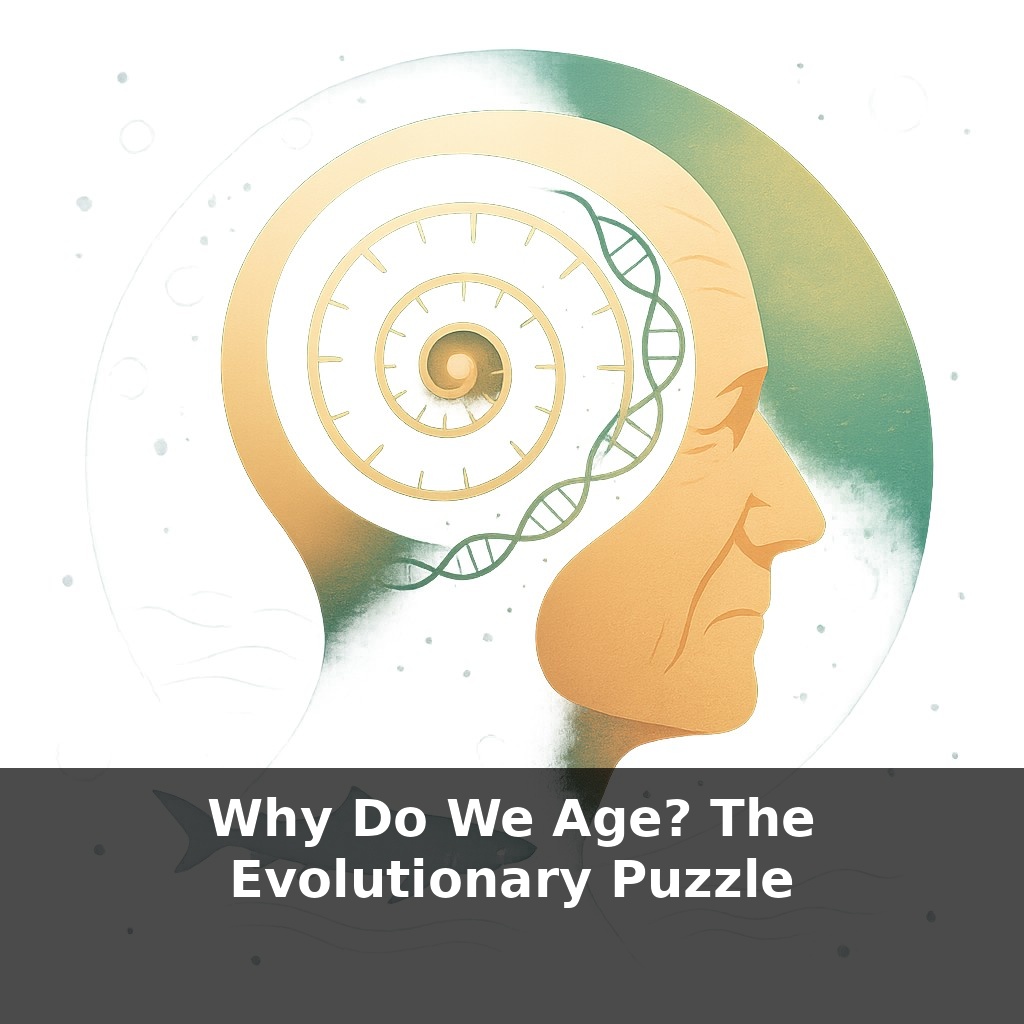
Why Do We Age? The Evolutionary Puzzle
📝 Transcript
A shark gliding through Arctic waters right now may outlive your entire family line. Same planet, same physics, utterly different aging clock. So here’s the puzzle: if some creatures barely seem to age at all, why are our own bodies on such a strict expiration schedule?
Some species seem to treat time like a mild suggestion; others burn through life like a short-term lease. The mystery is why evolution “allows” that frail decline in the first place. Cells already know how to repair DNA, clear waste, and replace broken parts. You’re walking around with a full maintenance toolkit, yet it’s used unevenly across your lifespan and your body. Your heart and brain get VIP service for decades, while other systems are more like an aging rental car: fix what’s critical, ignore the rattles. The core question isn’t just “what goes wrong?” but “why stop fixing it when we could?” That shifts aging from a sad inevitability to a strategic compromise: given limited energy, organisms must choose between building, reproducing, and preserving. In this light, our late-life wear and tear might be less a failure of design and more the bill for earlier evolutionary wins.
Here’s where the puzzle deepens: the rate of decline isn’t fixed by physics, it’s wildly negotiable. A Greenland shark and a bluefin tuna are both large predators, yet one can span centuries while the other barely reaches retirement age. Their parts aren’t made of different atoms; what differs is how often they’re likely to be killed by something else. When early death is common, biology behaves like a short-term renter—no point in renovating a kitchen you’ll soon lose. When survival is safer, long-term “upgrades” suddenly pay off, and lifespans quietly stretch.
Here’s the twist evolutionary biologists uncovered: the body doesn’t have one single “age switch.” It has countless small decisions about where to spend limited resources, and those decisions are heavily biased toward youth.
Natural selection is ruthless about what happens before and during reproduction. Any mutation that helps you grow faster, compete better, or have more offspring—even if it slightly sabotages you decades later—can spread. This is antagonistic pleiotropy: the same gene has a helpful effect early, a harmful one late. In lab worms, for instance, altering the age-1 gene in an insulin-like pathway extends life dramatically, but variants that boost early growth or fertility can win in the wild despite their late costs.
You can see this logic in experiments with fruit flies. Michael Rose simply changed the rules: only flies that reproduced late were allowed to found the next generation. Within a handful of generations, their lifespans nearly doubled. No new physics, no miracle molecule—just a shift in what evolution “pays for.” When survival to old age suddenly matters, bodies evolve to stay functional longer.
This helps explain why humans sit in a strange spot among mammals. Compared to many similar-sized species, we tend to live a long time. Once tools, social groups, and culture reduced adult death from predators and accidents, it became worthwhile to invest more in bodily upkeep. Older adults who could help grandchildren survive or pass on knowledge indirectly boosted their genetic legacy, nudging our species toward extended vitality.
Crucially, this doesn’t mean there are “death genes” whose job is to terminate us. Most genes linked to later decline are doing important work earlier on—managing growth, metabolism, reproduction. After those jobs are done, natural selection largely stops proofreading their long-term side effects. Meanwhile, a few species that rarely die from external causes and benefit from huge size or stability—some trees, Hydra—have slipped into a state where functional decline is minimal. Their existence shows the rules of chemistry don’t demand aging; it’s an evolutionary accounting choice.
Your challenge this week: notice where your own life reflects that same trade-off logic. Watch for moments you knowingly favor short-term payoff over long-term resilience—whether it’s sleep, food, stress, or work—and ask: “What would the ‘late-life optimized’ version of me choose here instead?”
Think about how different bodies “budget” across species. A mouse and a parrot can eat similar seeds, yet one is lucky to reach 3 years, while the other may chat through 60 birthdays. The mouse’s world is full of owls, traps, and winter; its biology leans into early speed and reproduction. The parrot, often safer in trees or social flocks, can “afford” slower development and extended upkeep. Or take Pacific salmon: they pour nearly everything into one explosive breeding event, then rapidly fall apart. Contrast that with elephants, where each calf is a massive investment; adults get sturdier bodies and slower aging because every extra year of competent parenting is biologically profitable.
A useful way to frame it is like a software company racing toward launch: most time goes into features that attract early users, not bulletproof security for version 4.0. Unless future stability pays off, it rarely gets full funding.
If late-life problems arise partly because our bodies stop “budgeting” for them, future medicine may try rewriting that budget. Senolytic drugs, for instance, are like hiring a cleanup crew to evict worn‑out cells so tissues keep functioning smoothly. Gene editing goes deeper, trying to keep the early-life benefits of powerful pathways while muting their late costs. Success here won’t just stretch healthy years; it could force new norms for work, caregiving, and even how societies value age.
Where does this leave us? Not with a fixed script, but with dials we’re only starting to find. Lab work in worms, flies, and mice hints that tweaking energy use, stress responses, and cell cleanup can stretch vigor, not just years. Think less “pause button” on time and more “better ingredients and timing” in a recipe we’re still learning to cook.
Here’s your challenge this week: Run a 7‑day “future‑self experiment” based on the evolutionary idea that our bodies prioritize reproduction over long-term maintenance. Each day, pick one concrete behavior that shifts energy toward long-term repair instead of short-term payoff: one day do 30 minutes of zone-2 style movement (easy but sustained), another day add a protein‑rich, minimally processed meal aimed at muscle maintenance, another night enforce a strict 8‑hour sleep window with no screens 60 minutes before bed, and another day schedule a social interaction that genuinely reduces your stress load. Before you start, write your current “future‑self age” (how old you *feel* you’re aging toward) and at the end of the 7 days, update that number and decide which single habit you’ll lock in for the next month.
From this course
The Science of Aging: Why We Get Old
7 episodesUnlock all episodes
Full access to 7 episodes and everything on OwlUp.
Subscribe — $1.99/monthLess than a coffee ☕ · Cancel anytime