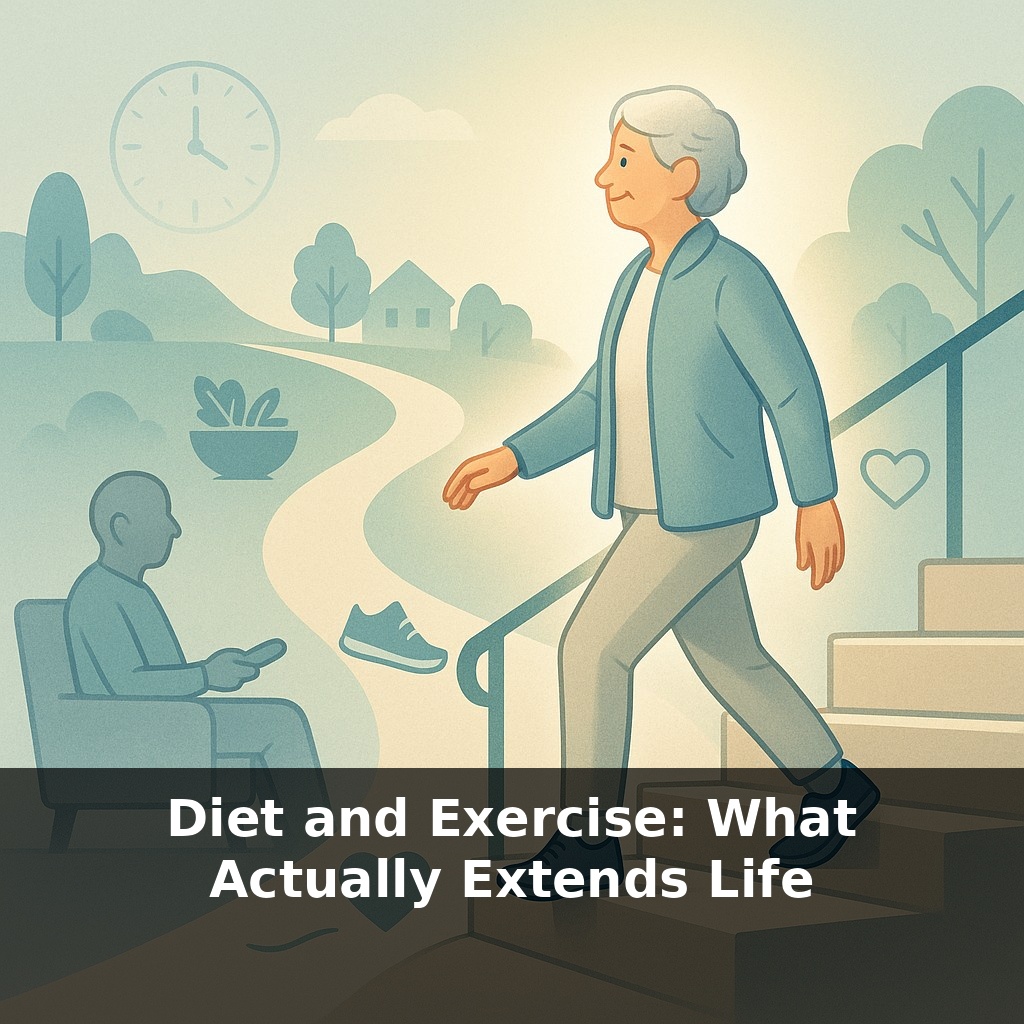
You probably already know your genes matter for aging—but here’s the twist: two quiet daily habits can stretch or shrink your lifespan more than most fancy supplements. Picture your future self at 80: are you walking up stairs with ease, or watching from the couch, out of breath?
People living in the longest-lived “blue zones” don’t count calories, own smartwatches, or chase perfect macros—yet they routinely reach their 90s with far fewer chronic diseases. The pattern that keeps appearing in both these real-world communities and rigorous trials is surprisingly simple: what you put on your plate and how often you move your body quietly shape how long—and how well—you live. In this episode, we zoom in on two levers you control almost every day: diet and physical activity. Not as abstract ideals, but as concrete tools you can tune, like adjusting flame and timing in a recipe to transform the same ingredients into a nourishing meal—or a burnt one. We’ll look at what the strongest studies say actually moves the needle, where “common sense” goes wrong, and how much is enough to measurably change your odds.
Here’s the twist the research keeps pointing to: details that feel small—whether your protein comes mostly from plants or animals, whether your “exercise” is a fast walk or true breathless effort—add up to surprisingly different outcomes over decades. This isn’t about moral perfection or chasing the “cleanest” lifestyle; it’s closer to long-term investing. Replace a few high-interest “health debts” (like processed meat and sitting all day) with steadier “assets” (like legumes, nuts, and brisk movement), and the compound returns often show up as more healthy years, not just better lab numbers. In this section, we’ll unpack what that looks like in real life.
A 90‑year‑old in rural Spain who cooks with olive oil and walks to the market isn’t following a secret longevity hack; they’re just stacking dozens of tiny, evidence-backed choices in the same direction. When researchers zoom out over decades and tens of thousands of people, two patterns keep surfacing with uncomfortable consistency: what you eat most days, and how hard your body has to work most weeks, quietly predict who ends up in the hospital—and who’s still moving easily in their 70s and 80s.
On the food side, studies like PREDIMED didn’t test exotic superfoods; they tested swaps. Butter for extra‑virgin olive oil. Processed snacks for nuts. Heavy meat meals for dishes built around beans, intact grains, and vegetables. Those “boring” substitutions changed real-world outcomes: fewer heart attacks, fewer strokes, less sudden death. Mechanistically, these foods tend to blunt blood sugar spikes, cool down chronic inflammation, and improve cholesterol particles in ways drugs struggle to fully mimic when the rest of the diet is working against them. Think of your weekly menu like a budget: you can “spend” some saturated fat and sugar, but the more of that allowance goes to plants, fibers, and unsalted nuts, the better the long-term balance sheet looks.
Movement shows a similar pattern. Huge data sets suggest you don’t need to be an athlete; getting to roughly 150–300 minutes per week of activity that noticeably raises your breathing—plus a couple of short strength sessions—delivers most of the longevity benefit. Beyond that, returns level off and may even dip at the extreme endurance edge. Interestingly, how you move matters too. Brisk walking seems to be more than just “steps”; it correlates with better cardiorespiratory fitness, which tracks more strongly with survival than almost any single lab test. Resistance training adds another layer, preserving muscle and strength that protect against falls, frailty, and loss of independence.
The nuance: these levers interact. A plant-skewed pattern without movement can still leave you metabolically fragile, while intense workouts built on ultra‑processed foods, sugary drinks, or heavy processed meats keep the inflammatory fire smoldering. The most robust gains appear when both are nudged into the “mostly good, most of the time” zone—not perfection, but a consistent tilt.
Skip the image of a perfect “health guru” kitchen. Think instead of a busy nurse grabbing food between shifts. On weeks when her meals lean on a microwaved grain pouch, a can of beans, frozen vegetables, and a handful of nuts, she’s quietly building in more fiber, potassium, and unsaturated fats than the drive‑thru burger she used to default to. Same time, similar cost, different biological “interest rate” over years.
Or look at movement through the lens of a crowded calendar. A parent who sprints up the stairs with laundry, does 10 squats while the kettle boils, and turns one kid drop‑off into a fast 15‑minute walk is not “exercising” in the gym sense, but they’re repeatedly nudging their heart and muscles above idle. Those micro‑bursts resemble interval training more than they look, and the body responds to the pattern, not the branding.
One analogy to keep in mind: like a software update installing in the background, these tiny, repeated choices rewrite how your metabolism runs—usually without any big announcement.
Future implications
The next wave won’t be a single “longevity pill” but a smarter environment around you. Grocery apps may nudge you toward items your microbiome handles best, while wearables quietly adjust workout prompts based on how well you recovered, not just steps. Cities could work like invisible coaches too: shaded walking routes, staircases that are faster than elevators, and subsidies that make beans and berries cheaper than chips—turning healthy defaults into the path of least resistance.
Your future isn’t a single before-and-after photo; it’s more like a long-running series with quiet plot twists. A few extra minutes of exertion most days, one more plant on the plate, and a little more protein aimed at strength can shift later chapters. The experiment now is less “how long can I live?” and more “how much life can I pack into the years I get?”
To go deeper, here are 3 next steps: 1) Plug your current habits into the free **“Lifespan Calculator” at Blueprint or LongevityTools.io** and screenshot your baseline; then tweak just *one* lever the podcast emphasized—like raising daily step count to 8–10k—and re-run the estimate to see how much that shifts projected healthspan. 2) Grab a practical longevity-focused cookbook like **“The Blue Zones Kitchen” by Dan Buettner** and pick **one** dinner recipe tonight that matches the episode’s guidance on whole-food, plant-forward eating and low ultra-processed intake. 3) Use a simple tracker like **Cronometer or MacroFactor** to log **today’s protein and fiber intake**, then compare your numbers to the episode’s suggested targets (e.g., ~1.6–2.2 g/kg protein, 25–40 g fiber) and set tomorrow’s grocery list directly from the foods the app shows will close your gaps.