Right now, inside your body, tiny crises are unfolding in nearly every cell you own. You don’t feel them, you can’t see them, yet they quietly decide how fast you age. In this episode, we’ll slip inside those cells and ask a simple question: what, exactly, is starting to go wrong?
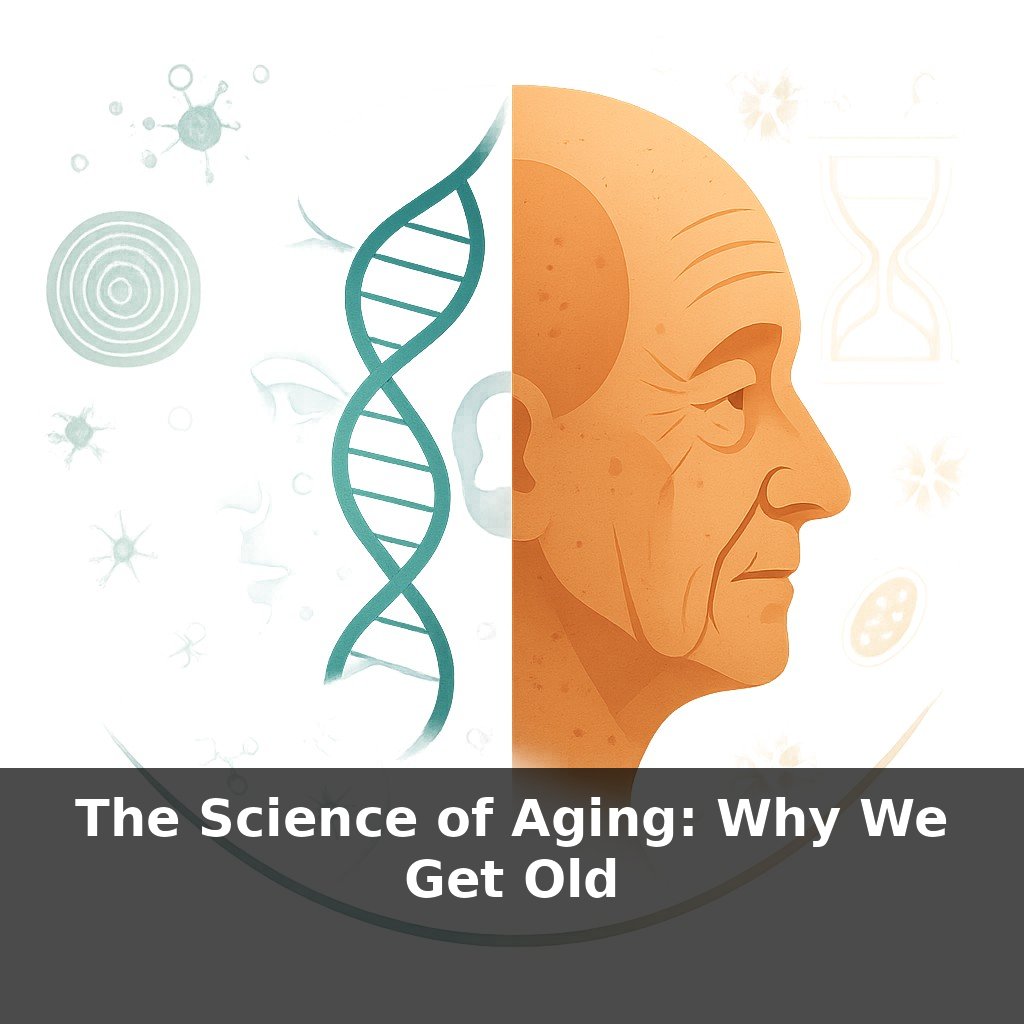
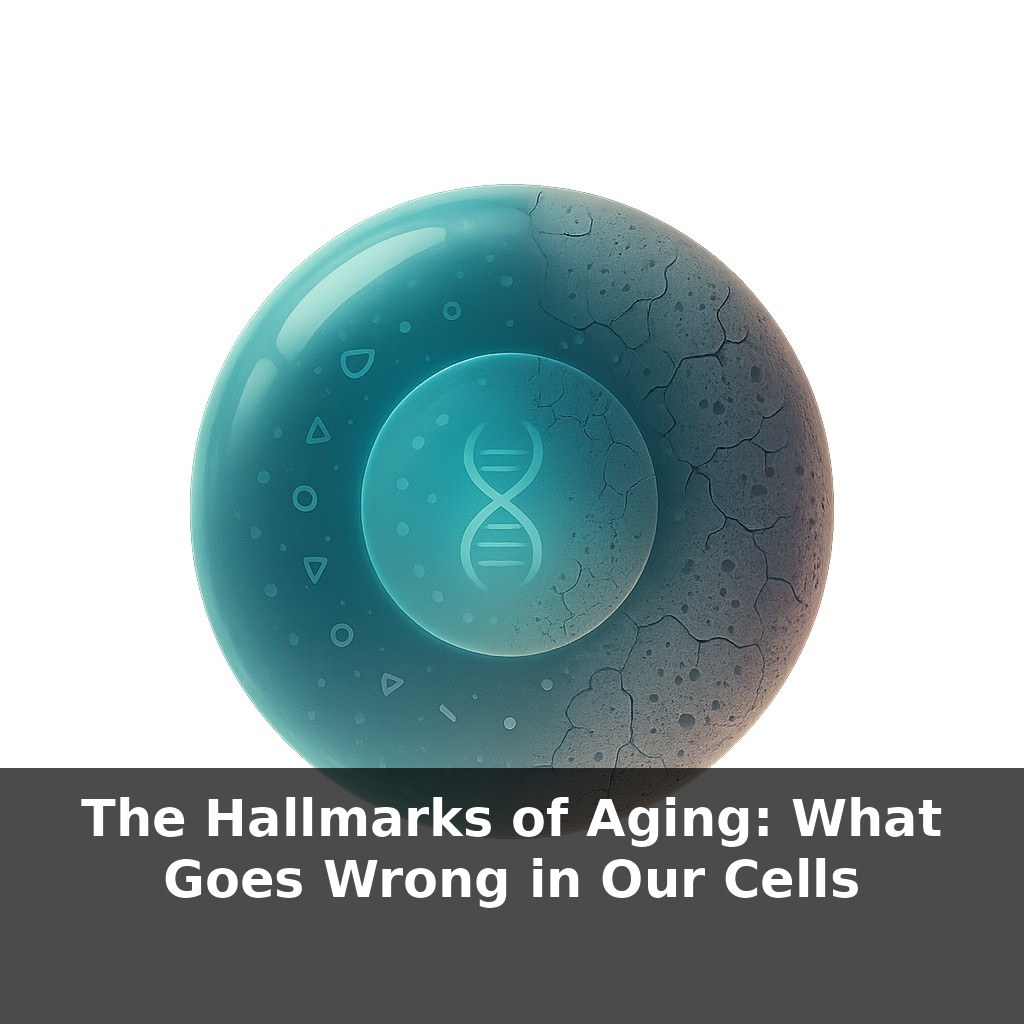
Those quiet crises inside your cells aren’t random accidents; they follow a pattern. Across species—from worms to mice to humans—biologists keep seeing the same nine kinds of breakdown show up as organisms get older. These are the “hallmarks of aging,” and they act less like nine separate diseases and more like a tangled group chat where everyone makes everyone else worse.
Some damage hits the DNA script, some scrambles the chemical “highlighters” that decide which genes get read, some jams the systems that fold and recycle proteins, and some warps the way cells sense fuel and stress. Mitochondria misfire, long-lived cells drop out of the workforce, and the messages cells send to each other grow noisy or downright inflammatory.
In this episode, we’ll map these nine troublemakers, see how they reinforce one another, and ask which ones we might actually be able to push back on.
As we zoom in, a pattern emerges: these nine hallmarks don’t fire all at once or in the same order. Some act like early “upstream” disturbances, nudging cells off balance decades before any diagnosis. Others show up later, as tissues already strained start to fail. Researchers now track which hallmarks shift first in different organs—brain, muscle, immune system—and how lifestyle, environment, and genes tilt that timeline. It’s less a single countdown clock and more like several clocks, each ticking at its own pace, sometimes speeding one another up, sometimes held back by built‑in repair systems.
If you line the nine hallmarks up, they look tidy on paper. Inside a living body, they behave more like a feedback loop than a checklist.
Start with genomic instability. A typical human cell faces thousands to hundreds of thousands of DNA insults per day from normal metabolism, stray chemicals, and background radiation. Repair systems fix most of them. The leftovers—small insertions, deletions, breaks—don’t just sit there; they can skew which proteins get built, subtly altering everything from how a cell divides to how it handles stress. Some of these changes are harmless, some push cells toward cancer, and some quietly erode function.
One of the most sensitive regions is the protective DNA at chromosome ends. As these caps erode with repeated cell divisions, they eventually cross a threshold where surveillance systems flag the cell as risky. When that happens, p53 and its allies can flip the switch to permanent arrest or self‑destruct. In young tissue, that’s a powerful tumor‑suppressor strategy. With age, more cells hit this threshold, thinning the pool of competent cells and pushing others into a senescent, non‑dividing state that still occupies space and resources.
Epigenetic drift adds another layer. Instead of breaking the DNA code, it gradually scrambles how that code is read: stress, diet, and toxins nudge these chemical marks in different directions in different organs. That’s part of why two people born the same year can show very different “biological ages,” and why a brain might show decline while muscle still performs well.
Loss of proteostasis means misfolded or damaged proteins build up faster than they can be refolded or cleared. In neurons, that can crystallize into aggregates like amyloid or tau; in other tissues, it looks more like a slow, sticky clutter that makes routine operations less efficient.
Nutrient‑sensing pathways—insulin/IGF‑1, mTOR, AMPK, sirtuins—sit at the crossroads of these problems. Treat them like a control panel in a data center: dial them toward constant growth and plentiful fuel, and short‑term performance goes up, but maintenance gets deferred. Dial them toward periodic scarcity, and growth slows while repair, recycling, and stress resistance ramp up. That’s one reason caloric restriction and drugs like rapamycin can extend lifespan in multiple species: they bias the system toward upkeep rather than expansion.
Meanwhile, mitochondria slowly accumulate mutations, especially in their own DNA. In older adults, a substantial fraction of mitochondrial genomes can carry deletions. As their efficiency drops, they leak more reactive byproducts which, in moderate bursts, help coordinate defenses but, in chronic excess, damage nearby proteins, lipids, and DNA, feeding back into instability and misfolding.
Cells that have absorbed too many hits often withdraw into senescence. They resist death but stop dividing, and their secretions can distort the local environment, coaxing nearby cells toward dysfunction. Over decades, this contributes to stem‑cell niches sputtering. Fewer fresh cells are produced to replace the old, so tissues with high turnover—blood, gut, skin—start to show wear earlier than slow‑cycling organs.
Finally, altered intercellular communication acts as the network effect: inflammatory signals, hormonal shifts, and immune misfires broadcast problems system‑wide. One organ’s distress can, through circulating factors, accelerate decline elsewhere. This helps explain why an intervention targeting a single hallmark—like enhancing senescent‑cell clearance in mice—can deliver broad benefits: damp one node of the network, and several others quiet down.
Your challenge this week: when you consider an “anti‑aging” claim—whether it’s a supplement, a fasting protocol, or an exercise method—ask one razor‑sharp question: which specific hallmark is this supposed to influence, and by what plausible mechanism? Don’t worry about being technically perfect; the goal is to train your attention.
For three different claims you encounter: 1) Write down the core promise in plain language. 2) Identify which hallmark it most likely targets (genome, telomeres, epigenetics, proteins, nutrient sensing, mitochondria, senescence, stem cells, or communication). 3) Note whether the mechanism sounds like it promotes repair, reduces damage, or simply covers up symptoms.
At the end of the week, look back at your notes. You’ll start to see patterns—some strategies cluster around the same few hallmarks, while others barely engage the biology at all.
Think of a restaurant kitchen running three parallel services—breakfast, lunch, and dinner—every single day. Early on, the knives are sharp, recipes are crisp in everyone’s memory, the fridges are cold, and the workflow is smooth. A decade later, small frictions accumulate: a few recipes have been edited and re‑edited until they barely resemble the original, the walk‑in door doesn’t quite seal, a burner runs too hot, and an overworked line cook starts cutting corners on cleanup. No single change shuts the place down, but together they shift the entire “character” of the kitchen.
That’s close to how these cellular shifts play out in real tissues. In the brain, tiny inefficiencies in energy use, cleanup, and signaling can converge into slower recall years before any diagnosis. In muscle, modest drops in renewal and fuel management show up first as “I just recover slower than I used to.” The biology is messy, but the pattern is consistent: small, interacting drifts that only look obvious in hindsight.
If these cellular shifts are partly steerable, aging becomes less a countdown and more like managing a portfolio of risks. Instead of hunting a single “longevity pill,” future care could layer modest tweaks: a drug that tones down one pathway, a diet pattern that nudges another, plus movement and sleep tuned to your biomarkers. Like adjusting several sliders on a mixing board, the aim isn’t immortality, but extra decades where your brain, muscles, and immune system still play in sync.
So the real question becomes: how do you want your future tissues to behave? Like a rushed short‑order cook, always chasing the next order, or like a chef who plans prep, rests the dough, and cleans as they go? As you move, eat, and sleep this week, notice which choices feel like “maintenance mode.” Those are the tiny levers that, over years, bend your aging curve.
To go deeper, here are 3 next steps: (1) Pull up the free “Hallmarks of Aging” review paper by López-Otín et al. (Cell, 2013; updated 2023) and skim the summary table at the end—pick one hallmark (like mitochondrial dysfunction or cellular senescence) that really interests you, then search PubMed or Google Scholar for one recent human-study trial targeting it (e.g., senolytics, NAD+ boosters, rapamycin analogs). (2) Queue up a focused listen to Peter Attia’s podcast series on the hallmarks (or his episodes with Judith Campisi or David Sinclair), and while you listen, pause to look up each intervention mentioned (like metformin, strength training, or time-restricted eating) on examine.com to see what current evidence actually supports. (3) If you want a structured deep dive, grab a copy of “Outlive” by Peter Attia or “Lifespan” by David Sinclair, then use the index to jump directly to the chapters on at least two hallmarks discussed in the episode—mitochondria and epigenetics, for example—and flag one intervention per chapter that you’ll investigate further using clinicaltrials.gov or the LEAF/Lifespan.io project database.