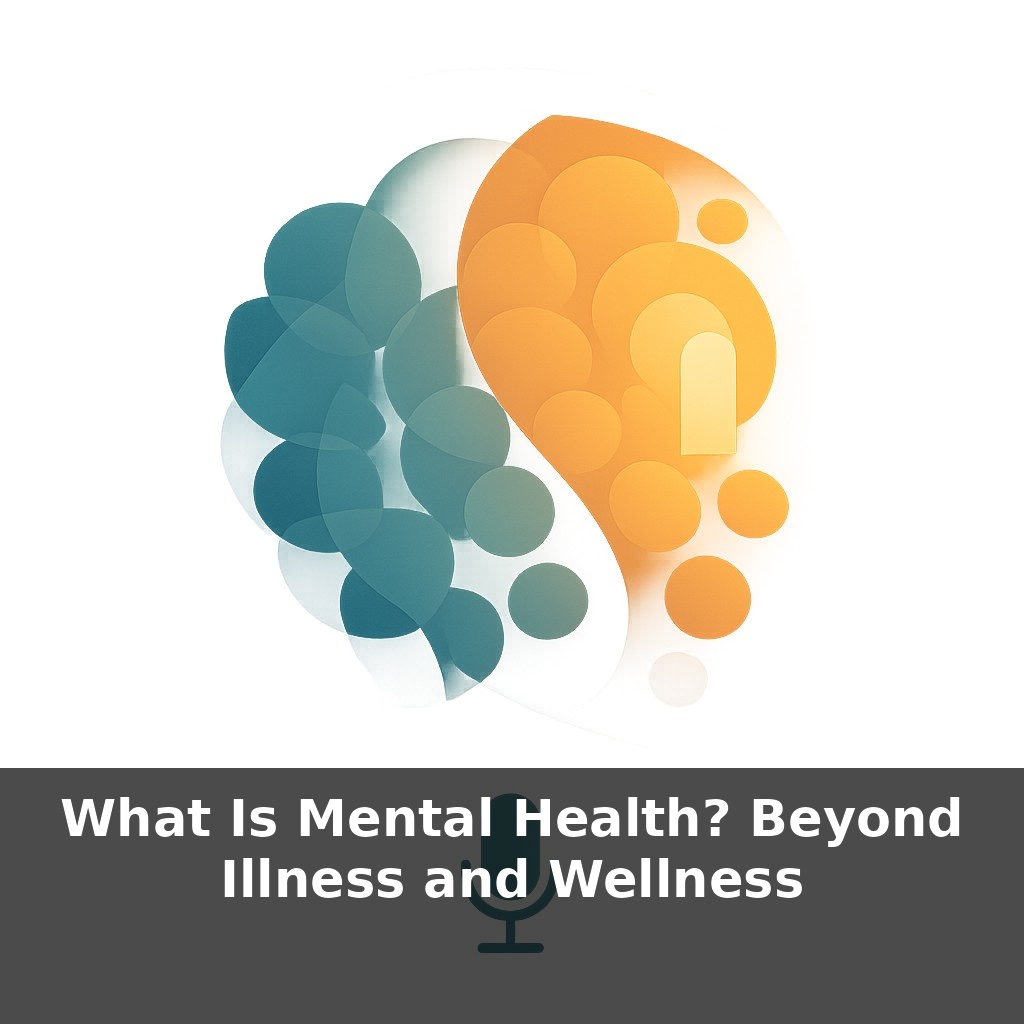
What Is Mental Health? Beyond Illness and Wellness
📝 Transcript
About a quarter of people will have a diagnosable mental disorder—yet only a small slice are actually thriving. On paper, many are “fine.” In daily life, they feel numb, stuck, or flat. How can so many be illness-free, but far from well? Let’s pry that paradox wide open.
Mental health isn’t just “struggling” vs “fine.” It shifts, like a mood over the course of a week or the light in your room throughout a day. Some mornings, your focus is sharp and conversations feel easy; other days, getting through a simple task feels like wading through wet cement. That variability isn’t random—it reflects where you sit on a broader spectrum psychologists call flourishing and languishing.
What’s changed in recent science is the target. Instead of asking only, “Do you meet criteria for a disorder?” researchers now also ask, “How well is your mind actually working? Can you bounce back from stress? Do your relationships nourish you? Does life feel meaningful?”
This shift lets us notice early warning signs, but also early opportunities: small, specific habits that move you from just coping toward genuinely feeling alive and engaged.
Scientists now map this spectrum using three overlapping layers: how you feel day to day (positive emotions, calm vs tension), how you function (focus, creativity, follow-through), and how you connect (belonging, feeling valued, able to lean on others). These aren’t fixed traits; they shift with sleep, workload, seasons, and life events. You might feel upbeat yet scattered, or focused but lonely. Instead of asking “Am I OK?”, a better question becomes “Which parts of my inner life are working well right now—and which could use a tune‑up?” That shift opens more options than “fine” or “not fine.”
Here’s the twist most of us miss: you can score “normal” on every screening questionnaire and still have a mind that’s running on low power. Not broken, not in crisis—just underused and undernourished.
When researchers look closely, they see that three ingredients tend to move together when mental health is strong:
- You feel generally steady and hopeful, even when days are hard - You can do what matters to you with reasonable energy and focus - You feel woven into something larger than yourself—family, friends, work, community, a cause
None of these has to be perfect. The key is how they add up over time.
Here’s where it gets interesting: these ingredients are shaped by far more than personality or “grit.” Housing stability, income, discrimination, workload, sleep, caregiving responsibilities, even city design (green space, safe sidewalks, noise) all nudge your mind up or down that spectrum. Two people with the exact same “attitude” can land in very different places because one is constantly dodging financial or safety threats and the other isn’t.
This is why experts talk about “population mental health.” Instead of only counting diagnoses, they track how whole groups are doing on life satisfaction, purpose, trust, loneliness, and daily functioning. When a country like New Zealand spends billions to redesign services and supports, they’re betting on a measurable payoff: fewer crises, but also more people feeling engaged, capable, and connected.
Another shift: mental health isn’t all-or-nothing across your life. You can be flourishing at work—creative, confident, energized—while languishing in your personal life, or vice versa. You might feel socially rich but emotionally drained, or emotionally calm yet unable to get anything done. Each domain can move independently.
Think of it a bit like personal finance software: instead of one “net worth” number, you see separate graphs—income, spending, savings, debt. A dip in one doesn’t erase the others, but it changes your overall stability and options. Mental-health researchers now try to chart your “inner dashboard” the same way, so support can be more targeted and more humane.
Some clues that you’re drifting toward the “languishing” end of the spectrum show up in tiny, ordinary moments. You open your laptop and stare at your inbox, unable to pick a starting point. You decline a call from a friend, not because you dislike them, but because even a light conversation feels strangely heavy. You finish a day having done “a lot,” yet can’t name a single thing that felt genuinely worth doing.
Researchers sometimes capture this with questions like: how often did you feel interested in life this week? Proud of something you did? Close to other people? Notice how different that feels from asking only, “Are you anxious or depressed?”
And strength can be just as quiet. Maybe you’re under pressure, but you still find yourself able to laugh with a coworker, or you catch a wave of gratitude while making coffee. Those micro-moments of connection and meaning are data points too—not signs that you’re “overreacting” or “fine,” but that your internal system is still trying to grow, not just survive.
The next frontier is treating your mind less like a smoke alarm—only noticed in crisis—and more like a dashboard that updates in real time. As mood-sensing wearables and mental-health–aware calendars mature, your daily patterns could surface like spending alerts from a bank: “This week’s meetings drained you more than usual,” or “Walks with Sam reliably lift your mood.” The risk isn’t surveillance; it’s using these tools only to prevent crashes instead of redesigning the road.
So instead of asking “Am I okay or not?” you can start asking, “Where am I on my own scale today, and what nudged me there?” Treat small shifts like tweaking a recipe: a pinch more rest here, a bit less screen time there, a conversation you’d usually postpone. Over time, those tiny edits can quietly rewrite how your inner life actually feels.
Before next week, ask yourself: (1) “If mental health isn’t just the absence of illness, where in my day do I actually feel most mentally *alive*—curious, connected, or grounded—and what exactly am I doing in those moments (who I’m with, what I’m focusing on, how my body feels)?” (2) “Looking at my last few days, when do I notice my ‘inner story’ turning harsh or catastrophic, and if I pressed pause right then, what kinder or more realistic alternative story could I try on instead?” (3) “If I treated my mind like I do my physical health, what is one ‘mental hygiene’ ritual I could experiment with this week—like a 5‑minute evening check‑in where I ask, ‘What drained me today? What nourished me? What do I need more or less of tomorrow?’”
From this course
Understanding Mental Health: Brain, Mind, and Wellness
8 episodesUnlock all episodes
Full access to 8 episodes and everything on OwlUp.
Subscribe — $1.99/monthLess than a coffee ☕ · Cancel anytime