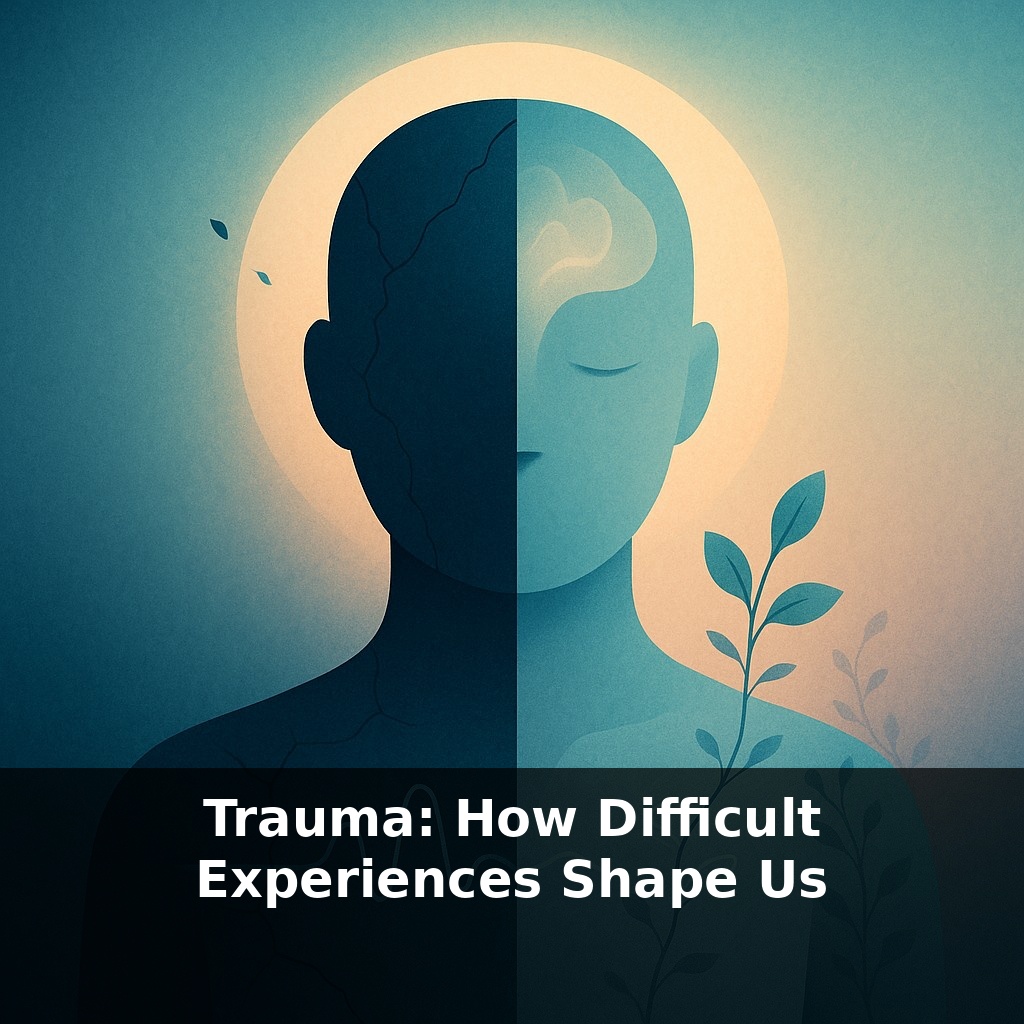
Roughly seven in ten adults will face at least one truly life‑shaking event. Yet two people can live through the same disaster—one has nightmares for years, the other slowly finds new strength. Today we step into that paradox: how trauma can both wound us and remake us.
About 70% of adults worldwide will go through at least one event that’s deeply distressing. Yet what happens afterward is far from uniform. Some people find their attention constantly hijacked by sudden flashes of memory. Others feel oddly numb, going through days like they’re watching someone else’s life. Many notice their reactions shifting in subtle ways—snapping at loved ones, avoiding certain routes home, sleeping with the lights on “just in case.”
Modern research shows these shifts aren’t simply “overreactions” or signs of weakness; they reflect real changes in how the brain and body handle threat. Circuits involved in detecting danger, storing context, and calming us down can all be reshaped. In this episode, we’ll explore how those changes unfold, why only some people develop lasting problems, and what science says about recalibrating a system that’s been pushed past its limits.
Some of these shifts are obvious, but others hide in the background of daily life. You might notice your attention pulled toward exits in a café, or feel your heart pound at a sound no one else reacts to. Over time, these patterns can quietly influence choices: which jobs feel “safe,” how close you let people get, even how you judge your own reactions. Researchers now track these changes across levels—brain activity, hormones, sleep, and relationships—to see how short-term survival strategies can turn into long-term habits, and, crucially, which ones can be unlearned or reshaped.
When researchers zoom in on the brain after overwhelming experiences, three hubs keep showing up: the amygdala, the hippocampus, and the prefrontal cortex. Under heavy, repeated strain, their usual collaboration can shift into a kind of “emergency configuration.”
The amygdala, which flags possible danger, can start firing more often and more intensely. This helps you react fast, but it also means neutral cues—footsteps in a hallway, a certain cologne, a phrase someone uses—may feel loaded with threat. Meanwhile, the hippocampus, which helps tag events with time and place, can struggle under prolonged stress hormones. That’s one reason why certain memories feel fragmented or timeless, more like you’re “back there” than simply remembering.
The prefrontal cortex—especially regions right behind the forehead—normally helps you weigh context, dampen false alarms, and choose responses. When it’s been repeatedly hijacked by crisis, its braking power can weaken in specific situations. People often describe this as “I knew I was safe, but my body didn’t believe me.”
These brain shifts also show up in the body’s hormone loops. The hypothalamic‑pituitary‑adrenal (HPA) axis may start releasing stress chemicals more easily or more sluggishly, depending on the person and the history. Over time, that pattern can influence sleep quality, immune function, appetite, and even how energized you feel during the day. Some studies suggest that trauma can leave “molecular bookmarks” on genes involved in stress regulation—chemical tags that don’t change the DNA sequence but can tilt how strongly certain genes are expressed.
None of this is destiny. One of the most striking findings in trauma research is how plastic these systems remain. Effective therapies don’t erase memories; they help the brain relearn associations and regain flexibility. During trauma‑focused treatments, neuroimaging often shows amygdala responses settling, prefrontal regions engaging more strongly, and memory networks linking sensory fragments into a more coherent narrative.
Social context matters just as much as biology. Having even one stable, responsive relationship after adversity—whether with a caregiver, partner, friend, or therapist—predicts better outcomes across many studies. Safe connections seem to act like an external scaffolding while inner systems reorganize. Cultural frameworks also shape what feels shameful, what is honored as survival, and how easily people can talk about what happened, which in turn affects how the brain files and revisits those experiences.
A traumatized brain is like a home smoke detector stuck on ultra‑sensitive mode—useful for real fires but blaring even when you make toast, disrupting daily life until it’s recalibrated. You might see this in someone who starts avoiding grocery stores because the clatter of carts spikes their heart rate, so they switch to late‑night shopping when aisles are empty. Another person might throw themselves into work, not because they “love the grind,” but because constant tasks keep memories at bay.
In relationships, a partner’s delayed text can feel less like “they’re busy” and more like “they’re gone,” prompting abrupt breakups or clinginess that confuse both people. At school, a teen who once raised their hand easily may now sit near the door, scanning, missing large chunks of what’s said. Some notice they only feel calm while running, gaming, or scrolling—activities that narrow the world to one manageable stream of input. None of these patterns are random; each is a creative attempt to negotiate safety with a nervous system that has quietly changed its rules.
As societies absorb trauma science, entire systems may start to “buffer shocks” better, the way modern buildings sway with earthquakes instead of snapping. Workplaces could design quiet rooms and flexible schedules as standard, not perks. Schools might teach body‑based calming tools alongside math. Policymakers may treat prevention like compound interest: small investments in early, supportive care growing into fewer crises, less incarceration, and healthier families two or three generations out.
Healing rarely looks cinematic; it’s closer to learning a new language of your own signals—slow, uneven, full of revisions. Progress might show up in tiny choices: answering one hard text, staying five more minutes at a gathering, booking that first therapy consult. Like tending a small balcony garden, consistent, modest care can gradually reclaim surprisingly wild inner space.
To go deeper, here are 3 next steps: (1) Watch Dr. Bessel van der Kolk’s talk “How Trauma Lodges in the Body” on YouTube, then try one 10-minute body-based practice he recommends (like simple breath + body scan) using the free “Insight Timer” app. (2) Read the first chapter of *The Body Keeps the Score* and, as you go, mark every example where someone’s trauma shows up in the body rather than in “memories”—this will help you see your own reactions in a new, less self-blaming way. (3) Explore the “Find a Therapist” directory at Psychology Today or the EMDR International Association site and save the profiles of 2–3 trauma-informed therapists who mention modalities like EMDR, somatic experiencing, or internal family systems—so you have concrete options ready if and when you decide to get support.