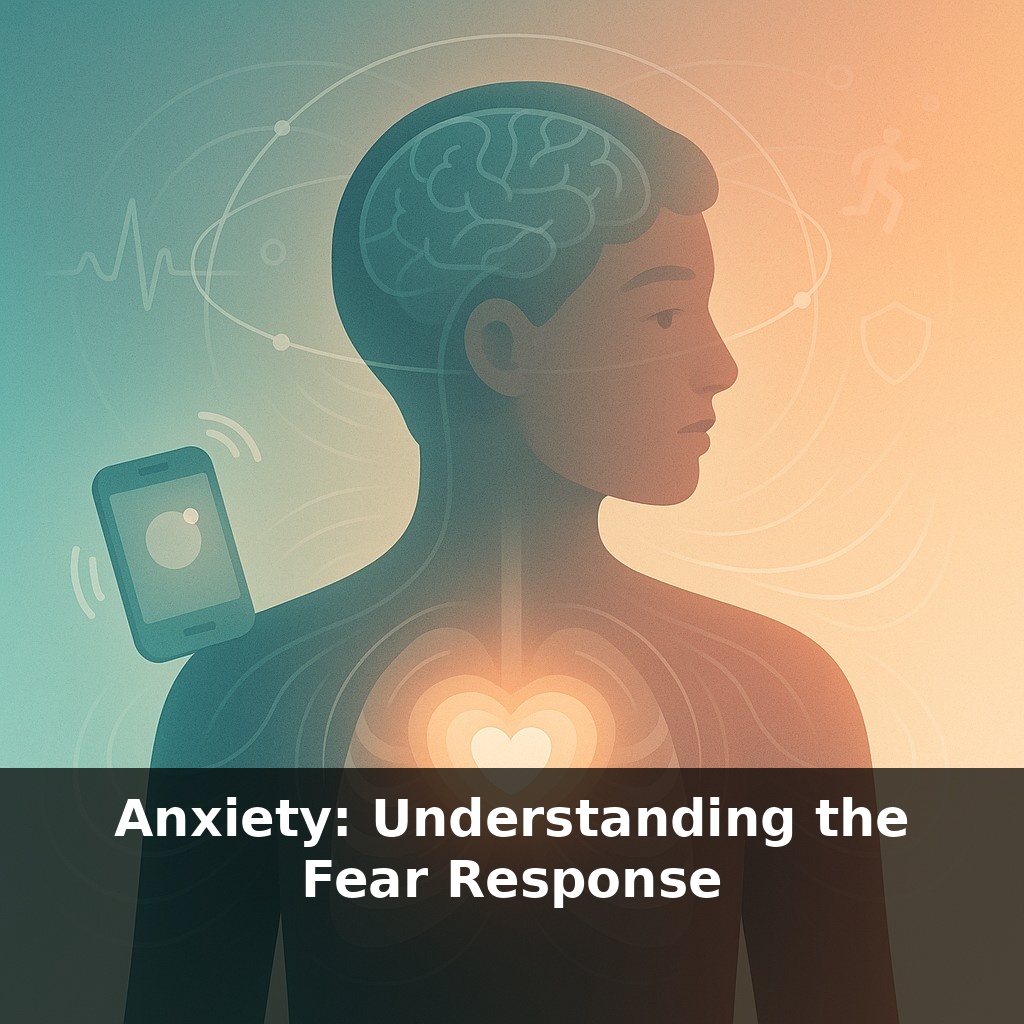
You know that jolt in your chest when your phone buzzes with an unknown number? Or the way your mind races the night before a big decision? Here’s the twist: that same inner alarm that feels like it’s sabotaging you was originally built to keep you alive.
Now zoom in on what actually happens in those edgy moments. Your heart speeds up, breathing shifts, muscles tighten, thoughts narrow. It can feel random or “all in your head,” but underneath is a highly coordinated chain reaction involving specific brain circuits, hormones, and past learning.
Maybe your chest tightens in meetings because your brain quietly linked “speaking up” with “social danger” years ago. Or your body surges with dread before checking email because it’s predicting criticism based on old experiences. Anxiety isn’t just about what you *think*—it’s about what your whole system has been trained to *expect*.
Here’s the crucial twist: this system is plastic. The same way a recipe can be tweaked—less salt, more spice—your fear response can be recalibrated. Understanding how it’s wired is the first step to changing how intensely, how often, and to what it reacts.
Here’s where things get interesting: that same system doesn’t flip on at random—it runs predictions. Your brain is constantly scanning for patterns: tone of voice, calendar reminders, unread messages, even how tired you are. Then it quietly runs “worst-case simulations” in the background and adjusts your internal dials accordingly. Some of this is inherited (genetic sensitivity), some is shaped by early experiences, and some is reinforced daily by habits—like doomscrolling before bed, or saying “yes” when every part of you wants to say “no.”
Here’s the part we usually *don’t* see: while your conscious mind is busy with work, conversations, errands, another layer of your brain is running constant “threat audits.” It tags situations as green, yellow, or red long before you can put feelings into words. That’s why you can walk into a room and instantly feel “off” without knowing why—your prediction system has already compared this moment to thousands of stored memories and subtle cues.
When that system leans too heavily toward “red,” anxiety shifts from occasional signal to near-constant background noise. Not a sharp alarm, but a hum: trouble sleeping, always bracing for bad news, second-guessing decisions, avoiding messages, saying no to plans you might actually enjoy. Over weeks and years, that chronic over-anticipation can reshape behavior, relationships, even career paths—often quietly, through tiny daily choices.
Three forces tend to pull those dials upward:
- **Genetic tilt.** Some people are born with a more sensitive alert system. Not a destiny, but a baseline. - **Learning from stress or trauma.** If your history taught you, “Danger shows up fast,” your brain will prioritize speed over accuracy. - **Reinforcement loops.** Avoiding what scares you brings short-term relief, which your brain interprets as, “Great, we survived *because* we escaped.” So the list of “unsafe” situations grows.
This is where treatments matter. CBT doesn’t just change “negative thoughts”; it gives your prediction system new data. You test out feared situations in structured ways and collect evidence that your old forecasts were exaggerated or outdated. Mindfulness adds another layer: instead of automatically believing every anxious signal, you practice watching sensations and thoughts rise and fall without immediately acting on them.
Exposure therapy goes a step further by carefully, repeatedly stepping into what you fear, in manageable doses. It’s like updating buggy software: each successful repetition tells your system, “We can handle more than we assumed.” Medications can lower the volume enough that these learning experiences are actually possible, rather than overwhelming.
Taken together, these approaches don’t erase anxiety; they help you train it to show up more accurately, less often, and with less authority over your choices.
Think about everyday micro-moments where your prediction system quietly takes over. You glance at a calendar invite from your manager and your stomach drops *before* you even read the subject line. Or you see three typing dots appear and disappear in a chat window and your mind autocompletes the worst possible message. Nothing “bad” has actually happened yet—your brain is fast‑forwarding based on old patterns.
Here’s where this gets practical. Those same patterns can be updated in ordinary situations, not just in therapy rooms. You answer one difficult email instead of postponing it, and notice the wave of dread peak, then fade on its own. You attend half of a social event instead of cancelling, and collect real data on how you actually felt at minute 5 versus minute 45. Each of these small experiments is like nudging a slider in a settings menu, teaching your system that discomfort isn’t the same as disaster, and that prediction errors are allowed.
An upgraded alarm system is already emerging: wearables tracking subtle shifts in your baseline could soon warn, “You’re trending toward overload,” before your day derails. Think of a budgeting app that nudges you *before* you overspend—only here, the currency is mental energy. Pair that with AI-guided micro‑exercises (90‑second breathing drills, targeted thought checks) that adapt to your patterns, and support starts looking less like crisis care and more like continuous tuning.
Tuning this response isn’t about becoming fearless; it’s about becoming a better strategist. Like updating the settings on a navigation app, you can decide which routes—habits, environments, relationships—lead to more stability. Over time, patterns of curiosity, rest, and support can shift not just how you feel, but what your brain expects from the world.
Start with this tiny habit: When you feel your heart rate spike or your chest tighten (like the episode described in the fear response), quietly press your thumb and index finger together and say in your head, “Body, you think I’m in danger, but I’m just [name what you’re actually doing—like ‘answering an email’].” Right after that, exhale just a bit longer than you inhaled—like a quick 3-second inhale, 4-second exhale—one time, not more. If you’re in public, do it silently and subtly so it feels doable anywhere. Over time, your brain will start to pair that anxious surge with this brief “I’m actually safe” signal.