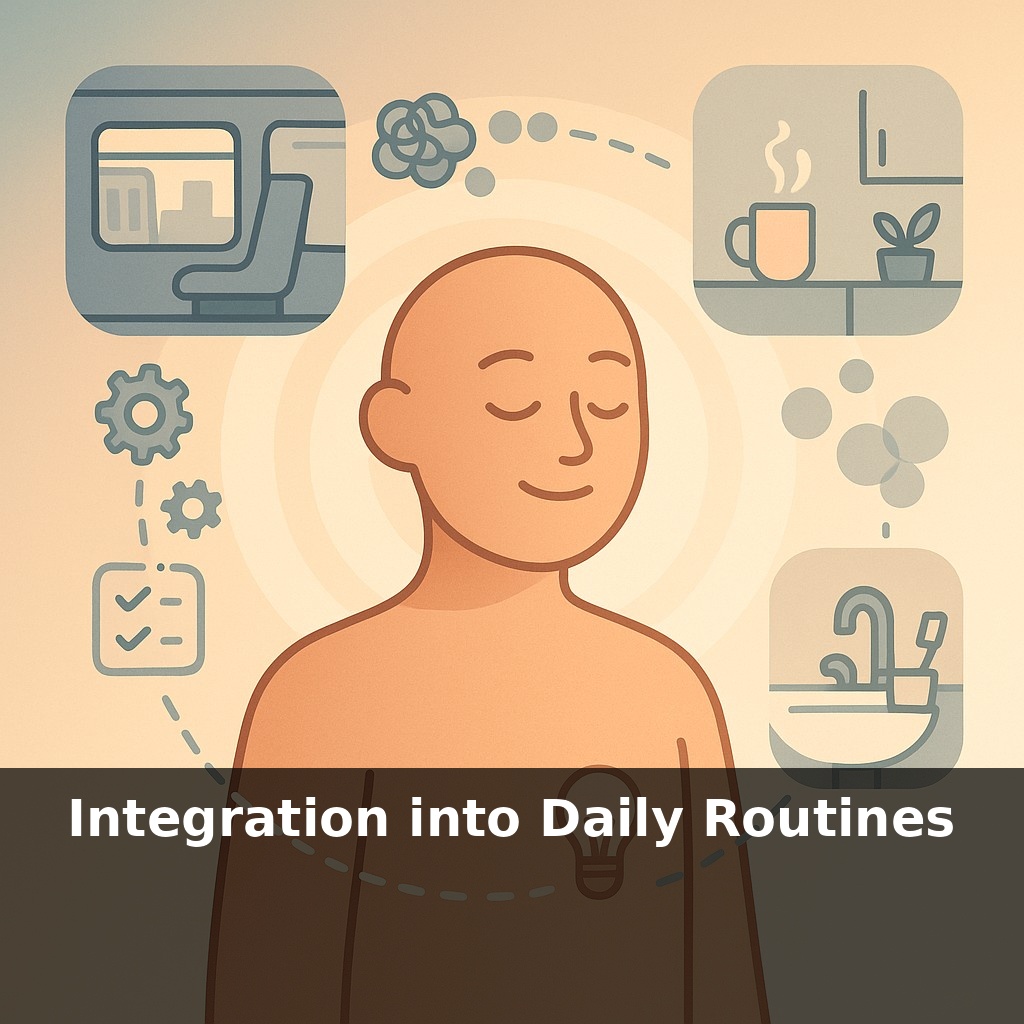
Right now, millions of people are learning CBT tools in therapy…but most of the change actually happens in the five-minute gaps of everyday life. On the train, in the break room, brushing your teeth—those tiny unseen moments are where anxiety quietly rises or falls.
301 million people worldwide are living with anxiety right now—and most of them are trying to “fix it” in rare, intense bursts: a long therapy session, a weekend deep-dive, a single long meditation. Yet the data point in a different direction: skills stick not when they’re big, but when they’re woven into the small, forgettable corners of your day.
Think of the tiny “in-between” moments: waiting for a video to load, standing in an elevator, walking from your car to the door, rinsing a mug. Each is a quiet decision point: drift into autopilot worry, or take 30 seconds to practice a skill.
Over 6–10 weeks, those choices can hardwire new patterns—so reaching for a tool feels less like “doing homework” and more like how you naturally move through your day.
Most people plan to “practice later” during a perfect quiet block that never actually appears. Daily life rushes in: emails, kids, traffic, notifications. The trick is not finding more time, but hitching CBT habits onto routines you already do without thinking—like washing your face, unlocking your phone, or making coffee. These existing habits act like reliable hooks: every time they happen, they can quietly cue a 20–60 second exercise. Over weeks, the cue and the skill start to travel together, so practice happens almost on autopilot, even when your motivation or energy is low.
Research on habits gives a specific roadmap for turning CBT into something you “just do” rather than something you have to remember and force.
One key piece: consistency beats intensity. Lally and colleagues found that people who repeated a small behavior at the *same* type of moment each day—like “after breakfast, I…”—reached automaticity faster than people who practiced in random windows. That means “whenever I feel like it” is a much weaker plan than “every time I sit down at my desk, I run one quick thought check.”
You can also stack different types of skills across the day instead of cramming one technique into a single block. For example: - Morning: 60 seconds of cognitive restructuring while you scroll your calendar. - Midday: a brief exposure step linked to opening your email (e.g., deliberately reading the subject line that scares you, then pausing before reacting). - Evening: a relaxation drill while the shower warms up or while your tea steeps.
Now you’re not just repeating one move—you’re building a flexible “CBT toolkit circuit” that tracks the natural rhythm of your day.
Rewards matter more than people think. Each time you do a micro-practice, tack on a tiny, immediate reward: a checkmark on a visible tracker, a satisfying app tap, a quick internal “that was me choosing differently.” The reward doesn’t have to be huge; it just has to be consistent enough that your brain starts linking “do skill → get a small good feeling.” Over 6–10 weeks, that pattern strengthens the habit loop.
Expect a wobbly middle period. Studies show habit strength grows in a curve: fast progress in the first couple of weeks, then a plateau where it feels boring or pointless, then gradual solidifying. That plateau is not failure; it’s the nervous system learning to fire the new pattern with less conscious effort.
Think of it a bit like walking the same forest path daily: at first you’re pushing through brush; eventually there’s a clear trail that’s hard *not* to follow. Each brief, repeated skill use is another pass along that path.
Maya uses her morning key-in at work as a cue. As the door clicks open, she asks herself one focused question: “What’s one thing I’m afraid might go wrong today?” She writes a single sentence in her notes app, then adds two quick alternatives that are *plausible*, not perfect. It takes under a minute, but over weeks she notices she enters the office less clenched, because her brain expects that tiny course correction at the threshold.
Luis links a micro-exposure to checking social media. The moment his thumb taps the app, he purposely reads one comment he’s been avoiding, lets the discomfort rise for ten slow breaths, and resists editing his post. No marathon session—just a repeated, bite-sized edge-push paired with something he already does many times a day.
Think of these as “anchor points” you sprinkle across your schedule. You’re not chasing motivation; you’re quietly teaching your day itself to nudge you toward practice, again and again, until using your tools feels like the normal way to move through time.
In a few years, your “mental health routine” may look less like a checklist and more like a responsive environment. Sensors could flag tense shoulders before you notice, dimming lights and prompting a two-breath reset. AR glasses might overlay a gentle nudge during a tough meeting, like a trail marker on a hike. The risk: turning daily life into a monitored lab. The opportunity: tools that quietly fit you, rather than you forcing yourself to fit the tools.
Over time, these small experiments can reshape how you relate to stress: less like a fire to put out, more like weather you’re equipped to walk through. Your challenge this week: choose three ordinary moments and add one micro-skill to each. Notice not just symptom shifts, but any extra room you gain to choose your next step.