You’re more likely to abandon a habit because you missed two days… than because the habit was too hard. You wake up, see the broken streak, and think, “Well, that’s over.” In this episode, we’ll turn that moment—from “I blew it” to “Here’s exactly how I get back on track.”
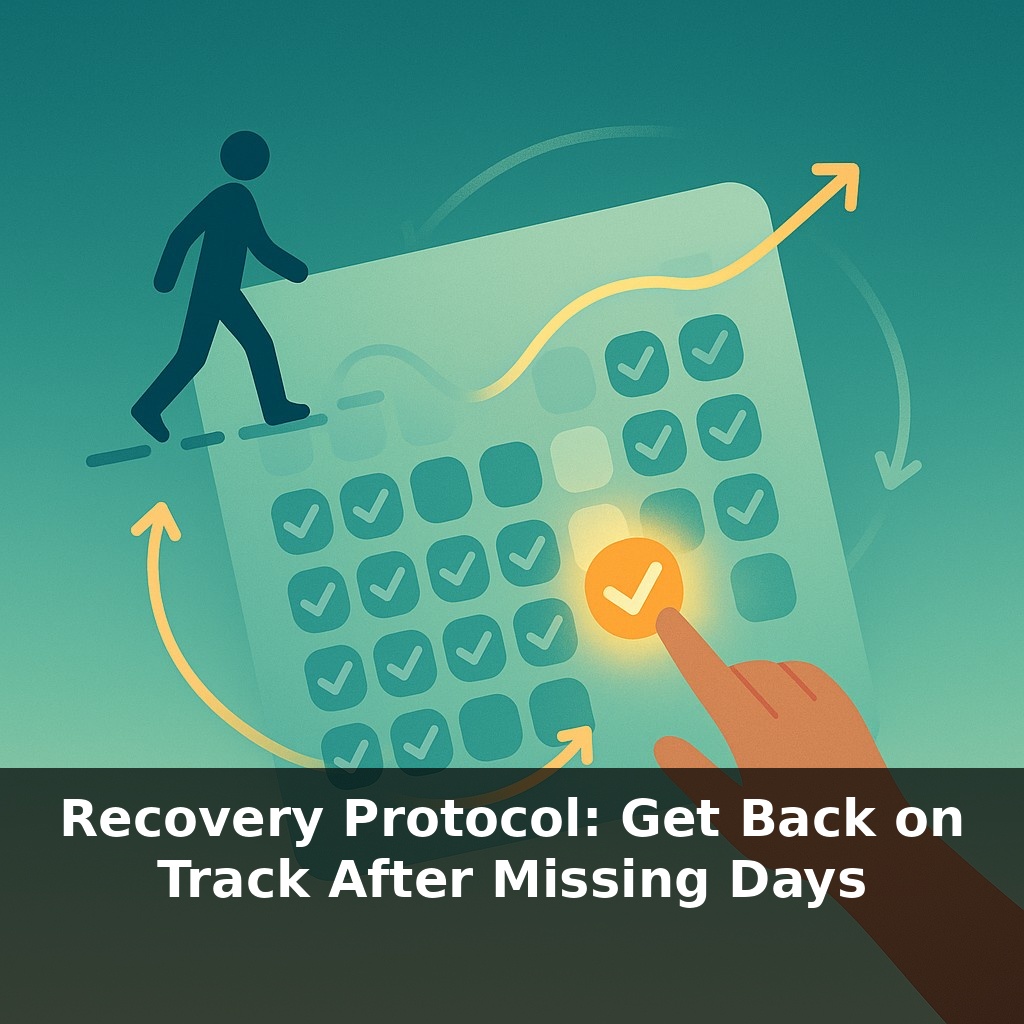
Here’s the important shift for this episode: recovery isn’t a vague “try again tomorrow” idea—it’s a trainable skill with a repeatable protocol. Missed days will happen. Across a year, even a well-run habit will be interrupted at least 10–20 % of the time by illness, travel, deadlines, or simple forgetfulness. The difference between people who keep their habits and people who quietly abandon them isn’t willpower; it’s what they do in the first 24 hours after a miss. In this episode, we’ll turn that window into a system. You’ll learn how to use a 3-step recovery protocol grounded in research: a 2-minute reflection that stops the spiral, an “if–then” script that pre-decides your next move, and fast restoration of your cues so your brain can slide back into autopilot. By the end, a missed day won’t be a crisis—it’ll be a routine bump you know how to handle.
Most people think consistency means “never miss,” but real data from long-term behavior studies tell a different story. Across months of habit change, the people who succeed don’t have fewer disruptions—they just recover faster and more deliberately. One study found that even with regular interruptions, participants still automated a habit over roughly 66 days, as long as they resumed within a few days each time. That means the real metric that matters isn’t streak length; it’s “recovery latency”: how many hours or days you take to run your protocol after a miss. We’ll focus on shrinking that gap.
Most people respond to a miss with a vague promise: “I’ll be better tomorrow.” Your brain needs something much more concrete—especially in the first 24 hours. Think of this section as tightening the bolts on that recovery protocol so it can handle real-life chaos: travel, kids, crunch weeks, illness.
Let’s put numbers on it. Say you’re building a daily 10‑minute walk. Over 90 days, you plan 90 reps. If you miss 1 day and come back the next, your “completion rate” is 89 / 90 ≈ 99 %. If you let that slip turn into a week, you’re at 83 / 90 ≈ 92 %. On paper, 92 % looks fine—but that extra 7 % gap usually represents multiple “I’ll restart Monday” cycles, which massively increase mental friction. So the goal isn’t perfection; it’s keeping your recovery window short enough that friction never gets a chance to compound.
Pillar 1: reflection. Instead of asking “What’s wrong with me?”, ask three precise questions: 1) What exactly happened in the 60 minutes before I missed? 2) Which obstacle was MOST decisive—time, energy, access, or mood? 3) What’s one tiny change (≤ 5 minutes or one object moved) that would have made success more likely?
Notice how each question points toward a design tweak, not a character judgment.
Pillar 2: your if–then script. It works best when it has four parts: • a clear trigger (“If I miss my habit at the usual time…”), • a specific backup slot (“…then I will do the 2‑minute version at X time today”), • a pre-decided minimum dose (“…for at least 2 minutes”), • and a hard boundary (“…and I will NOT try to ‘make up’ missed volume”).
That last piece matters more than it seems. Trying to “repay the debt” (e.g., “I’ll meditate 30 minutes because I skipped yesterday”) doubles the perceived cost and makes starting less likely tomorrow.
Pillar 3: cues. After a miss, restore three things within 24 hours: • the physical object (shoes by the door, book on pillow), • the location (same chair, same corner of the gym), • the time label (“after coffee,” “right after logging off work”).
You’re not relying on motivation; you’re rebuilding the shallow groove that lets the deeper habit circuitry fire again.
When researchers tracked people building a new exercise habit over 12 weeks, some “successful” participants still missed 15–20 planned sessions—but they almost never missed **two in a row**. Let’s make that concrete.
Suppose you’re aiming for 5 home workouts a week for 12 weeks: 60 total. Two people both end at 45/60:
- Person A: mostly single misses sprinkled through the calendar (never more than 2 days away). - Person B: three “off the rails” weeks where nothing happens.
Same total count, radically different futures. Person A’s brain keeps seeing the behavior in its usual context at least every 48 hours. Person B’s brain quietly files the habit under “past project.”
Here’s how this plays out across different habits:
- Reading: 10 minutes after dinner, 5 nights a week. A “miss cap” of 1 day keeps you at 200–210 sessions a year instead of sliding under 120. - Sleep: in bed by 11 p.m., 6 nights a week. Never missing two nights in a row turns into roughly 300+ decent nights a year, even with travel and deadlines.
As recovery becomes normalized, you can design systems, not rely on willpower. For example, set a “red flag” metric: 3+ missed days in 10 triggers a prewritten downgrade plan (cut volume by 50 % for 7 days). Teams can mirror this: if weekly wellness actions drop below 60 %, managers shorten meetings or add walking 1:1s. Over a year, these safeguards can protect 150–200 sessions that previously would have vanished into all‑or‑nothing thinking.
Treat this like strength training: each disruption is one more rep for your “restart muscle.” Over 12 months, even recovering from just half your slip‑ups could mean 40–60 extra workouts, 150+ pages read, or 20 more early nights. That volume compounds. Your goal isn’t to avoid breaks—it’s to become the person who always knows their next move.
Try this experiment: For the next 3 days, consciously “start in the middle” of your routine instead of trying to restart perfectly from the top. If you missed several days, skip any complex planning or backlog-catching and jump straight to the *next* logical action you would have done today if you’d never fallen off (e.g., do today’s workout, today’s writing session, today’s meditation block). Each evening, quickly rate your day from 1–10 on two things: how easy it felt to restart and how much dread you felt beforehand. At the end of day 3, compare your ratings to how it usually feels when you try to “make up for lost time,” and decide which restart style actually helps you get back on track faster.