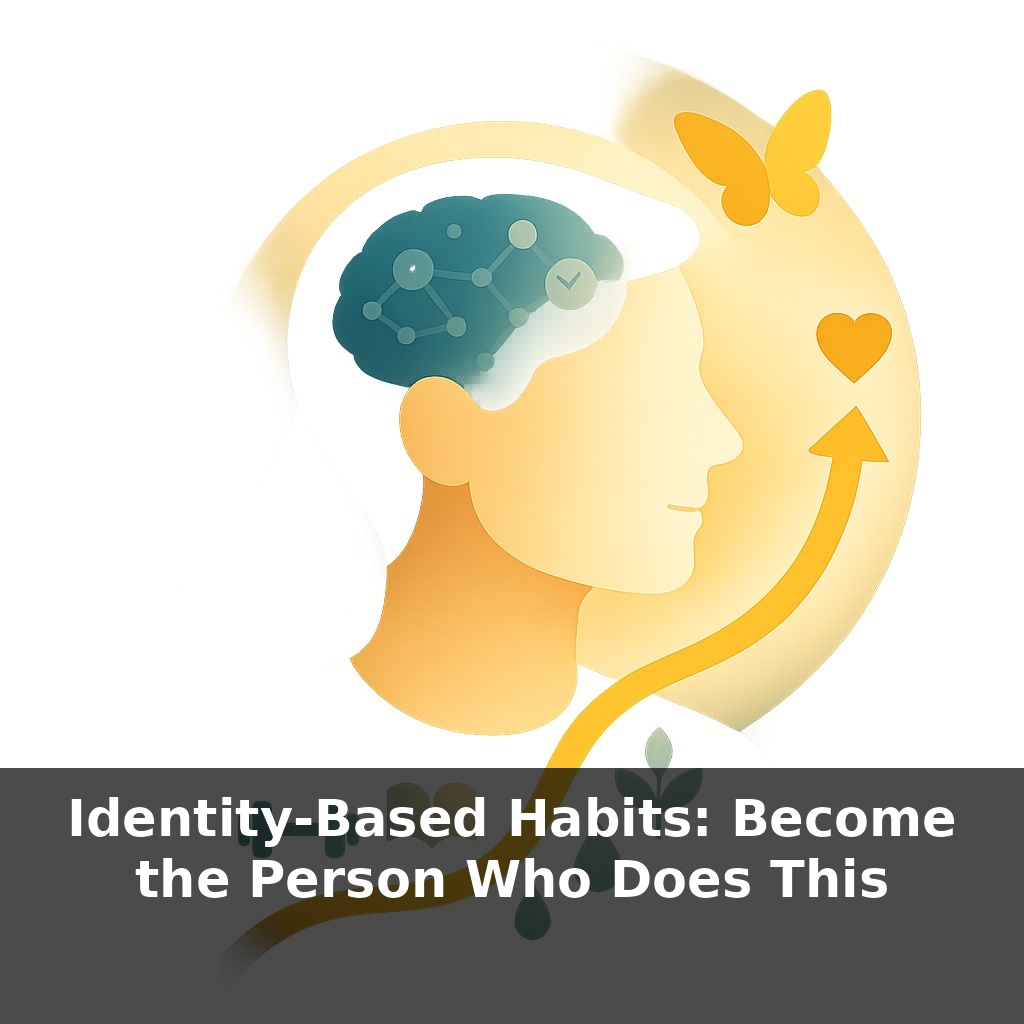
About half the time, people fail at behavior change not because the plan is bad, but because they’re chasing the wrong thing. You can follow the perfect routine, hit every target, and still feel stuck—if, deep down, you don’t believe you’re the kind of person who does it.
Research shows something subtle but powerful: your brain treats “I am” statements like long-term contracts. Say “I am a night owl” enough times, and your mind quietly organizes your choices around late nights—snacking more, skipping morning workouts, hitting snooze by default. The label becomes a compass, even when you’re not consciously deciding.
The same thing happens in the other direction. When people start saying “I’m someone who takes care of my body,” missed workouts feel like being out of character, not just off schedule. Neural pathways begin to favor the new pattern, making the healthier option feel slightly more “like you” each time.
This isn’t about faking positivity or forcing affirmations. It’s about carefully choosing the small, believable identities you’re willing to experiment with—and then letting daily actions quietly vote for them until they feel honest.
Here’s where it gets especially practical: identity isn’t one big label, it’s a collection of “micro-roles” you play across your day—parent, teammate, late-night snacker, weekend cyclist, stressed-out email checker. Each role comes with its own quiet rules about what’s “normal” for you. That’s why someone can be disciplined at work yet feel chaotic around food. Healthier habits stick when you update the specific role tied to the behavior, not your whole personality. You don’t need to become “a healthy person” overnight; you only need to upgrade a few key roles where your current identity keeps pulling you off track.
Here’s the twist most people miss: your “micro-roles” aren’t just stories in your head—they quietly compete and cooperate all day long.
Think about your morning. One role wants to be “the reliable teammate” who answers messages right away. Another wants to be “the person who moves their body before work.” When your alarm goes off, those roles don’t vote equally. The role with more past evidence, sharper emotional charge, and clearer rules usually wins.
Research on self-referential processing shows why this matters: when a behavior feels like it belongs to “who I am,” your brain tags it as personally relevant, not just logically sensible. The same workout can feel optional when it’s just a task, and oddly non-negotiable when it’s part of a role you respect in yourself.
This is where language becomes a quiet lever. In lab studies, people who said “I don’t do X” behaved more consistently than those who said “I can’t do X.” One phrasing frames the action as incompatible with a role; the other frames it as a temporary rule that can be bent. “I don’t skip my walks” creates a tiny clash when you reach for the couch. “I can’t skip my walk” leaves more negotiating room.
Identity-framed cues work at the group level too. When Weight Watchers shifted toward “wellness,” they weren’t just doing PR—they were giving members a broader, more dignifying role than “dieter.” That kind of role allows more behaviors to “count” as successes: sleep, stress, food quality, movement, not just the number on the scale. More behaviors that feel on-identity means more daily wins, and more daily wins means faster consolidation of that role.
The paradox is that you don’t need full conviction for this to work. In the early days, it’s enough to treat a role like a hypothesis: “What would someone who takes care of their body do in this exact situation?” Each time you answer that question with an action, you’re adding one more piece of evidence. Over a few weeks, those moments stop feeling like experiments and start feeling like your default setting.
One helpful way to think about it: identity is less like a tattoo and more like a medical chart. Every action is a new line in the file. A single note changes nothing. But a steady pattern of the same observation—“active, active, active”—eventually forces an update to the diagnosis of who you are.
Skip the grand life makeover and zoom in on one tiny role where you’d like a quiet upgrade. Say your evenings keep collapsing into snacking and scrolling. Instead of forcing a strict rule, experiment with a new label: “I’m the kind of person who closes the day with one small act of care.” Notice how that single sentence opens options: stretching for five minutes, prepping tomorrow’s lunch, taking a short walk, or simply going to bed on time. Each option “fits” the role, so you get flexibility without losing coherence.
You can do the same with food: shift from “I’m bad with nutrition” to “I’m learning to eat like someone who respects their energy tomorrow.” That phrasing turns choices into curiosity: what would protect future-me’s focus or mood?
Your challenge this week: pick one narrow role—“after-dinner me,” “commute me,” or “lunch break me”—and script a one-line identity for it. Then, once a day, do just one action that could honestly count as evidence for that sentence.
Soon, your roles may be co-authored with algorithms. Wearables, calendars, even grocery receipts can quietly suggest patterns: “You show up as an early mover three days a week—want to grow that streak?” Schools might do something similar: not just grading work, but reflecting back “you’ve been acting like a researcher all term.” The upside is tailored encouragement; the risk is feeling boxed in, like a character a platform has written for you instead of a health story you’re still drafting.
Identity shifts rarely arrive with fanfare; they sneak in like a new song on a playlist, quiet at first, then strangely familiar. As you keep adding evidence, your choices start to feel less like discipline and more like alignment. The real experiment isn’t “Can I stick to this habit?” but “What story about myself feels truer six weeks from now?”
Before next week, ask yourself: “In what specific situations this week (morning routine, social media use, end-of-day wind-down, etc.) did I actually think, ‘What would the kind of person I want to be do right now?’ and what did I choose in that moment?” Then ask, “If I fully believed I *am* the kind of person who [reads every day / lifts three times a week / cooks at home on weekdays], how would I handle tonight at 8pm differently than I usually do?” Finally, ask, “Where did my current identity story (e.g., ‘I’m not a disciplined person’ or ‘I always break routines’) show up this week, and what’s one concrete moment tomorrow when I’m willing to deliberately act *out of character* and prove that old story even a little bit wrong?”