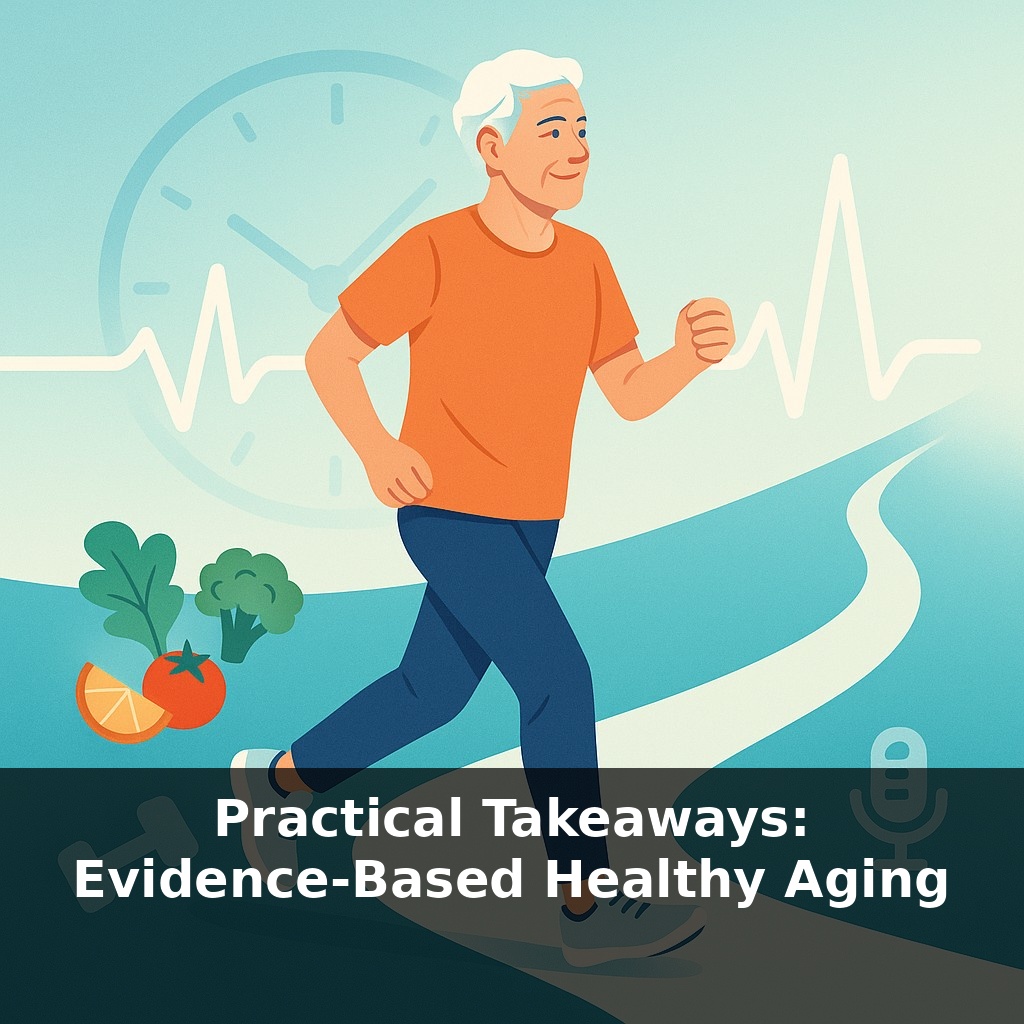
Runners in their seventies sometimes have the heart health of people decades younger. Yet many of them don’t train like athletes or eat perfect diets. In this episode, we’ll explore how a few specific, doable habits quietly bend the curve of aging in your favor.
150 minutes a week. Two short strength sessions. An extra serving of plants most days. On paper, these sound almost trivial against something as complex as your entire lifespan—but the data say otherwise. When researchers follow large populations for decades, the same pattern keeps emerging: people who consistently stack a few modest behaviors don’t just live longer; the years at the end look and feel different.
So in this episode, we’re zooming out to the bigger picture: not a single “longevity hack,” but seven core areas of daily life that, together, shift your long‑term trajectory. Think of everyday choices—taking the stairs, turning off screens a bit earlier, calling a friend—as tiny “votes” that accumulate over time. We’ll break down which votes matter most, how much is enough to move the needle, and how to do it in a way that fits a real, messy schedule rather than an idealized routine.
Here’s where the science gets practical. When researchers look at populations who stay sharp and mobile into their eighties and beyond, it isn’t one “super habit” that stands out—it’s a consistent pattern across a handful of domains. Movement, food, sleep, mental challenge, relationships, medical vigilance, and stress handling show up again and again in the data, like recurring characters in a long-running series. In the next section, we’ll unpack each one, translate research numbers into real-life thresholds, and explore how much flexibility there actually is without losing the benefits.
A useful way to look at these seven pillars is not as rigid rules, but as “levers” you can pull to different degrees at different times of life. The research doesn’t say you must be perfect in all of them; it says that being consistently “pretty good” in several beats being excellent in just one.
Take physical activity. The data that impress researchers most aren’t from ultramarathoners—they’re from people who reliably clear a modest weekly threshold. Above a certain point, more effort adds only small extra benefits, but crossing from “almost nothing” to “some” creates a sharp drop in risk. This is why even 10‑minute brisk bouts matter. Strength work behaves the same way: muscles respond to progressive challenge at 25 or 75, especially when you target major muscle groups a couple of times a week.
Diet shows a similar pattern. Studies comparing broad eating styles find that the overall pattern—more plants, fewer ultra‑processed foods—matters more than obsessing over single “magic” items. It’s less about never touching dessert and more about what dominates your plate most days. One way scientists judge this is by dietary scores that tally plant variety, fiber, and processing level rather than individual nutrients in isolation.
On the mental and social side, stimulation and connection act like parallel systems protecting your brain. Lifelong learning—new languages, skills, or even complex hobbies—builds what neurologists call “cognitive reserve,” extra capacity that helps you tolerate age‑related changes longer before they affect daily function. Social ties add another layer: people who feel supported and engaged tend to show lower inflammatory markers and better immune profiles, which partly explains the mortality gap between the well‑connected and the chronically lonely.
Then there’s proactive medical care and toxin avoidance. Here, the big wins often come from boring, preventive moves: blood pressure checks, vaccines, managing blood sugar, and not smoking. In finance terms, these are like avoiding huge losses rather than chasing spectacular gains—the absence of damage is itself a major driver of healthy years.
Finally, stress management and purpose help coordinate the rest. Chronic, unaddressed stress keeps biological “alarm systems” switched on, subtly wearing down tissues and organs. People who cultivate a sense of direction—through work, caregiving, creative projects, or community roles—tend to adopt and maintain other healthy practices more easily, because those practices serve something they value.
Think of these seven pillars like a personal “portfolio” you can rebalance over time. Some weeks, your “movement stock” might dip because of work demands, so you nudge up your “stress-management bond” by being stricter about wind‑down routines or brief breathing breaks. Another season, you might lean heavily into social connection—joining a cooking group or volunteer project—while keeping other domains on a maintenance setting rather than a growth push.
Concrete example: someone in their fifties facing a new diagnosis of high blood pressure might first raise their “medical care” allocation—getting on the right treatment, monitoring numbers—then layer in small shifts in eating patterns and walks with a friend, effectively diversifying their risk reduction instead of overbetting on a single change.
Over years, what matters isn’t that every pillar is perfectly balanced at all times, but that you rarely let any category drop to zero and you periodically “audit” where your current life stage allows the easiest gains.
Smart cities and cheap, continuous health sensors could soon act like a “navigation app” for your future self—quietly rerouting you before trouble builds. Imagine your watch flagging subtle shifts in gait or mood weeks before a fall or depressive episode, or your neighborhood library prescribing a language class after a cognitive screen, the way a doctor prescribes meds. The risk: widened inequality if only affluent groups gain access to these early-warning systems.
The next step isn’t overhauling your life; it’s running small experiments. Treat your week like a test kitchen: swap one commute for a walk‑and‑podcast, turn a scrolling session into a call, book that screening you’ve delayed. Notice which tweaks feel sustainable. Over time, these micro‑edits become your personal blueprint for staying capable and curious longer.
Before next week, ask yourself: 1) “If I had to pick just one ‘anchor habit’ for healthy aging from this episode—like a 20–30 minute daily walk, a consistent sleep window, or a protein-rich breakfast—which one would make the biggest difference in my life right now, and what specific time of day could I realistically protect for it starting tomorrow?” 2) “Looking at the evidence on protein and muscle as we age, how could I adjust ONE meal I already eat (for example, adding eggs, Greek yogurt, lentils, or an extra palm-sized serving of chicken or tofu) so it hits that higher-protein target without making my day more complicated?” 3) “Where am I unintentionally sitting for long stretches (commute, TV, computer), and what is one trigger I can set up today—a timer, a water bottle refill, a phone call I always take standing—to turn at least two of those long sitting blocks into chances for a 2–5 minute movement or stretch break?”