“About one in five people around you is struggling with their mental health right now—and odds are, they’re not asking for help. A friend cancels plans again. A coworker goes quiet. A sibling snaps over nothing. In this episode, you’ll learn what to *actually* do in those moments.”
“Support” often gets confused with “solutions.” Someone opens up, and many of us instantly move into fixing mode: advice, pep talks, “have you tried…?” Yet data from programmes like Mental Health First Aid show something different: after brief training focused mainly on listening and empathy, participants feel 35% more confident helping—and the people they support feel 28% more supported, *without* receiving any magic answers.
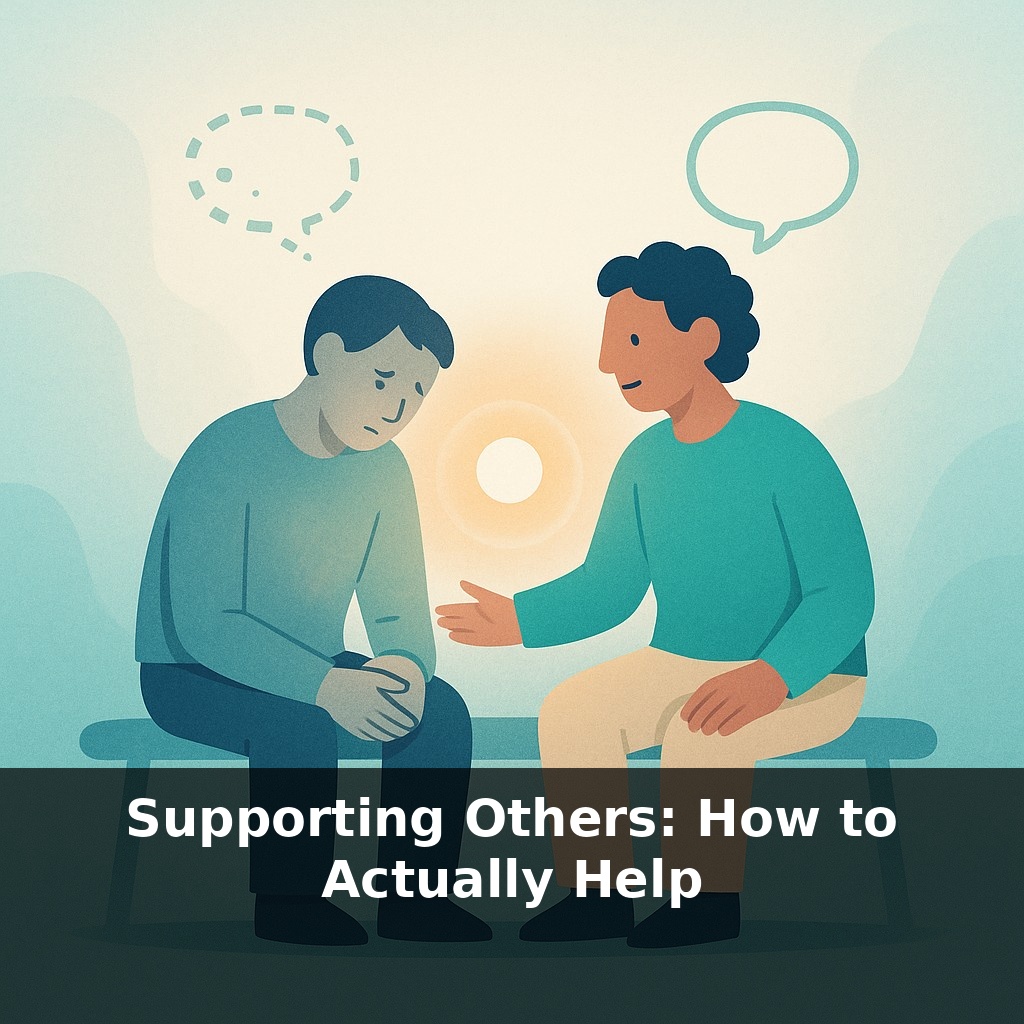
In this episode, we’ll turn “being there” into a set of learnable skills. You’ll see how simple behaviours—like summarising what you heard in one sentence, or asking one clarifying question instead of giving three tips—can lower distress in real time. You’ll also learn when *not* to stay in friend‑mode, and how to encourage professional help in a way that respects the other person’s autonomy and dignity.
Here’s the twist: most people *think* they’re good at supporting others. Yet when researchers record real conversations, helpers interrupt within about 11 seconds on average, and switch the focus back to themselves more than 60% of the time. No wonder so many check‑ins end with, “Thanks, but I’m fine.” The good news: small, specific shifts can change that. In hospital studies, when staff simply ask one follow‑up question and reflect back a feeling, patient satisfaction jumps by over 30%. You don’t need hours—you need a different *way* of using the next 5 minutes with someone who’s struggling.
Non‑judgmental presence sounds abstract, so let’s turn it into a clear sequence you can use in almost any hard conversation. Think of it as four moves, each only a sentence or two long.
**Move 1: Open the door clearly.** Generic “How are you?” rarely gets past “fine.” Use a *specific*, observable cue plus permission. For example: “I’ve noticed you’ve been quieter in our meetings the last two weeks, and I care about you. Is this a good time to talk about how you’re doing?” Specific behaviour (quieter, two weeks) signals you’re paying attention; asking about timing respects their boundaries. In crisis hotlines, this kind of concrete, time‑bound opening is linked to higher disclosure rates—people share more, earlier.
**Move 2: Stay with their story, not your theory.** When they start talking, your brain races to causes and fixes. Instead, aim for a 90/10 ratio: 90% of your words are questions or reflections, 10% are your opinions or experiences. That might mean: - “That sounds exhausting. What part of it feels hardest right now?” - “When that happened, what was going through your mind?” Support platforms that track conversations find that even one extra clarifying question before any suggestion increases reported relief by double‑digit percentages.
**Move 3: Name the feeling, not the flaw.** People already judge themselves: “I’m weak,” “I’m failing.” Your job is to pull the lens back to feelings and circumstances, not character. Try: - “Given everything on your plate, it makes sense you feel overwhelmed.” - “A lot of people in your position would feel scared too.” In clinical settings, statements like these (validation without agreement or disagreement) are associated with better follow‑through on care plans and lower dropout rates.
**Move 4: Co‑create next steps in tiny units.** Jumping to “You should see a therapist” can feel like a verdict. Instead, scale actions down until they’re doable in the next 24–72 hours and let them choose. For instance: - “On a scale from 0 to 10, how ready do you feel to talk to someone professional?” - “What’s one small thing that might make this week 5% more bearable?” Motivational interviewing studies show that even a single question about readiness—combined with choice among 2–3 options—boosts follow‑through compared with direct advice.
Across all four moves, aim for brevity over speeches. In analyses of millions of text‑based support messages, the most helpful responses tended to be short (often under 50 words), concrete, and followed by a simple, open question that handed the conversation back.
In real conversations, this four‑move approach is more like a loop than a script. Say a colleague texts: “Today sucked. I’m done.” You might start with Move 1: “I saw you left the meeting suddenly and haven’t been on chat since. I’m around for the next 20 minutes—want to vent a bit?” If they reply, “It’s pointless, nobody listens,” Move 2 kicks in: “I hear a lot of frustration. What happened that pushed it over the edge today?” After they describe being blamed for a project delay, Move 3: “Being singled out like that in front of everyone would feel humiliating for most people.” Then Move 4, in small units: “We can tackle this in pieces. Which feels more manageable tonight: drafting an email to your manager together, or just figuring out what you need to get through tomorrow?” Across about 8–10 texts and under 10 minutes, you’ve moved from shutdown to specific, chosen action—without a single pep talk.
One big shift ahead: these skills will be treated less like “soft” extras and more like core literacy. Expect workplaces to tie promotions partly to peer‑support actions logged in HR systems, schools to require a 5–10 hour basics course by graduation, and online platforms to badge users who complete evidence‑based modules. As this scales from dozens to thousands in a community, the odds of someone suffering in total isolation drop sharply.
Your challenge this week: have *one* 10‑minute check‑in that follows the four moves. Before you start, jot down a guess: how open will they be, 0–10? Afterwards, rate how open they actually were. If you’re off by 3+ points, repeat the experiment with someone else. Across 4–5 tries, you’ll usually feel your skill—and their relief—climb.