About half of adults say they’re “trying to eat healthy” yet still feel sluggish after meals. You grab a fast lunch, feel stuffed, but are hungry again an hour later. Dinner looks “normal,” but your energy crashes. Something on the plate is off-balance—without you realizing it.
Here’s the good news: you can fix an off-balance plate without weighing, measuring, or opening a tracking app. Instead, you’ll use something you already own: the surface of your plate. Research-backed “plate methods” show that a simple visual rule of thumb can guide portions, steady blood sugar, and naturally cap calories—even if you never look at a nutrition label.
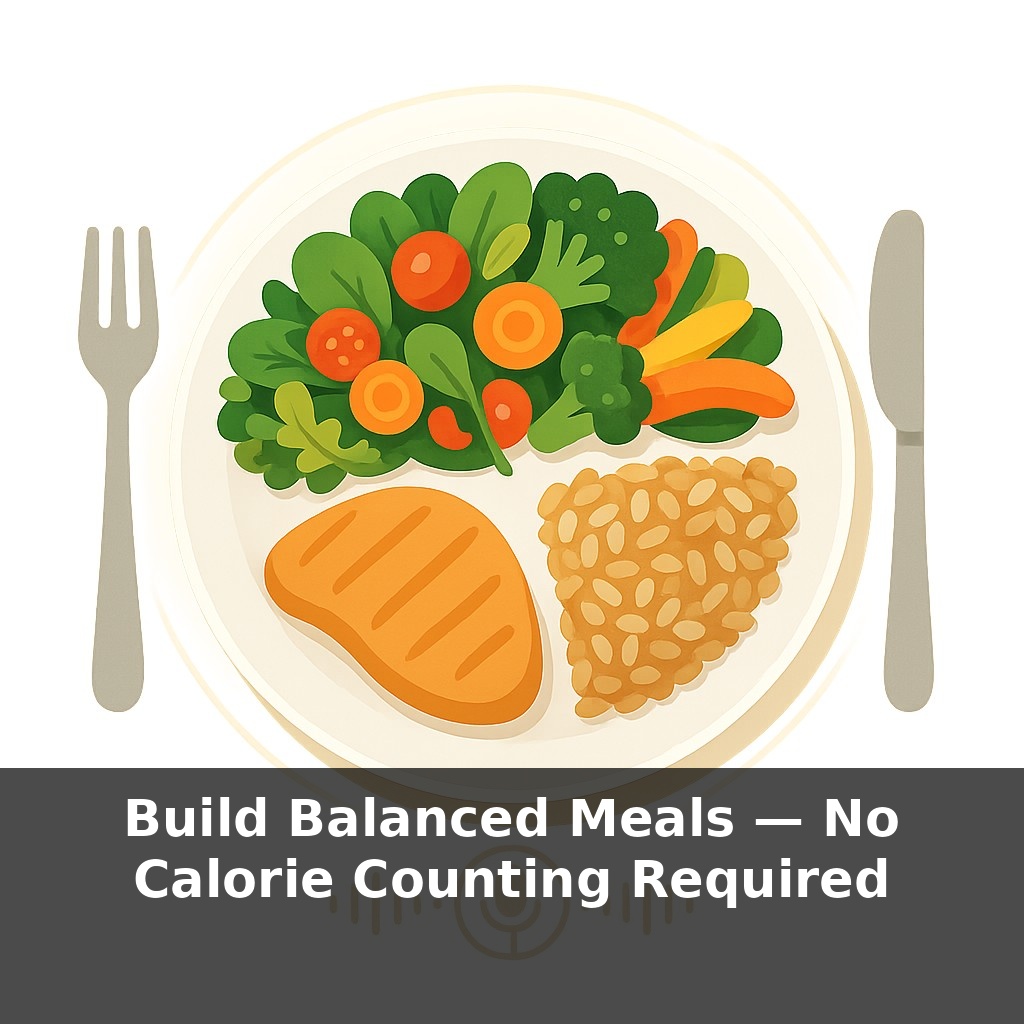
The basic idea is straightforward but surprisingly powerful: on a standard dinner plate (about 10–11 inches), filling half with colorful vegetables and fruits, one quarter with protein-rich foods, and one quarter with whole grains or starchy sides consistently nudges people toward better nutrient balance. In studies, this single shift changed what people served themselves within one meal, and what they weighed on the scale months later—without asking them to count a single calorie.
That simple layout isn’t just “nice in theory”—it holds up in real-life kitchens and clinics. In a Mexican trial, adults with type 2 diabetes who were taught a plate layout (no calorie apps, no scales) cut their HbA1c by about 1.2 points in just 3 months. National guidelines echo similar visuals because they work across cuisines: that 1/2–1/4–1/4 split fits stir-fries, burrito bowls, pasta dinners, even takeout. It also compensates for how plates have quietly grown; with 12‑inch dishes now common, using the surface as a fixed blueprint stops portions from silently expanding with plate size.
Most people *think* they’re following that visual layout—but when researchers photograph real meals, the numbers tell another story. In one survey, only about 1 in 10 plates actually had produce as the largest section. The rest were dominated by starches or protein, even among people who said they were “watching what they eat.” So the first step is to get specific about what belongs in each section and how it looks in real food.
For the vegetable-and-fruit half, aim for at least 2–3 different colors. Non-starchy vegetables should take the lead: leafy greens, broccoli, peppers, carrots, tomatoes, cucumber, mushrooms, green beans, cabbage, zucchini. A typical dinner might be 1 cup cooked vegetables plus 1 cup salad, or 1 cup veggies and a small piece of fruit. That’s already 2 of the ~5 servings per day linked to lower heart and cancer risk. Fruits fit best as a side or dessert in this half, not squeezed into the “starch” space.
For the protein quarter, think in terms of your palm, not the package: roughly 3–4 ounces cooked (about 20–30 g protein) for most adults. That’s a chicken breast the size of a deck of cards, 1 cup of Greek yogurt, 2 eggs plus a few egg whites, 3/4–1 cup cooked beans or lentils, or a palm-sized piece of tofu, fish, or lean meat. Higher‑fat cuts (sausage, bacon, fried chicken) use up that space faster, so they fit best as occasional choices, not the backbone of every plate.
For the grain/starchy quarter, the goal isn’t “no carbs,” but the right amount and type. On a standard dinner plate, that usually means: - 1/2–1 cup cooked whole grains (brown rice, quinoa, farro, oats), or - 1 medium potato or sweet potato (about fist-sized), or - 1 small tortilla (6 inches) or 1 slice of whole‑grain bread, or - 1 cup cooked pasta, ideally paired with plenty of vegetables
When you fill the starch space first, it almost always spills over. Instead, physically claim the vegetable half *before* you add grains. In experiments where people served vegetables first, total calories at the meal dropped by around 150–200 without them feeling less full.
This layout also adapts. If you’re very active or taller, you might use a 12‑inch plate or slightly expand the grain quarter. If you’re smaller or aiming for weight loss, an 8–9‑inch plate with the same proportions quietly trims intake by hundreds of calories a day while keeping meals visually satisfying.
A practical way to test this is to walk through specific meals. Take a basic pasta dinner. On a 10‑inch plate, start by adding 1–1.5 cups of roasted broccoli and cherry tomatoes. Next, place a palm‑sized portion (about 3–4 oz) of grilled chicken or 3/4 cup lentils. That leaves space for roughly 1 cup cooked pasta. Most people start with 2–3 cups of pasta; this simple reorder cuts 200–300 calories while keeping the plate full.
For breakfast, instead of a 430‑calorie large bagel, try: 2 scrambled eggs (140 kcal), 1 slice whole‑grain toast (80 kcal), and 1 cup berries (60–80 kcal). Volume is similar, but protein almost doubles and you add fiber without tracking a thing.
Your plate can flex by meal: at lunch you might go heavier on beans or tofu; at dinner you might slightly shrink the starch zone if you’re less active. Over a week, these 100–200 calorie nudges per meal can sum to 1500–3000 fewer calories—without ever opening a food diary.
Future implications go beyond home kitchens. In early trials, restaurant meals that follow a plate-style layout cut average intake by 120–180 kcal without lower satisfaction scores. If hospitals, schools, and cafeterias adopted similar defaults, a person eating 2 such meals per day could reduce annual intake by ~90,000 kcal—roughly 25 pounds of weight gain avoided—without any food bans, apps, or lectures, just a consistent, visual norm repeated thousands of times.
Your plate becomes even more powerful when you repeat this pattern across the day. Hitting it at just 2 meals can add ~18–25 g extra fiber, 20–40 g more protein, and cut 150–300 kcal, compared with a typical U.S. pattern. Over 30 days, that’s roughly 1–2 lb of fat avoided—not by eating “perfectly,” but by letting your plate quietly do the math.
Before next week, ask yourself: 1) “Looking at my usual breakfast, lunch, and dinner, where can I quickly add one more source of protein, one colorful veggie or fruit, and a healthy fat so my plate actually feels balanced, not skimpy?” 2) “The next time I build a meal or snack, how full and energized do I feel 2–3 hours later, and what does that tell me about whether I had enough protein, fiber, and fat?” 3) “When I’m tempted to count calories, what’s one simple plate-based check I can use instead (like ‘Do I see a palm of protein, a fist of carbs, two thumbs of fat, and some color on my plate?’), and how does that change the way I choose my food today?”