You can “eat healthy” all day and still blow past your sugar limit before lunch. A granola bar on the train, a “light” yogurt at your desk, a green drink on the way home—each looks virtuous. Together, they might hide more sugar than a can of soda.
That “healthy” commute lineup is just the opening act. The real problem is how quickly clever labels can turn your 5‑minute grocery stop into a guessing game you’ll usually lose. Words like “wholesome,” “smart,” and “heart‑friendly” float across boxes the way steam rises off street‑cart food: it looks comforting, but tells you nothing about what’s actually inside.
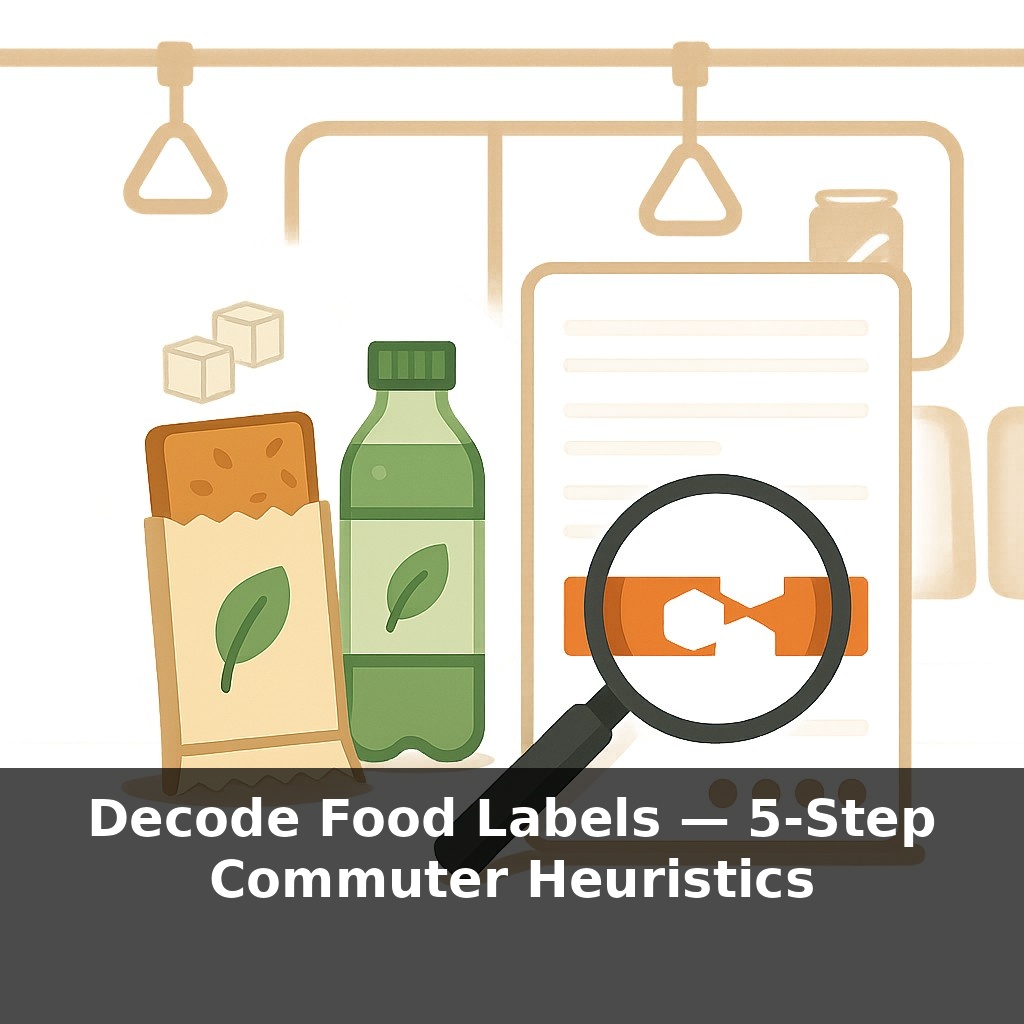
On a rushed day, you don’t need a nutrition degree; you need a tiny, repeatable script you can run while your train countdown ticks from 3 minutes to 1. That’s where a 5‑step, 10‑second scan comes in. Instead of arguing with every package, you learn to flip, scan a few key lines, and make a call.
Think of it less like “eating perfectly” and more like learning a few commuter shortcuts: same city, same traffic, but suddenly you’re the one who knows which turns to take and which detours to ignore.
The catch: labels were never designed for people sprinting through a store. They were built for regulators and food scientists, then squeezed onto packages already crowded with logos and health claims. That’s why you see bold fonts bragging about protein while the fine print whispers about sodium. During a rushed stop, your brain latches onto the loud, easy messages—“high fiber,” “natural,” “reduced something”—and quietly skips the parts that matter. The good news: those tiny black‑and‑white boxes *are* consistent once you know where to look and what to ignore. Your scan becomes less “Is this good?” and more “Show me your numbers.”
Start in the same corner every time: serving size. This isn’t about guilt; it’s about math. If the serving is 2 tablespoons and you usually pour half a cup, you’ve quietly tripled everything on that label—sugar, sodium, and those “only 90” calories. For commuter foods, assume you’ll finish the whole container unless you *know* you don’t. If the “serving” is half a bottle or ⅔ of a bar, mentally multiply the numbers up to what you’ll actually eat.
Next checkpoint: sugars. Don’t just glance at the calories and move on. Look for the “Added Sugars” line—that’s the stuff pushing you toward that ~17‑teaspoon daily average. A “healthy” drink with 18 g added sugar is nearly half of what many adults should have in an entire day. If a snack has more grams of added sugar than grams of protein or fiber, treat it as dessert, not fuel.
Then scan fats, but with two quick twists. First, “0 g trans fat” can legally hide up to 0.5 g per serving. Your clue is the ingredient list: “partially hydrogenated” anything means there’s trans fat, even when the panel says zero. Second, “reduced” claims on fat or sodium only mean “less than before,” not “low overall.” A chip that cuts sodium by 25% can still land you above 480 mg per serving, which is considered high.
Fourth, zoom out to nutrient density. Ask: what do I *get* for these calories? Fiber, protein, and meaningful amounts of vitamins or minerals are a good trade; loads of refined starch and oils are not. Two products can both be 200 calories—one gives you 8 g protein and 5 g fiber, the other gives you a blood sugar spike and a crash.
Finally, flip to the ingredient list. Ingredients are listed from heaviest to lightest, and those first three usually make up most of what you’re buying. If they’re sugar names (syrup, cane sugar, honey), refined flours, or cheap oils, that “wholesome” claim on the front is mostly costume. Watch for sugar splitting—using several types (maltodextrin, brown rice syrup, fructose) so none appear first, even though together they dominate the product.
Your challenge this week: pick just one daily “health‑halo” item—maybe a cereal, bar, or drink—and run this 5‑step scan *every single time you buy it*. Same product, same quick routine. By Friday, notice: do you still see it the same way, or has the back of the package changed your mind more than the front ever did?
Grab a box of “multigrain” crackers that promises to be “simple” and “natural.” On the front: fields, wheat stalks, maybe a rustic font. On the back: first three ingredients might still be refined flour, cheap oil, and a sweetener, with the actual “ancient grains” sprinkled in like seasoning. That’s a health halo in action—more costume than character.
For another test, take two breakfast cereals side by side. One shouts “Made with Whole Grains!” while the other sits quietly on the shelf. The loud one may list whole grain first but follow it immediately with sugar in three different outfits—honey, brown rice syrup, molasses—keeping any single one from claiming the top spot. The quiet box might have a shorter list, more fiber, and fewer sweeteners.
Use a rainy‑day mindset: when the sky looks gray, you don’t trust one cloud; you check the forecast. On labels, the ingredient order, sugar names, and fine print *are* your forecast—telling you if this “sunny” snack hides a storm.
Soon, your quick label scan may spill beyond the package. Retailers are testing shelf tags that auto-flag products based on your loyalty data—highlighting lower-sugar options the way stores now spotlight sale prices. Restaurant menus are next: QR codes could reveal not just calories, but blood-glucose “spikiness” scores or how often you’ve ordered that item this month. The risk: personalization that nudges choices quietly, blurring the line between guidance and manipulation.
Soon you’ll see this faster scan meeting new tools: apps that flag red‑light items as you point your camera, smart carts that tally added sugars in real time, even default “swap” suggestions when you tap self‑checkout. Treat each as a sous‑chef, not a boss. The more you practice reading quietly for yourself, the less any single claim can steer you.
Start with this tiny habit: When you grab a packaged food on your commute (at a store, vending machine, or café), pause for 5 seconds and look only at the *first three* ingredients on the label. If sugar (or any “-ose” like glucose, fructose, sucrose) is listed in those first three, just say to yourself, “Sugar top 3” and put it back once this week. If the first ingredient is something you’d find in a normal kitchen (like oats, beans, rice, nuts, or veggies), give yourself a quick mental high-five and choose that once this week instead.