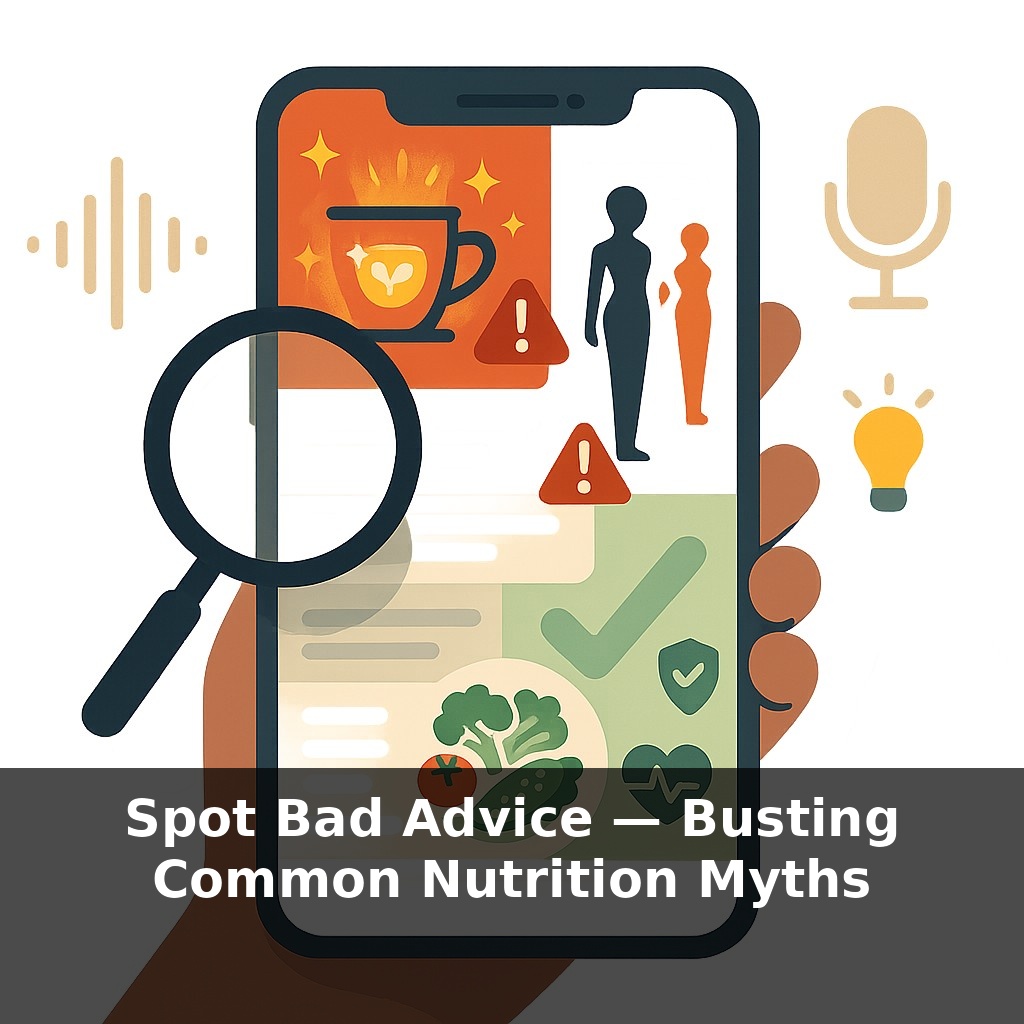
About half the nutrition advice people see online each day is misleading or flat‑out wrong. You scroll past a friend swearing celery burns more calories than it has, a reel praising coconut oil as brain medicine, and a “detox tea” ad. Which one—if any—deserves your trust?
Here’s the tricky part: bad nutrition advice rarely sounds obviously wrong. It often comes wrapped in confident language, dramatic before‑and‑after photos, or a personal story that feels “too real” to doubt. One creator promises coconut oil will “switch on” your brain, another insists that “all carbs are addictive,” and a third claims you’re “toxic” unless you buy their cleanse. The claims clash, but each sounds convincing in the moment. That’s because your brain loves simple explanations and clear villains—sugar, gluten, seed oils—especially when you’re tired of conflicting headlines. In this episode, we’ll slow things down and look at how to test these bold promises against actual evidence, so you can separate helpful shortcuts from dangerous oversimplifications without needing a nutrition degree.
Think of today’s episode as zooming out from single claims and looking at the whole information “ecosystem” you’re swimming in. The average U.S. adult now bumps into several nutrition posts a day, but those posts aren’t weighed equally: dramatic ones travel fastest, while boring but solid research moves slowly. Add in algorithm “echo chambers,” and you can end up seeing the same myth so often it starts to feel true. To push back, we’ll lean on what large trials and long‑term studies actually show—and practice quick, simple checks you can run on any claim before it reshapes your grocery list.
Here’s where evidence starts doing the heavy lifting.
When you see a big promise—“this oil heals your brain,” “this food melts fat,” “this smoothie cleans your liver”—the first question isn’t “could this be true?” but “what kind of evidence would we need for this to be true?”
For nutrition, the strongest answers usually come from three places:
1. **Randomized controlled trials (RCTs)** People are randomly assigned to different diets or foods, and everything else is kept as similar as possible. If a “miracle” oil really protected memory, we’d expect RCTs showing people using it had better cognitive scores over time than those using other fats, after accounting for things like age, medications, and overall diet.
2. **Systematic reviews and meta‑analyses** Instead of one small study on 30 people, these pool many trials together and look at the big picture. Individual studies can be noisy; patterns across dozens of them are harder to fake. When these reviews look at overall eating patterns—like Mediterranean or DASH styles—they consistently see lower rates of heart disease, diabetes, and sometimes dementia.
3. **Large, long‑term observational studies** These follow tens of thousands of people for years, tracking what they eat and what happens to their health. They can’t prove cause and effect on their own, but when their signals match RCTs and meta‑analyses, confidence grows.
In contrast, viral posts usually lean on:
- **Single anecdotes** (“It cured my aunt’s brain fog”) - **Short, uncontrolled “detox” experiments** (no comparison group, other changes happening at once) - **Cherry‑picked lab or animal data** that never tested real‑world doses or long‑term outcomes
Nutrition researchers also watch *how* something is claimed to work. Take “negative calorie” foods: we can estimate the thermic effect of food (roughly 10% of calories eaten) and basic digestion costs. When you run the numbers, even high‑fiber, low‑calorie foods don’t create a net energy loss. They can help you feel full on fewer calories, but they’re not magic erasers.
Or look at “detox” promises: we know most detoxification runs through liver enzymes and kidney filtration. If a product truly improved that, we’d expect to see changes in specific lab markers (like liver function tests or measured toxin levels) in controlled studies—not just testimonials about “feeling lighter.”
Across all this research, one theme keeps reappearing: **overall patterns beat single products.** Diets rich in minimally processed plants, reasonable in calories, and light on saturated fats—especially from sources like coconut oil—consistently link to better long‑term health, even when no one food is perfect.
Your challenge this week: every time a nutrition claim pops up in your feed, pause for 10 seconds and silently label it as “pattern claim” (about overall diet) or “product claim” (about one food/supplement). By the end of the week, notice which category tends to come with bigger promises and weaker evidence.
Think about the last three “too good to be true” posts you saw: maybe one promised “hormone balance” from a powder, another swore off “nightshade vegetables,” and a third claimed fruit after 6 p.m. “turns straight into fat.” Rather than arguing with the creator, zoom in on the *structure* of each claim. Does it promise one food will fix many unrelated problems—skin, sleep, bloating, mood? That’s like a drug ad claiming the same pill treats infections, broken bones, and anxiety: biology rarely works that way.
Try running three quick “friction tests”:
- **Time:** Does it work suspiciously fast for a chronic issue? - **Scope:** Does one change supposedly fix everything at once? - **Cost:** Is the solution oddly tied to a product–especially one with a discount code?
When two or more are “yes,” you’re probably looking at marketing, not medicine.
82% of U.S. adults now meet health info first through a screen, not a clinic—so whoever frames the “story” often wins your attention long before data enters the chat. Future tools may flag weak claims the way browsers flag unsafe sites: auto-labeling posts with study quality, sample size, and funding sources. Until then, treat AI and influencers like new restaurant reviewers: useful, but unproven. Check what they say against trusted “regulars” like major medical societies or registered dietitians.
Real progress usually comes from small, boring moves: more plants, fewer ultra‑processed foods, steadier meals. Think of it like tending a slow‑growing herb garden instead of hunting for one magic spice. Keep asking, “How would we *know* this works?” That question, more than any superfood, is what quietly upgrades your plate—and your long‑term health.
Start with this tiny habit: When you catch yourself thinking “carbs are bad” or “I was ‘good’ or ‘bad’ with food today,” pause and add one neutral fact about what you ate (like “that oatmeal gave me energy” or “that sandwich kept me full for 3 hours”). Then, once a day when you open your fridge, take 5 seconds to move one protein-rich food (like yogurt, eggs, tofu, or chicken) to the front where you can see it first. Finally, when you pour any drink besides water, take one sip of water right before it—just a sip—to start shifting away from “detox” or “fat-burning” drink myths and back toward basics.